Forex Margin Call: What It Is, Why It Happens, and How to Avoid It
A margin call is one of the most feared events in retail forex trading. Learn exactly what triggers it, how to calculate your margin level, and the 5 practices that prevent margin calls from destroying your account.
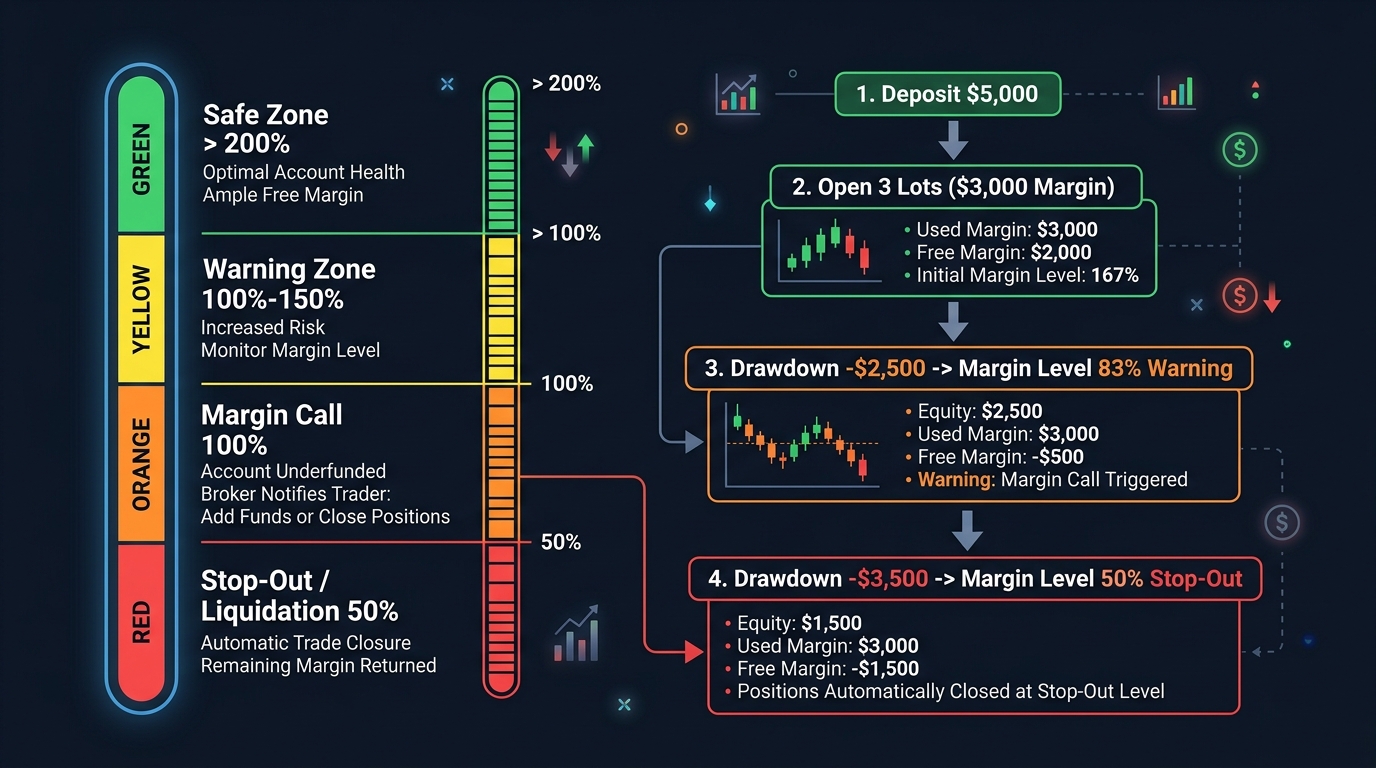
A margin call occurs when your account doesn’t have enough equity to support your open positions. If you ignore it (or can’t fund it fast enough), your broker will automatically close your trades — usually at the worst possible time, at the worst possible prices.
It’s not a system glitch. It’s a contractual mechanism built into every leveraged trading account. Understanding it before you encounter it is how you make sure you never encounter it.
What Is Margin in Forex?
Before understanding a margin call, you need to understand margin itself.
When you open a leveraged forex position, your broker requires you to deposit a fraction of the total trade value as collateral. This collateral is called the margin.
Example:
- You want to buy 1 standard lot of EUR/USD (100,000 units)
- Leverage: 100:1
- Required margin: 100,000 / 100 = $1,000
The $1,000 is not a fee — it’s held by the broker as security against potential losses. The remaining value of the position is effectively “lent” to you.
Key margin terms:
| Term | Definition |
|---|---|
| Used Margin | Total margin locked in your open positions |
| Free Margin | Equity not locked as margin; available for new trades or to absorb losses |
| Margin Level | (Equity ÷ Used Margin) × 100 — the key number brokers monitor |
| Margin Call Level | The margin level % at which the broker issues a warning |
| Stop-Out Level | The margin level % at which the broker automatically closes positions |
The Margin Level Calculation
The margin level is the relationship between your account equity and your used margin:
Margin Level % = (Account Equity / Used Margin) × 100Example:
- Account equity: $2,000
- Used margin (for 2 open positions): $1,000
- Margin level = ($2,000 / $1,000) × 100 = 200%
This is healthy. Most brokers consider 100%+ normal. Problems begin when losses erode equity and the margin level drops.
When a Margin Call Happens
Step 1 — Margin Call Level (typically 50–100%): When your margin level drops to this threshold, the broker sends a warning: “Please deposit funds or close positions.” This is the margin call itself. At this point, you still have control — you can add funds, close some positions, or reduce exposure.
Step 2 — Stop-Out Level (typically 20–50%): If you ignore the margin call and losses continue, the broker automatically closes your positions starting with the least profitable, until the margin level recovers above the stop-out threshold. This is called stop-out or automatic liquidation.
Broker margin levels vary:
| Broker Type | Typical Margin Call Level | Typical Stop-Out Level |
|---|---|---|
| Most retail brokers | 100% | 50% |
| Some offshore brokers | 50% | 20% |
| Prop firm accounts | Often 100% | 100% (immediate breach = account termination) |
Check your specific broker’s terms. These numbers are always disclosed in the account agreement.
A Concrete Example of Margin Call Progression
Account: $5,000
Trade: Long 2 standard lots EUR/USD at 1.1000 (Leverage 100:1)
Required margin: $2,000 (2 lots × $1,000 per lot)
| Scenario | Equity | Used Margin | Free Margin | Margin Level | Status |
|---|---|---|---|---|---|
| Trade opens | $5,000 | $2,000 | $3,000 | 250% | Normal |
| -$1,500 loss (150 pips) | $3,500 | $2,000 | $1,500 | 175% | Normal |
| -$3,000 loss (300 pips) | $2,000 | $2,000 | $0 | 100% | Margin Call Warning |
| -$4,000 loss (400 pips) | $1,000 | $2,000 | -$1,000 | 50% | Stop-Out — Broker closes positions |
Notice: without a stop-loss, this trade required a 400-pip move to trigger stop-out. But with 2 standard lots on a $5,000 account, a 300-pip move consumed 60% of the entire account.
The lesson: Excessive position sizing creates margin call vulnerability even when the stop-out level seems far away.
The 5 Practices That Prevent Margin Calls
1. Use Proper Position Sizing
The fundamental protection. When you risk only 1% of your account per trade and your stop-loss is set at entry, your equity will be protected long before a margin call becomes a concern.
Use the position size calculator to ensure your lot size matches your risk tolerance.
2. Set Stop-Losses on Every Trade
A stop-loss is the mechanism that ensures trades close before they can erode enough equity to threaten margin. A trade without a stop-loss can run indefinitely against you — which is the primary path to margin calls.
No exceptions. Every trade, every time.
3. Monitor Your Margin Level
Check your margin level before opening any new position. If your margin level is below 300%, think carefully before adding exposure. Below 200% in volatile market conditions is a warning sign.
Most trading platforms display margin level in real time on the account summary panel.
4. Reduce Exposure Before Major News Events
High-impact releases (NFP, FOMC, CPI) can move markets 100–200+ pips within minutes. If you have multiple large positions open during these events, a single adverse spike can drop your margin level dramatically.
Reduce position sizes or close positions ahead of events that could create exceptional volatility in your open pairs.
5. Keep Adequate Free Margin
A useful rule: your free margin should always be at least equal to your used margin. This ensures you have a buffer to absorb normal market fluctuations without approaching the margin call threshold.
If free margin drops below 50% of used margin, close the smallest position to restore the buffer.
Margin Call vs. Stop-Out: The Distinction
Many traders confuse these two events:
| Event | What Happens | Who Acts |
|---|---|---|
| Margin Call | Broker sends warning; account at margin call level | You must act (deposit or close) |
| Stop-Out | Broker automatically closes positions | Broker acts automatically |
The margin call is the warning. The stop-out is the consequence of ignoring the warning. In fast-moving markets (news releases, gap openings), you may skip the margin call and go directly to stop-out if the move is fast enough.
Can You Lose More Than Your Deposit?
With standard retail brokers in regulated jurisdictions (EU, UK, Australia, US), the answer is no — negative balance protection is mandatory. Your account cannot go below zero.
With unregulated offshore brokers, negative balance protection may not apply. In extreme events (the 2015 CHF flash crash, for example), some traders ended up owing their brokers money beyond their deposit. This is one of many reasons to trade with regulated brokers only.
Key Takeaways
- A margin call occurs when your account equity drops to the broker’s threshold relative to used margin — typically when margin level hits 50–100%
- Margin Level = (Equity ÷ Used Margin) × 100; healthy levels are 200%+; danger begins below 100%
- Margin calls precede stop-outs: the margin call is the warning, the stop-out is the automatic position closure if the warning is ignored
- The primary prevention: proper position sizing (1% risk per trade) and stop-losses on every trade
- Keep free margin at least equal to used margin; reduce before major news events
- Regulated brokers offer negative balance protection — you cannot lose more than your deposit
- Check your specific broker’s margin call and stop-out levels in their terms of service before trading

Ready to Practice This Strategy?
Test what you learned on a free, risk-free demo account before risking real money.