Forex Trader Psychology: Mastering the Mental Game in 2026
Most forex traders lose not because of bad strategies, but bad psychology. Learn the cognitive biases that destroy accounts, the emotional trading cycle, and practical techniques to trade with discipline.
A strategy can be backtested to produce 65% win rate and positive expectancy over 500 trades. That same strategy, in the hands of a psychologically unprepared trader, will produce losses. Not occasionally — reliably. Because the human applying the strategy will deviate from it at exactly the wrong moments.
This is the trader psychology problem. And unlike chart reading or risk management math, there is no formula that solves it. It requires honest self-examination, deliberate practice, and the kind of pre-commitment mechanisms that work even when you’re stressed, losing, or euphoric.
The Emotional Trading Cycle
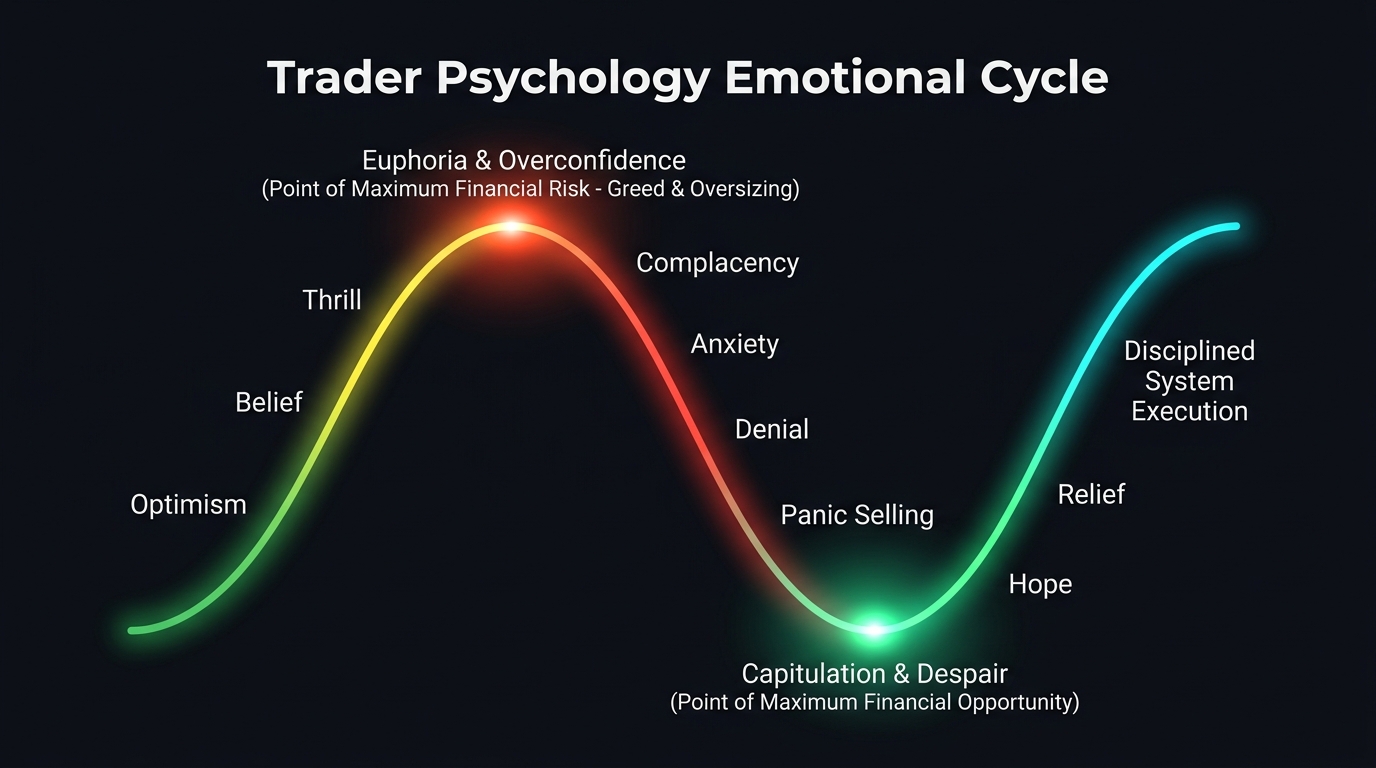
Most retail traders go through a recognizable cycle of psychological states as their account moves up and down:
Phase 1 — Optimism: You open the account. The strategy looks good on paper. You’re confident. Early trades are positive.
Phase 2 — Excitement: A few winning trades. You feel like you’ve “figured it out.” Position sizes start to grow.
Phase 3 — Overconfidence: Win rate was probably lucky, but it feels like skill. You take trades outside your system. You’re barely following the rules.
Phase 4 — Anxiety: A losing stretch begins. Trades that “should” work aren’t. You start second-guessing the system.
Phase 5 — Denial: Losses are explained away. “The market was manipulated.” “My strategy works, just not right now.” You modify the strategy mid-drawdown.
Phase 6 — Fear: The account has dropped significantly. Every trade feels like a potential disaster. Paralysis sets in — you miss valid setups because you’re afraid to lose.
Phase 7 — Capitulation: You close all positions after a large loss. The pain is too great. “I’m done trading.”
Phase 8 — Reflection (hopefully): You review what went wrong. You realize the issue wasn’t the strategy — it was the execution.
Experienced traders don’t escape this cycle entirely. They learn to recognize which phase they’re in and apply specific countermeasures before the cycle reaches its destructive phases.
The Six Core Biases That Kill Trading Accounts
1. Loss Aversion
What it is: The psychological pain of a loss is approximately twice as powerful as the pleasure of an equivalent gain. A $100 loss feels worse than a $100 gain feels good.
How it destroys trading: Traders hold losing positions beyond their stop-loss because closing the trade makes the loss “real.” They convince themselves the trade will come back. The stop-loss is moved, removed, or simply ignored. Small losses become catastrophic ones.
The fix: Automated stop-loss orders. Set them at entry. Do not touch them. Your future self, watching price move against you, cannot be trusted to close the trade at the right time. Remove the decision.
2. Overconfidence Bias
What it is: Humans tend to overestimate the accuracy of their own predictions, especially after recent success.
How it destroys trading: After a winning streak, position sizes increase. Stops get wider. Trades that barely meet the entry criteria get taken. The winning streak was partly luck — the increased risk is pure vulnerability.
The fix: Keep position sizing mechanical and constant, regardless of recent results. Never increase position size after a win. Let the edge compound at constant risk, not variable risk that inflates during lucky streaks.
3. Confirmation Bias
What it is: The tendency to seek information that confirms what you already believe and dismiss information that contradicts it.
How it destroys trading: You’ve decided EUR/USD is going up. You look at the chart and see every bullish signal. You ignore the bearish ones. You enter. The bearish signals were right.
The fix: Before entering a trade, deliberately look for reasons it could fail. “What would have to be true for this trade to be wrong?” If the bearish case is compelling, reconsider. This deliberate devil’s advocate exercise reduces confirmation bias.
4. Gambler’s Fallacy
What it is: The belief that past independent events influence future independent events. “I’ve had five losing trades in a row — I’m ‘due’ for a winner.”
How it destroys trading: After a losing streak, a trader takes a lower-quality setup because they “feel” a win is coming. Or they increase position size because “the probability has shifted.” It hasn’t. Each trade is independent.
The fix: Track each trade’s setup quality, not its sequence. If a trade meets all your criteria, it’s a valid trade. If it doesn’t, it’s not — regardless of how many consecutive wins or losses preceded it.
5. Anchoring
What it is: Over-reliance on the first piece of information encountered. In trading: fixating on an entry price after the trade goes against you.
How it destroys trading: You bought EUR/USD at 1.0850. It drops to 1.0780. Your stop should have triggered at 1.0820. Instead, you’re holding because “it just needs to get back to 1.0850.” You’re anchored to your entry price rather than evaluating the trade objectively.
The fix: After a trade is open, ask periodically: “If I had no position right now, would I enter in this direction at this price?” If the answer is no, the trade should probably be closed.
6. Sunk Cost Fallacy
What it is: The tendency to continue an activity because of previously invested resources (time, money, emotion) rather than its current or future value.
How it destroys trading: “I’ve already lost 40 pips on this trade — I can’t close it now. I need to at least get back to breakeven.” The 40 pips are gone. Whether you close now or later, they’re gone. The only relevant question is: does holding this trade have positive expectancy from here?
The fix: Evaluate every open trade as if you were evaluating it fresh, with no prior position. Past losses are irrelevant to the current decision.
Practical Discipline Techniques
Pre-Session Checklist
Before opening any charts, complete a brief mental assessment:
1. How do I feel right now? (Tired, stressed, calm, rushed?)
2. Am I trading capital I cannot afford to lose?
3. Did I sleep enough? Have I eaten?
4. Am I still following my trading plan unchanged?
5. What is my daily loss limit today?
If the answer to questions 1, 2, or 3 is concerning, reduce position size by 50% or don’t trade at all. Emotional state directly affects trading decisions. This is not a metaphor — it’s neuroscience.
Post-Trade Journal Entry
After every closed trade, record:
- Setup quality (1–5 scale)
- Did you follow the plan exactly? (Yes/No)
- If No: what did you deviate from and why?
- Emotional state at entry
- Emotional state at exit
The journal is not for tracking profits. It’s for identifying behavioral patterns. Three months of this data will reveal exactly which conditions cause you to deviate from your rules.
The 30-Minute Break Rule
After any losing trade that hits the full stop-loss, take a minimum 30-minute break before the next entry. Stand up. Walk away from the screen. The urge to “get it back” immediately is one of the most powerful and destructive emotional responses in trading. The break interrupts it.
The Two-Mistake Rule
Commit to this rule: if you violate your trading rules twice in a single session (any deviation — removing a stop, sizing up impulsively, taking a non-setup trade), stop trading for the rest of the day. Two rule violations in one session is a signal that your emotional state has taken over. Adding more trades while compromised will not improve the outcome.
Trading Psychology vs. Strategy Performance
One of the hardest truths in trading: you can have a genuinely profitable strategy and still lose money if your execution is psychologically compromised.
The difference between strategy performance (what the system should produce) and actual account performance (what you actually produce) is called the execution gap. Most traders have an execution gap of 20–40% — meaning their actual results are 20–40% worse than their system’s theoretical performance.
This gap is almost entirely attributable to psychology: premature exits, late entries, removed stops, oversized revenge trades.
Closing the execution gap is the highest-leverage improvement most traders can make — higher than finding a better strategy.
Key Takeaways
- The emotional trading cycle (optimism → excitement → overconfidence → anxiety → denial → fear → capitulation) is predictable and can be interrupted if recognized early
- The six core biases that destroy trading accounts: loss aversion, overconfidence, confirmation bias, gambler’s fallacy, anchoring, and sunk cost fallacy
- Loss aversion is particularly dangerous — it causes traders to hold losing positions beyond their stops; automated stop-loss orders are the structural fix
- Pre-session mental state checks, post-trade journaling, and the 30-minute break rule are practical techniques — not soft suggestions
- The execution gap (difference between theoretical system performance and actual results) is primarily psychological; closing it is the highest-leverage improvement available to most traders
- Trading psychology cannot be solved once. It requires ongoing self-monitoring, honest journaling, and a willingness to enforce rules against your own impulses
Next: Forex Margin Call | Risk of Excessive Leverage
Related lesson: Trading Journal | Trading Plan

Ready to Practice This Strategy?
Test what you learned on a free, risk-free demo account before risking real money.