Risk Management in Forex Trading: The Complete Beginner's Guide (2026)
Risk management is what separates long-term profitable traders from those who blow up. Learn the 7 pillars of forex risk management, from position sizing to drawdown limits.
Here is a number that should stick with you: according to the European Securities and Markets Authority (ESMA), between 74% and 89% of retail CFD and forex accounts lose money. That is not a scare tactic. It is the regulated disclosure that European brokers are legally required to show you. The number has barely moved in a decade.
The traders in the 11–26% who consistently profit are not necessarily smarter, better educated, or more technically skilled than the ones who lose. The most consistent differentiator is how they manage risk.
What Risk Management Actually Means in Forex
Most beginners think risk management means setting a stop-loss. It doesn’t. A stop-loss is one tool within a much larger system.
Proper forex risk management is a complete framework that governs:
- How much money you expose per trade (position sizing)
- How much you can lose in a day, a week, a month before stopping
- What leverage ratio is appropriate for your account and strategy
- How you respond to losing streaks without making them worse
- How your overall exposure is managed across multiple open positions
Think of it as the structural engineering of your trading operation. Without it, even a sound trading strategy can destroy an account. With it, a mediocre strategy can still survive long enough to be improved.
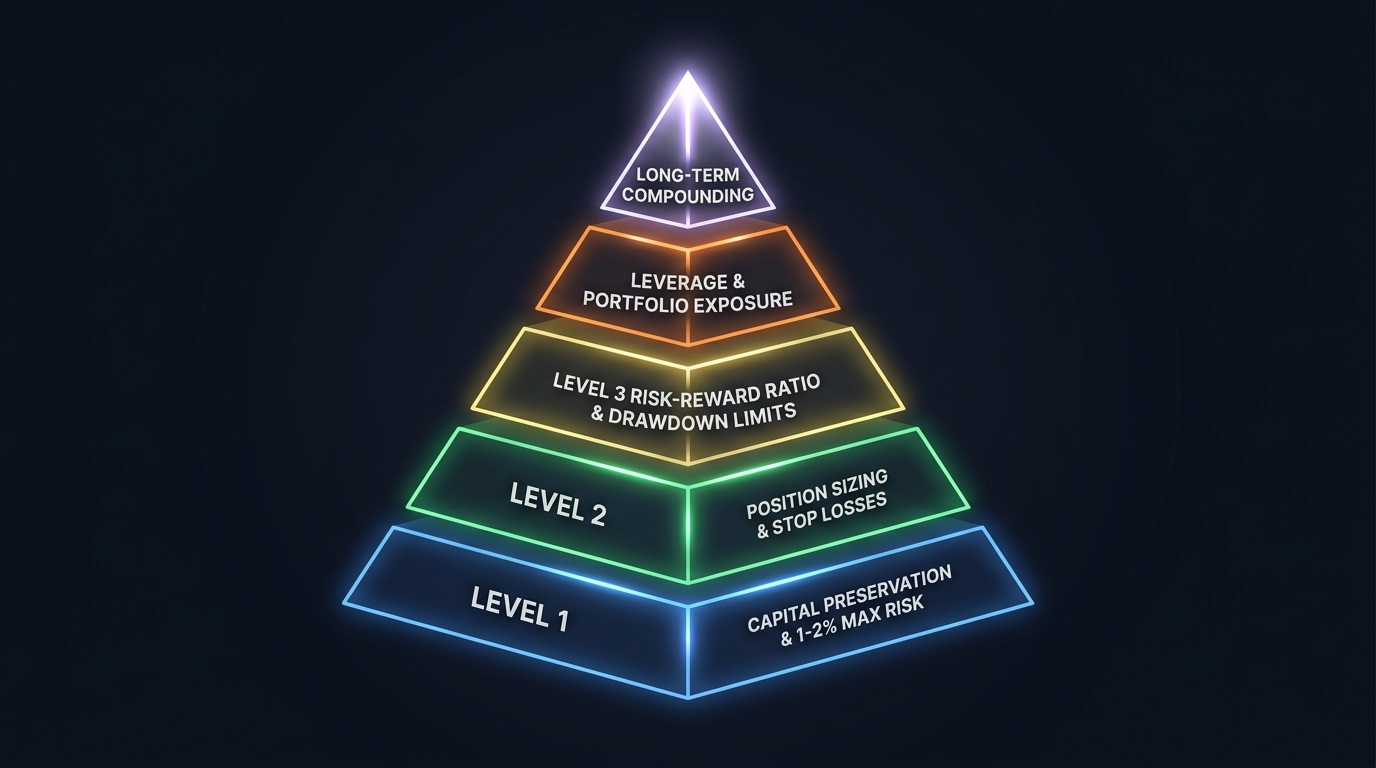
The 7 Pillars of Forex Risk Management
1. Capitalization: How Much to Put In
Capitalization refers to the total amount of money you allocate to trading. The single most important rule here: use only money you can afford to lose completely.
This isn’t pessimism. It’s a structural requirement. Markets can move against you in ways that stress-test even the best systems. If the capital you’re trading with would cause genuine financial or emotional harm if lost, it creates a psychological feedback loop that destroys discipline.
Most trading coaches suggest keeping trading capital between 5% and 20% of your net liquid assets. The rest stays in safer instruments.
Account type matters too. Your capitalization determines which account type makes sense:
| Account Type | Typical Minimum | Min Position Size | Who It Suits |
|---|---|---|---|
| Micro account | $100–$500 | 0.01 lots (micro lot) | Complete beginners |
| Mini account | $500–$2,000 | 0.1 lots (mini lot) | Learning phase |
| Standard account | $2,000–$10,000+ | 1 lot (standard) | Experienced traders |
| ECN/RAW account | $1,000+ | 0.01 lots | Professionals |
2. Position Sizing: The Math That Protects You
Position sizing is the calculation that determines exactly how many lots to trade on each position. It is driven by one question: how much can I afford to lose on this trade?
The professional standard is to risk no more than 1–2% of your account balance per trade. Here’s why that matters in practice:
- A 1% risk rule on a $10,000 account = $100 maximum loss per trade
- With a 20-pip stop-loss on EUR/USD, that means 0.50 standard lots
- A string of 20 consecutive losses (extremely rare) reduces the account by ~18%, not 100%
Use the position size calculator to compute the exact lot size for every trade before you open it.
The risk percentage comparison:
| Risk Per Trade | Account After 10 Losses | Account After 20 Losses |
|---|---|---|
| 0.5% | 95.1% | 90.5% |
| 1% | 90.4% | 81.8% |
| 2% | 81.7% | 66.8% |
| 5% | 59.9% | 35.8% |
| 10% | 34.9% | 12.2% |
The 1% rule is not conservative. It is survival arithmetic.
3. Drawdown: Setting Your Personal Loss Ceiling
A drawdown is the peak-to-trough decline in your account equity during a losing period. It’s measured as a percentage of the account’s highest value.
Every trader — including professionals — will experience drawdowns. The question is not whether you’ll have them. It’s how deep you allow them to go before you stop trading, reassess, and begin the recovery process.
Common drawdown limits used by professional traders and prop firms:
- Daily drawdown limit: 2–5% of account
- Weekly drawdown limit: 5–8% of account
- Monthly drawdown limit: 8–12% of account
When any limit is hit, the correct response is to stop trading for the rest of that period, review what happened, and start fresh. Not to double down. Not to recoup. Stop.
The psychological pressure of a losing streak can make this feel impossible. That’s exactly why it must be written into your trading plan before you’re in a drawdown, not during.
4. Risk-Reward Ratio: The Quality Filter
The risk-reward ratio measures the potential profit of a trade against its potential loss. A 1:2 ratio means you risk $50 to potentially make $100. A 1:3 means you risk $50 to potentially make $150.
Why does this matter so much? Because it directly determines the minimum win rate you need to be profitable.
| Risk-Reward Ratio | Minimum Win Rate Needed to Break Even |
|---|---|
| 1:1 | 50% |
| 1:2 | 33.3% |
| 1:3 | 25% |
| 1:4 | 20% |
A trader using a 1:3 ratio can be wrong 75% of the time and still break even. That’s a significant edge in terms of how often your analysis needs to be correct.
Most professional traders target a minimum 1:2 risk-reward ratio and will not enter a trade where the ratio is worse than 1:1.5. If you cannot identify a logical target that offers at least twice your risk, the trade is not worth taking.
5. Leverage: The Double-Edged Tool
Leverage is what makes forex simultaneously powerful and dangerous. It allows you to control large positions with a small amount of capital.
A 100:1 leverage ratio means you can control $100,000 worth of currency with $1,000 in margin. The gains and losses both scale proportionally.
This creates a critical misconception: many beginners think more leverage means more opportunity. It does. But it also means that a 1% adverse move against a maximally leveraged position wipes out the entire margin.
Practical leverage recommendations by experience level:
| Trader Level | Recommended Maximum Leverage |
|---|---|
| Beginner (< 6 months) | 5:1 to 10:1 |
| Intermediate (6–24 months) | 10:1 to 30:1 |
| Advanced (2+ years profitable) | Up to 50:1 situationally |
Note: Regulatory caps vary by region. ESMA limits leverage for EU/UK retail traders to 30:1 for major currency pairs. US CFTC caps retail forex leverage at 50:1.
Read the full lesson on forex leverage for the complete mechanics.
6. Stop-Loss Placement: Where Logic Meets Price
A stop-loss is the order that automatically closes your trade at a predetermined loss level. Without one, a single bad trade can theoretically wipe out an account (and it does, regularly).
There are three valid approaches to placing a stop-loss:
Structure-based stop-loss — Place it beyond a key technical level. If you’re buying at a support zone, the stop goes below the support. If the support breaks, the trade thesis is invalid.
ATR-based stop-loss — Use the Average True Range to measure current volatility. A stop set at 1.5–2x the ATR is wide enough to survive normal price noise but tight enough to limit damage.
Equity-based stop-loss — Calculate the stop-loss distance backward from your maximum acceptable loss. If you can lose $100 on the trade and the pip value is $10, your stop must be within 10 pips. This is less precise technically but ensures position sizing discipline.
The common mistake: placing stops “just outside” a round number because it feels safe. Real stop runs happen there precisely because it’s where everyone places them. Use the chart stop-loss technique instead.
7. Managing Exposure Across Multiple Positions
If you have three open positions, all long EUR/USD, GBP/USD, and AUD/USD, you’re not diversified. You have three bets on USD weakness. If the dollar strengthens, all three positions lose simultaneously.
Correlated pair exposure is one of the most overlooked risk management failures among intermediate traders.
Rules to apply:
- Maximum 1–2% risk per correlated pair group
- If EUR/USD and GBP/USD are both open long, combined risk should not exceed 2%
- When news is due on a specific currency (e.g., Fed announcement), reduce total USD-pair exposure beforehand
Read more in the lesson on managing exposure and position sizing.
The Psychology of Risk Management
Risk management is primarily a behavioral discipline, not a technical one. The rules are simple. The execution is hard.
One thing experienced traders consistently report: the hardest trades to manage psychologically are not the big losing trades. It’s the trade that you know is wrong but you’re down 30 pips and you’re hoping it will come back. The plan says close it. You don’t close it.
This is called loss aversion — a cognitive bias where the pain of a loss is psychologically approximately twice as powerful as the pleasure of an equivalent gain. It causes traders to hold losing trades longer than they should and cut winning trades earlier than they should. Both behaviors reverse the natural risk-reward equation.
The solution is a pre-commitment mechanism: your stop-loss, set at the moment of trade entry, enforces the exit automatically. You take the decision-making away from your future self, who will be emotional, and give it to your current self, who is calm and rational.
Common Risk Management Mistakes to Avoid
- Removing stop-losses after a trade goes against you “just to give it more room”
- Revenge trading — increasing position size after a loss to recover faster
- Averaging down — adding to a losing position instead of closing it
- Trading too many pairs simultaneously with correlated exposure
- Ignoring the compounding effect of small, frequent losses (death by a thousand cuts)
- Skipping the daily loss limit rule because “this trade feels different”
Tools to Put Risk Management Into Practice
- Position Size Calculator — Calculate exact lot sizes based on risk %
- Margin Calculator — See required margin and margin level in real time
- Pip Value Calculator — Know your monetary exposure per pip before entering
Key Takeaways
- 74–89% of retail forex accounts lose money. The differentiator is almost always risk management quality.
- Risk management is a complete framework — position sizing, drawdown limits, leverage control, stop-loss discipline, and correlation management working together.
- The 1% rule (never risk more than 1% of account per trade) is the most important single number in retail trading.
- Your drawdown limits must be defined and enforced before you enter a losing streak, not during one.
- Stop-losses are not optional. They are the mechanism that keeps a bad trade from becoming a catastrophic one.
- Risk management is fundamentally a behavioral challenge. The rules must be pre-committed in your trading plan to be effective.
Continue this module: What Is a Drawdown? | Risk vs. Reward Ratio

Ready to Practice This Strategy?
Test what you learned on a free, risk-free demo account before risking real money.