Risk of Excessive Leverage in Forex: The Math That Destroys Accounts
Excessive leverage is the fastest path to a blown forex account. Learn exactly how over-leveraging destroys capital, the regulatory safeguards in place, and the personal leverage limits that protect long-term trading survival.
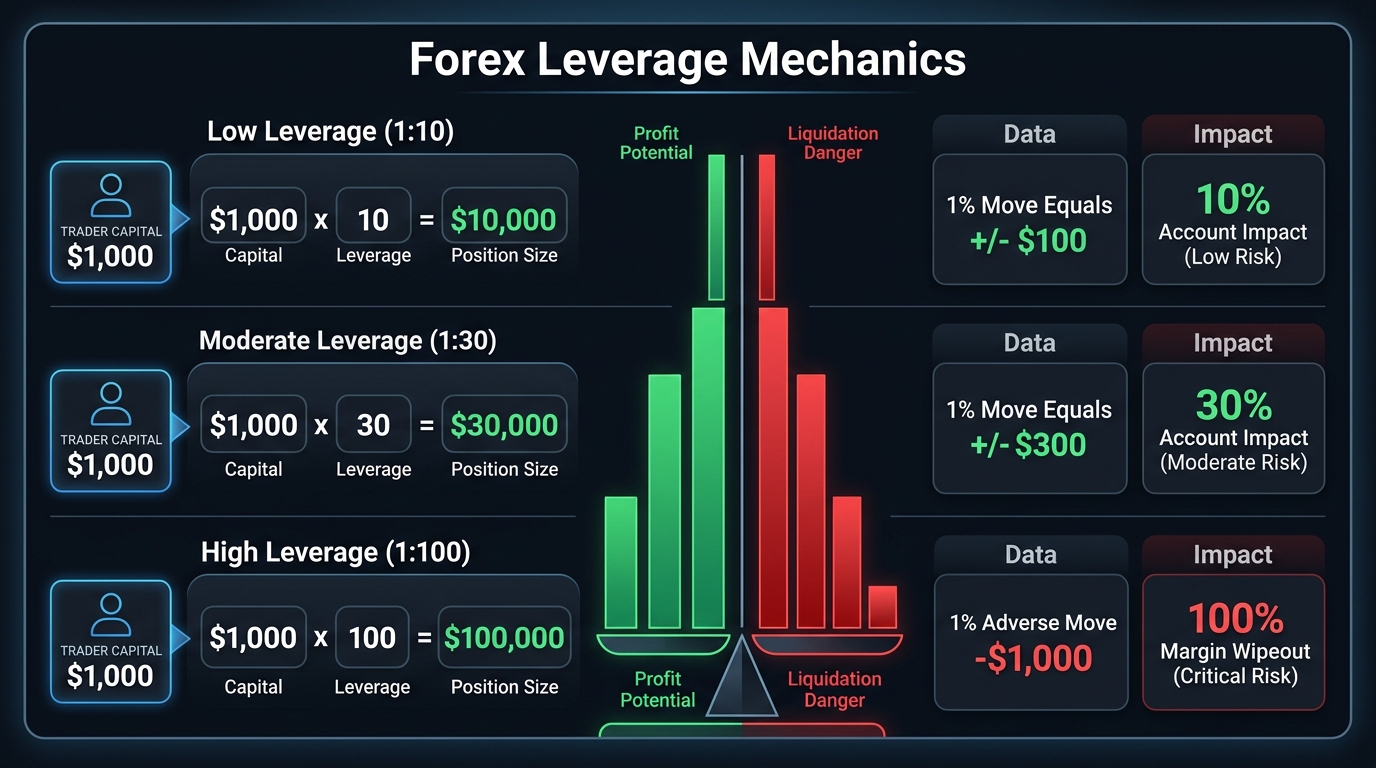
The ESMA disclosure required across the EU and UK states that 74–89% of retail forex accounts lose money. That statistic has barely moved in a decade despite improved education, better tools, and more accessible markets. The most consistent structural cause: excessive leverage.
Not leverage itself — used correctly, leverage is a precision instrument. Excessive leverage: the practice of controlling positions so large relative to account size that normal market fluctuations create catastrophic losses.
What “Excessive” Actually Means
Leverage becomes excessive when a normal, expected price movement in the pair can wipe out a significant portion of the trading account.
Normal EUR/USD daily range: 70–110 pips (based on current 2026 ATR averages).
Consider two traders with $10,000 accounts, both trading EUR/USD:
| Trader | Leverage Used | Position Size | 100-pip Loss = |
|---|---|---|---|
| A | 5:1 effective | 0.5 standard lots | -$500 (-5%) |
| B | 100:1 effective | 10 standard lots | -$10,000 (-100%) |
For Trader B, a single 100-pip adverse move — entirely within the normal daily range of EUR/USD — destroys the entire account. Not a black swan event. Not a crisis. A normal trading day.
That’s what excessive leverage does: it makes routine market behavior lethal.
The Compounding Effect on Drawdown
Excessive leverage doesn’t just increase the size of individual losses. It makes recovery from those losses mathematically harder with each consecutive losing trade.
$10,000 account, 10% loss per trade (excessive sizing):
| Trade # | Account Balance | % Remaining |
|---|---|---|
| Start | $10,000 | 100% |
| After 5 losses | $5,905 | 59% |
| After 10 losses | $3,487 | 35% |
| After 15 losses | $2,059 | 21% |
| After 20 losses | $1,216 | 12% |
Same account, 1% loss per trade:
| Trade # | Account Balance | % Remaining |
|---|---|---|
| Start | $10,000 | 100% |
| After 20 losses | $8,179 | 82% |
| After 50 losses | $6,050 | 61% |
| After 100 losses | $3,660 | 37% |
At 1% risk, even 100 consecutive losses (statistically near-impossible with any reasonable system) leaves 37% of capital remaining — recoverable. At 10% risk, 20 losses (easily achievable during an unfavorable stretch) reduces the account to 12% — essentially a wipeout.
The Margin Call Chain
Excessive leverage creates a specific failure sequence:
- Large position opened (10 lots on $10,000 = 100:1 effective leverage)
- Market moves 50 pips against position — loss = $5,000 (50% of account)
- Margin level drops toward the broker’s stop-out threshold
- Margin call or stop-out triggered — position closed at market
- Account is now $4,000–$5,000 (half the starting capital)
- Trader attempts recovery by reopening a similarly large position
- Another adverse move triggers another stop-out
- Account is below usable threshold
This sequence — which typically plays out over hours to days — has ended millions of retail trading accounts. It’s not bad luck. It’s a deterministic outcome of oversized positions.
Regulatory Response to Excessive Leverage
Recognizing the consistent destruction caused by excessive retail leverage, regulators in developed markets have imposed caps:
| Region | Max Leverage (Major Pairs) | Requirement |
|---|---|---|
| European Union | 30:1 | ESMA Product Intervention Measure (2018, permanent) |
| United Kingdom | 30:1 | FCA rules, post-Brexit continuation |
| United States | 50:1 | CFTC/NFA regulations |
| Australia | 30:1 | ASIC regulations (2021) |
| Japan | 25:1 | FSA regulations |
| Singapore | 20:1 | MAS regulations |
Offshore brokers (Seychelles, Vanuatu, etc.) are not covered by these regulations and commonly offer 500:1 to 1000:1. This is not an opportunity — it’s the absence of a consumer protection mechanism. The leverage itself is the risk, not a regulatory gap to exploit.
Personal Leverage Limits: The Framework
Regardless of what your broker allows, your effective leverage should be determined by your risk parameters, not the broker’s maximum:
Step 1: Decide your risk per trade (1% of account)
Step 2: Identify your stop-loss distance (determined by chart structure)
Step 3: Calculate position size using the formula:
Position Size = Risk Amount / (Stop-Loss Pips × Pip Value)Step 4: Check effective leverage:
Effective Leverage = (Position Size × Lot Size) / Account BalanceStep 5: If effective leverage exceeds 15:1, question whether the trade makes sense at this account size.
Example:
- $5,000 account
- 1% risk = $50
- 30-pip stop on EUR/USD
- Pip value (1 lot) = $10
Position size = $50 / (30 × $10) = 0.17 lots
Effective leverage = (0.17 × 100,000) / 5,000 = 3.4:1
This is the correct effective leverage for this trade — well within safe parameters regardless of your broker’s nominal 100:1 or 500:1 maximum.
Signs You Are Using Excessive Leverage
| Warning Sign | What It Indicates |
|---|---|
| A single trade can eliminate more than 5% of your account | Oversized position |
| You check positions anxiously every few minutes | Psychological sign of overexposure |
| You’ve had multiple margin calls in the past 3 months | Systematic overleveraging |
| Your free margin drops below 50% of used margin regularly | Overexposure structurally |
| You’ve increased position sizes after losses to “recover” | Revenge trading + overleveraging |
| Your broker’s maximum leverage feels like a target, not a ceiling | Fundamental misunderstanding of leverage |
The Correct Use of Leverage
Leverage, used correctly, is a capital efficiency tool — not a profit multiplier:
What leverage is for:
- Allowing smaller accounts to trade standard lot sizes
- Reducing the margin required for a correctly sized position
- Capital efficiency when you have multiple open positions
What leverage is not for:
- Making positions larger than your risk parameters justify
- Recovering losses faster
- Bypassing the constraints of a small account by taking bigger trades
A trader with a $1,000 account who wants to trade “like” a $50,000 account by using 50:1 leverage is not trading a bigger account — they’re exposing a $1,000 account to $50,000-scale losses. The math is the same. The protection isn’t there.
Key Takeaways
- Excessive leverage is the single most common cause of blown retail forex accounts; it makes normal market movements capable of destroying accounts
- At 100:1 effective leverage, a 100-pip move — entirely within EUR/USD’s daily range — wipes a $10,000 account
- Regulatory caps (30:1 EU/UK, 50:1 US) exist specifically because the data on retail losses from excessive leverage was conclusive
- Your effective leverage should be calculated trade-by-trade from your risk percentage and stop-loss distance — not from your broker’s maximum
- Safe effective leverage for retail traders: below 10:1 for beginners, below 15:1 for experienced traders
- Leverage is a capital efficiency tool, not a profit multiplier — it allows correctly-sized trades with less margin, not larger trades with the same margin
Next: Forex Margin Call | Managing Exposure and Position Sizing

Ready to Practice This Strategy?
Test what you learned on a free, risk-free demo account before risking real money.