Moving Averages Crossover Trading: Using MA Signals for Trend Entries
Moving average crossover trading uses the intersection of two MAs to identify trend shifts and entry points. Learn the correct timeframe application, the golden and death cross, and how to filter false signals in this classic approach.
When a shorter-period moving average crosses a longer-period moving average, the crossover signals a potential shift in momentum — the short-term trend direction has changed relative to the longer-term baseline.
This is the foundation of moving average crossover trading. It’s one of the oldest technical signals, widely used by institutional systems and retail traders alike. Its simplicity and objectivity make it a reliable building block for more complex strategies.
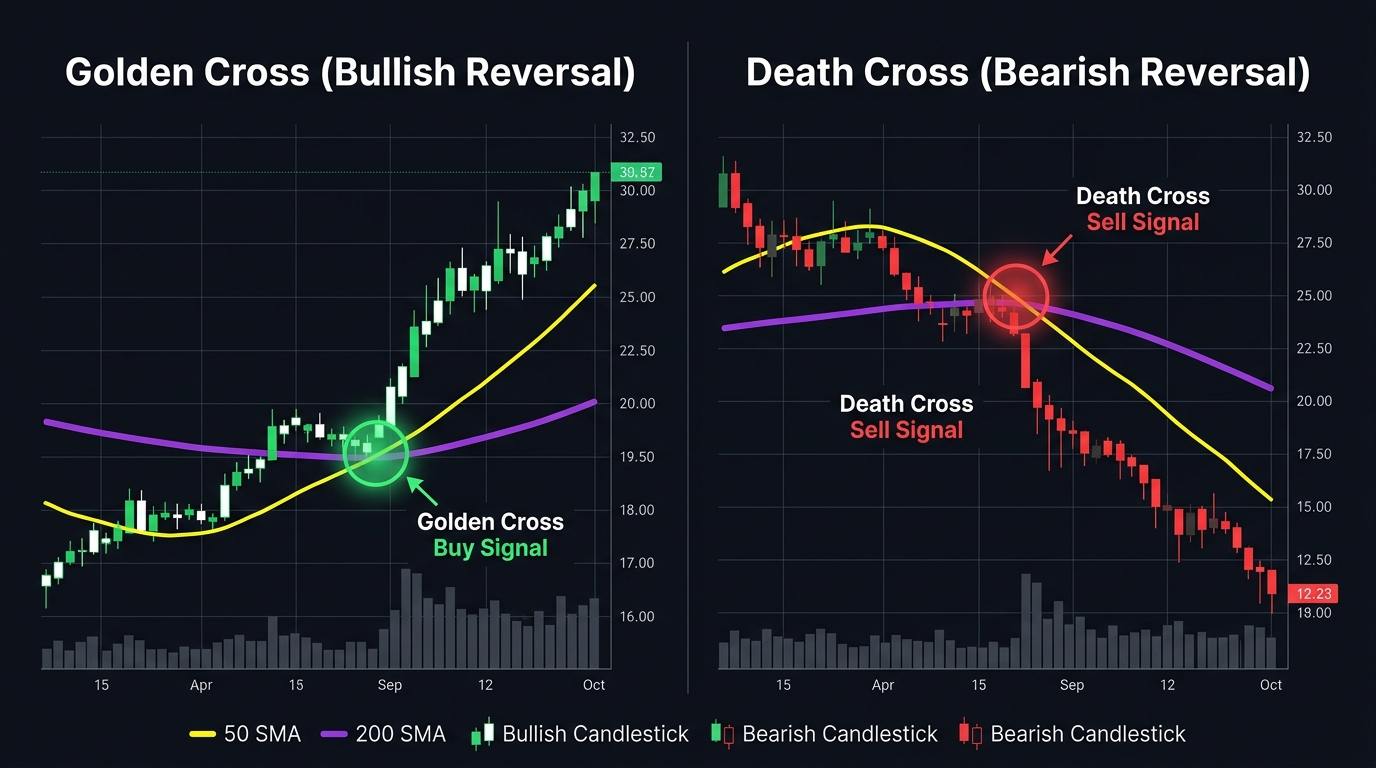
How Crossover Signals Work
Bullish crossover (Golden Cross): The fast MA (shorter period) crosses above the slow MA (longer period). Short-term momentum has shifted upward.
Bearish crossover (Death Cross): The fast MA crosses below the slow MA. Short-term momentum has shifted downward.
The most significant crossover in forex: The 50 SMA crossing the 200 SMA on the daily chart. When these two major institutional MAs cross, it produces a broadly watched signal that attracts institutional repositioning and generates significant media coverage.
Common MA Crossover Pairs by Timeframe
| Timeframe | Fast MA | Slow MA | Application |
|---|---|---|---|
| Daily | 50 SMA | 200 SMA | Long-term trend shifts; position trading |
| 4H | 20 EMA | 50 EMA | Swing trade entries in trending markets |
| 4H | 9 EMA | 21 EMA | Active swing entries; higher frequency |
| 1H | 9 EMA | 21 EMA | Day trading trend entries |
Entry Rules
Long Entry (Bullish Crossover)
| Step | Action |
|---|---|
| 1. Crossover | Fast MA crosses above slow MA |
| 2. Direction check | Both MAs beginning to slope upward |
| 3. ADX filter | ADX above 20 (confirms trending conditions) |
| 4. Entry | Long at next candle open after the crossover candle |
| 5. Stop-loss | Below the slow MA at time of entry + buffer |
| 6. Take-profit | Next significant resistance, or 2× stop distance |
Short Entry (Bearish Crossover)
Mirror conditions: fast MA crosses below slow MA; ADX above 20; short at next candle open.
The ADX Filter: Non-Negotiable
Without ADX filter, MA crossovers produce continuous false signals in ranging markets. When two MAs are close together and price oscillates without direction, the fast MA crosses the slow MA repeatedly — sometimes 5–10 times in a single week — while price goes nowhere.
ADX threshold:
- ADX below 20: No crossover trades; MAs tangled in range conditions
- ADX above 20 (rising): Trend developing; crossovers have meaning
- ADX above 25: Strong trend; crossover signals are most reliable
The Lag Problem
MA crossovers always lag behind price. By the time the 50 SMA crosses the 200 SMA on the daily chart, the underlying trend has already moved substantially. The crossover confirms the trend has been established — it doesn’t catch it at the beginning.
Implication: Use MA crossovers for:
- Directional bias confirmation (which side of the market to be on)
- Identifying existing trends to enter on pullbacks
Don’t use MA crossovers for:
- Catching early trend moves (price action is faster)
- Precise entry timing (the crossover candle may open at a poor price)
Better approach: When a Golden Cross forms on the daily chart, don’t enter at the crossover. Instead, wait for a 4H pullback to the 50 EMA (which will be below current price after the cross) and enter the pullback with a confirmation candle. This gives you the trend context of the Golden Cross with a tighter entry and better RR.
Moving Averages Crossover as Background Signal
Many traders use MA crossovers not as direct entry signals but as background context that determines their bias:
Example workflow:
- Daily 50 SMA crosses above 200 SMA (Golden Cross) → bullish bias established
- Wait for 4H pullback to 50 EMA → price returns to a key level
- Bullish rejection candle at 50 EMA on 4H → entry signal
- Long entry → trade aligned with daily crossover trend AND 4H price action
This workflow extracts the trend identification value of MA crossovers while using price action for actual entry timing.
Key Takeaways
- MA crossover (fast crossing slow) signals a momentum shift in the fast MA’s direction relative to the slow MA’s baseline
- The 50/200 SMA daily Golden/Death Cross is the most significant crossover in forex due to institutional recognition and market attention
- ADX filter is non-negotiable: crossovers below ADX 20 produce constant false signals in ranging markets; only trade crossovers when ADX is above 20
- MA crossovers lag behind price — they’re best used for trend confirmation and directional bias, not early trend entry
- More effective approach: use the Golden/Death Cross for directional bias, then enter on 4H pullbacks to the slower MA with price action confirmation
- For shorter timeframes: 9/21 EMA crossovers on 1H/4H provide faster signals with the same lag caveat — ADX filter still required
Related lessons: Moving Averages Overview | SMA Explained | EMA Explained
Related strategies: Moving Averages Crossover Strategy | EMA Crossover and ADX

Ready to Practice This Strategy?
Test what you learned on a free, risk-free demo account before risking real money.