Forex Gap Strategy: How to Trade Weekend Gaps Profitably
Forex gaps occur when markets reopen after the weekend at a price different from Friday's close. Learn why gaps form, which gaps fill, and the exact rules for trading the gap-fill setup.
Every Sunday evening when the forex market reopens, the first price displayed is rarely identical to where trading ended on Friday. That discrepancy — the gap — creates one of the most consistently tradeable patterns in retail forex.
Gaps are not random. They occur for specific, understandable reasons, and the majority of them resolve in a predictable direction within 24–48 hours. This predictability is the foundation of the gap trading strategy.
What Is a Forex Gap?
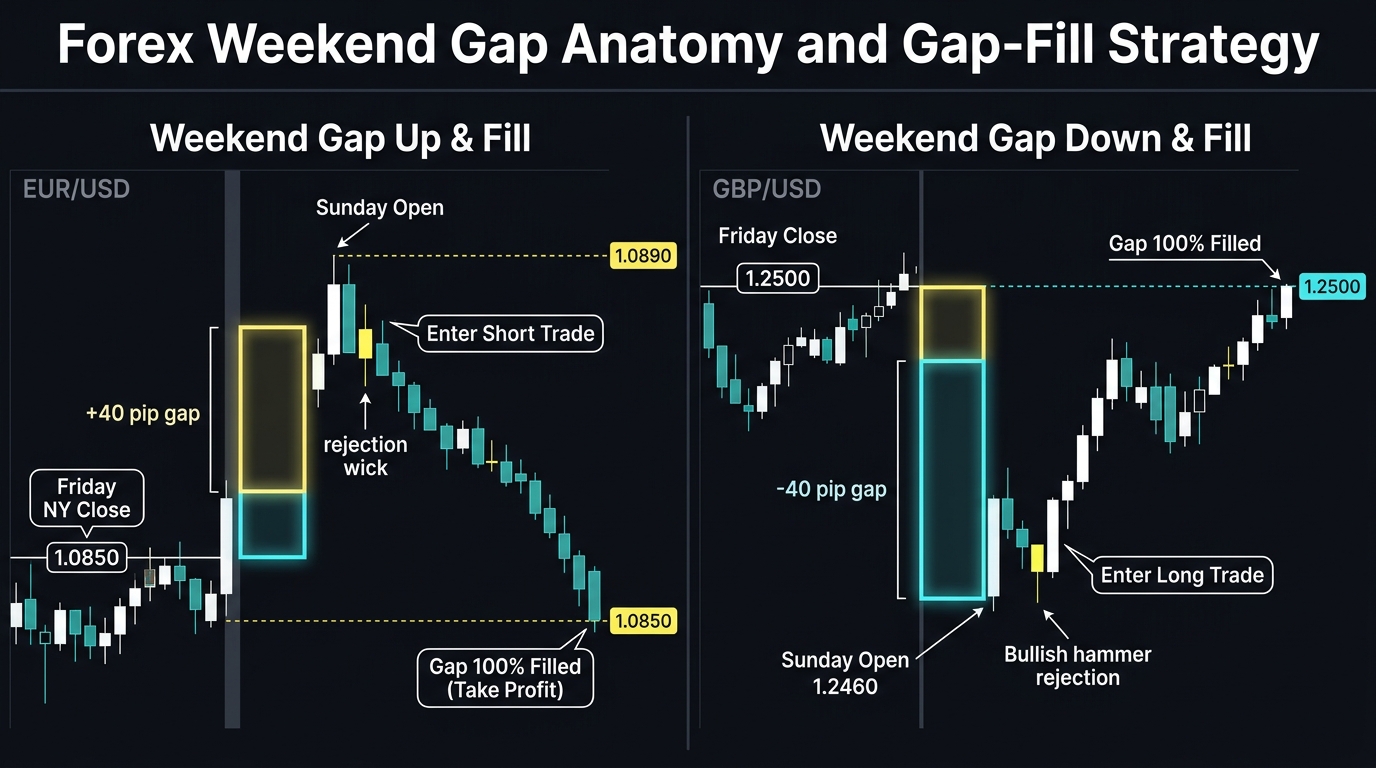
A gap is a price discontinuity between one session’s close and the next session’s open. In forex, the primary gap opportunity occurs between the Friday New York close (approximately 17:00 EST) and the Sunday Tokyo open (approximately 17:00 EST Sunday, or 22:00 GMT).
During this ~48-hour window:
- The forex market is officially closed for retail trading
- Geopolitical events, major economic announcements, and news releases continue
- Sentiment shifts that build up over the weekend are expressed all at once at Sunday’s open
The result is a price “jump” — the Sunday open is above or below Friday’s close by anywhere from a few pips to hundreds of pips during high-impact events.
Types of Forex Gaps
| Gap Type | Description | Fill Probability | Tradeable? |
|---|---|---|---|
| Common gap | Small gap (5–30 pips) in a ranging market | Very High (80%+) | Yes |
| Breakaway gap | Gaps above/below a key S/R level with strong momentum | Low | No — trade in gap direction |
| Runaway/continuation gap | Occurs mid-trend, confirms strong momentum | Very Low | No — trade in gap direction |
| Exhaustion gap | Occurs near end of major trend; often reverses | High | Yes — fade the gap |
For most retail traders, the focus should be on common gaps — the everyday small-to-medium Sunday gaps that fill reliably.
Why Gaps Fill: The Mechanics
The gap-fill tendency exists because:
-
Algorithmic positioning: Major institutions and algos place orders at Friday’s closing prices. When Sunday opens with a gap, those resting orders become relevant and pull price back.
-
Mean reversion: Small gaps without fundamental justification are statistical anomalies. Price naturally reverts to the region of recent activity.
-
Liquidity vacuum: The gap area represents an unfilled liquidity zone. Market makers and institutional traders often push price back through these zones to fill orders left there.
-
Psychological anchoring: Many traders set their reference points at Friday’s close. When price gaps away from that anchor, they trade toward the gap being filled.
Research consistently shows that gaps under 50 pips on major pairs (EUR/USD, GBP/USD, USD/JPY) fill at a rate of approximately 70–80% within the following 48 hours. Larger gaps fill less reliably.
The Gap-Fill Setup: Entry Rules
Pre-Conditions (Check Before Trading)
| Condition | Requirement |
|---|---|
| Gap size | 5–50 pips (common gap range) |
| Gap direction | No fundamental news justification for the gap direction |
| Day of week | Sunday evening / Monday early session |
| Market regime | Ranging or mildly trending (not in explosive breakout) |
| Avoid | Gaps occurring after major weekend geopolitical events |
Long Entry (Gap Down — Fill Upward)
| Step | Action |
|---|---|
| 1. Confirm gap | Sunday open is below Friday’s close by 5–50 pips |
| 2. Confirm no news | No major negative fundamental event explains the gap |
| 3. Entry | Buy at or near Sunday’s open price |
| 4. Stop-loss | 20–30 pips below Sunday’s open (below pre-gap support) |
| 5. Take-profit | Friday’s closing price (the “fill” target) |
| 6. Time limit | If gap not filled within 48 hours, close the position |
Short Entry (Gap Up — Fill Downward)
| Step | Action |
|---|---|
| 1. Confirm gap | Sunday open is above Friday’s close by 5–50 pips |
| 2. Confirm no news | No major positive fundamental event explains the gap |
| 3. Entry | Sell at or near Sunday’s open price |
| 4. Stop-loss | 20–30 pips above Sunday’s open (above pre-gap resistance) |
| 5. Take-profit | Friday’s closing price |
| 6. Time limit | Close if unfilled within 48 hours |
The Gap Extension: Trading With the Gap
Not all gaps should be faded. When a gap occurs alongside a fundamental catalyst — a surprise central bank decision, a geopolitical shock, or a major economic miss over the weekend — the gap often extends rather than fills.
Trade the gap direction when:
- The gap is large (50+ pips)
- A specific news event explains the gap clearly
- Price holds the gap level on the first retest attempt (fails to start filling)
- The gap direction aligns with the existing weekly trend
In these cases, enter in the direction of the gap, targeting the next significant support or resistance level.
Historical Examples
Gap fill (February 2024): EUR/USD closed Friday at 1.0785. Sunday open: 1.0751 (34-pip gap down, no major weekend news). By Monday afternoon, price had returned to 1.0783. Classic common gap fill.
Gap extension (August 2024): USD/JPY closed Friday at 149.20. Over the weekend, Bank of Japan unexpectedly raised rates. Sunday open: 146.80 (240-pip gap down). Price continued lower to 141.70 over the following week. The BoJ news was the catalyst — fading this gap would have been catastrophic.
The lesson: always identify why the gap occurred before deciding to fade or extend.
Risk Management
| Parameter | Recommendation |
|---|---|
| Risk per trade | 0.5–1% of account |
| Stop-loss | 20–30 pips from entry (not fixed — beyond structure) |
| Time limit | 48 hours maximum; exit if not filled |
| Avoid | Any gap associated with a clear fundamental catalyst |
| Position size | Standard (calculate from stop distance using position calculator) |
The 48-hour rule is critical. Some gaps take longer than expected to fill, and holding indefinitely ties up capital and margin. If Friday’s close is not reached within 48 hours, the setup’s logic has weakened — exit and reassess.
Key Takeaways
- Forex gaps occur primarily at Sunday’s open, when weekend sentiment shifts express themselves in price
- Common gaps (5–50 pips, no fundamental catalyst) fill approximately 70–80% of the time within 48 hours
- Trade common gap fills: buy gap-downs, sell gap-ups, target Friday’s close as the take-profit
- Do not fade gaps driven by genuine fundamental catalysts — these often extend significantly
- Apply the 48-hour rule: exit the position if the gap is not filled within 48 hours regardless of paper loss
- Gap trading works best on major pairs (EUR/USD, GBP/USD, USD/JPY) where liquidity is highest
Related strategies: News Trading | Support and Resistance Without Indicator
Tools: Position Size Calculator
Risk Disclosure & Testing
Past performance of any trading strategy is not indicative of future results. Always backtest and forward test this strategy on a free demo account before committing real financial capital.

Practice This Strategy on a Live Demo
Choose an ECN broker with tight spreads and fast execution for strategy backtesting.