A-Share
An A-Share designates three distinct financial instruments: Class A mutual fund shares with front-end sales loads and low ongoing expense ratios, corporate dual-class equities with distinct voting privileges, or mainland China Renminbi-denominated equities listed in Shanghai and Shenzhen.
What Is an A-Share?
The financial term A-Share (or Class A Share) refers to three fundamentally distinct capital structures depending on the market context:
- Investment Funds (Class A Mutual Fund Shares): A share class characterized by an upfront front-end sales charge (load) deducted from the initial investment, paired with lower ongoing annual operating expenses and 12b-1 distribution fees.
- Corporate Equity (Dual-Class Common Stock): A tier of common stock issued by a corporation that carries distinct voting rights (or dividend entitlements) relative to Class B or Class C shares.
- Emerging & Global Markets (Chinese A-Shares): Common shares of mainland Chinese companies incorporated and listed on the Shanghai Stock Exchange (SSE) or Shenzhen Stock Exchange (SZSE), quoted and traded in Chinese Renminbi (CNY).
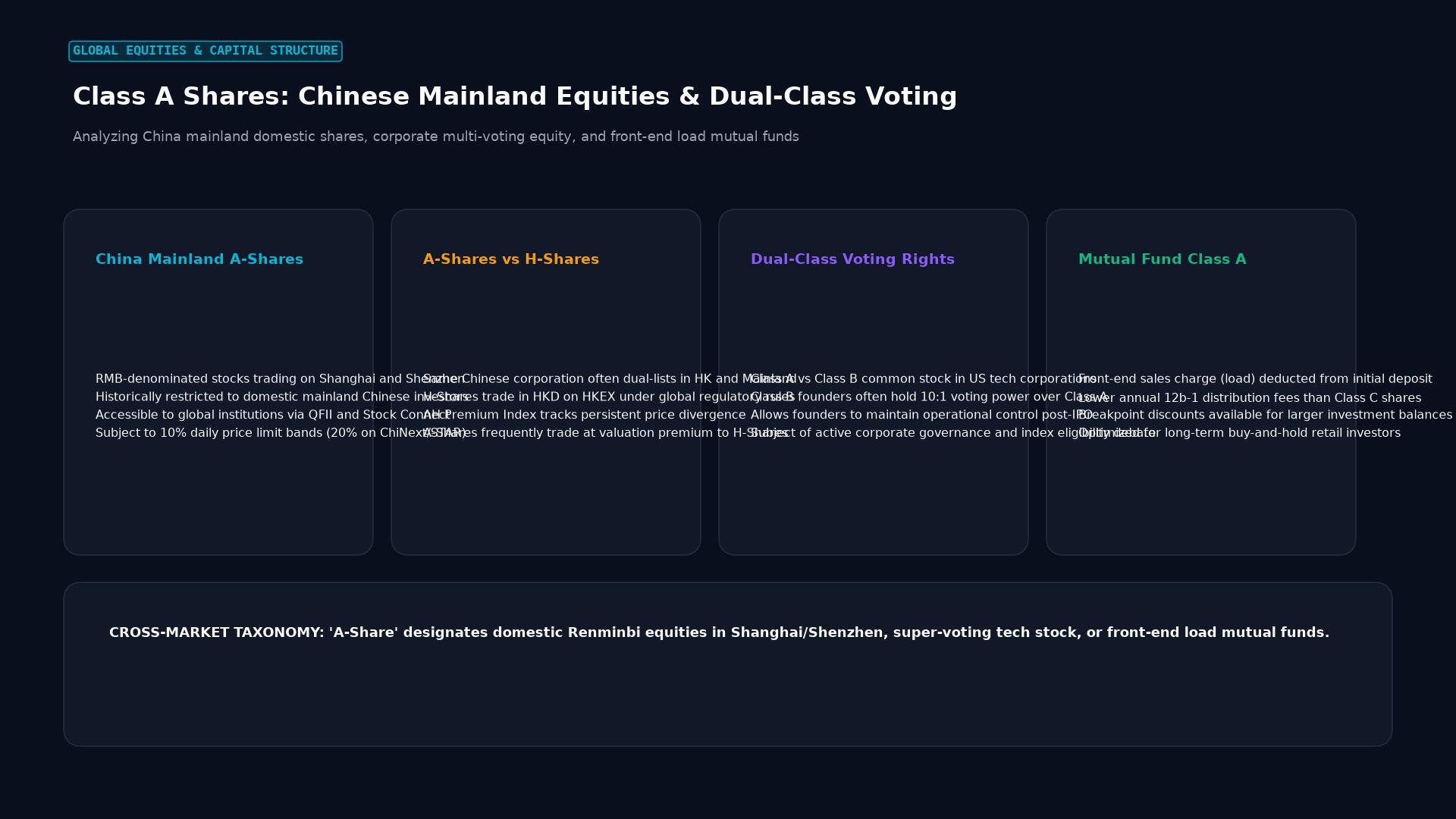 Figure: Analyzing China mainland domestic shares, corporate multi-voting equity, and front-end load mutual funds
1. Class A Mutual Fund Shares
In open-end mutual funds, investment companies offer identical underlying portfolios across multiple share classes. Class A shares are tailored for long-term investors seeking to minimize long-term operational drag:
Front-End Loads and Breakpoint Schedules
When buying Class A shares, an investor pays a sales commission upfront, reducing the net capital deployed:
$$\text{Net Invested Capital} = \text{Gross Investment} \times (1 - \text{Front-End Load})$$
Fund sponsors offer breakpoints—sliding scale volume discounts where the front-end load declines as the investment size increases (e.g., 5.75% for investments under $50,000, stepping down to 0.00% for investments exceeding $1,000,000). Because Class A shares charge minimal ongoing 12b-1 marketing fees (typically 0.25% annually vs. 1.00% for Class C shares), they deliver superior compound returns for horizons exceeding 5 years.
2. Dual-Class Corporate Shares
In corporate finance, companies implement multi-class equity structures to insulate executive management and founders from hostile takeovers and activist hedge fund pressures while tapping public equity capital:
- Alphabet Inc. (Google): Class A shares (NASDAQ: GOOGL) possess one vote per share and trade publicly. Class B shares (unlisted, held by founders Larry Page and Sergey Brin) possess ten votes per share. Class C shares (NASDAQ: GOOG) hold zero voting rights.
- Berkshire Hathaway: Class A shares (NYSE: BRK.A) never split, trade at several hundred thousand dollars per share, and possess 10,000 times the voting rights of Class B shares (NYSE: BRK.B).
3. Chinese A-Shares in Global Finance
Chinese A-Shares represent the second-largest equity market by capitalization globally. Historically restricted to domestic Chinese retail investors, international participation was unlocked through:
- QFII & RQFII Programs: Qualified Foreign Institutional Investor quotas.
- Stock Connect (Shanghai-Hong Kong & Shenzhen-Hong Kong): Mutual market access channels allowing international institutional traders to route orders directly through the Hong Kong Stock Exchange.
- MSCI & FTSE Inclusion: The gradual phased inclusion of Chinese A-Shares into benchmark emerging market indices (such as the MSCI Emerging Markets Index), driving hundreds of billions in passive tracking inflows.
Comparative Matrix: Mutual Fund Share Classes
| Feature / Metric | Class A Shares | Class B Shares | Class C Shares | Institutional (Class I) |
|---|---|---|---|---|
| Sales Charge Type | Front-end load (paid at purchase) | Contingent Deferred Sales Charge (CDSC) | Level load / No upfront load | Zero load (Clean shares) |
| Annual 12b-1 Fee | Low (typically ~0.25%) | High (~0.75% - 1.00%) | High (~1.00% ongoing) | None / Negligible |
| Breakpoint Discounts? | Yes (tiered fee reductions) | No | No | N/A (low base fee) |
| Conversion Feature | Does not convert | Typically converts to A after 6–8 years | Does not convert | Permanent class |
| Optimal Investor Horizon | Long-term (> 5 years) | Obsolete in modern finance | Short-term (1–3 years) | Institutional / High-Net-Worth |
Institutional Case Study: MSCI Emerging Markets A-Share Inclusion
In 2018, global index provider MSCI commenced the systematic inclusion of mainland Chinese A-Shares into its flagship MSCI Emerging Markets Index:
- Initial Weighting Constraints: International asset managers initially held reservations regarding market accessibility, daily trading limits, and capital repatriation restrictions during periods of market stress.
- Four-Step Inclusion: MSCI executed a phased inclusion, raising the index inclusion factor (IIF) of 472 large- and mid-cap Chinese A-Shares from 5% to 20%.
- Passive Rebalancing Flows: Global exchange-traded funds (such as the iShares Core MSCI EM ETF) executed automated multi-billion-dollar portfolio rebalancing trades, selling emerging market equities in South Korea, Brazil, and South Africa to allocate over $80 billion directly into onshore Chinese A-Shares.
Frequently Asked Questions (FAQ)
What is a Letter of Intent (LOI) for Class A mutual fund shares?
A Letter of Intent (LOI) is a contractual commitment by an investor declaring their intention to invest a specified dollar threshold (e.g., $250,000) across Class A shares within a 13-month window. The fund sponsor immediately applies the lower breakpoint sales commission to the very first purchase, allowing the investor to save on upfront transaction costs.
Can foreign retail traders directly buy Chinese A-Shares?
Direct trading of Chinese A-Shares on the Shanghai and Shenzhen exchanges by individual non-Chinese citizens is generally restricted. However, international retail investors access A-Shares easily through specialized ETFs (such as ASHR or KBA) or through international brokerages supporting Northbound trading via the Hong Kong Stock Connect program.
Why do some investors prefer Class C shares over Class A shares?
Class C shares do not deduct a front-end sales commission, meaning 100% of the investor’s principal is deployed into the market on day one. For an investor with a short investment time horizon (e.g., 12 to 24 months), the absence of a 5% front-end load outweighs the impact of Class C’s higher annual 12b-1 fee.
Ready to trade forex?
Open a free demo account with a regulated broker. Practice with virtual funds before risking real money.