Market Maker
A market maker is a financial institution or brokerage firm that actively provides liquidity to financial markets by continuously quoting two-sided prices—both a buy (bid) and a sell (ask)—profiting primarily from the bid-ask spread.
What Is a Market Maker?
A market maker (MM) is a financial institution, commercial bank, or securities dealer that facilitates trading by guaranteeing continuous, two-sided liquidity for financial instruments. Rather than passively waiting for buyers and sellers to find each other, a market maker stands ready at all times to purchase assets from sellers at the bid price and sell assets to buyers at the ask (offer) price.
In the multi-trillion-dollar foreign exchange ecosystem, market makers operate across two primary tiers:
- Tier-1 Wholesale Market Makers: Global investment banks (such as JPMorgan Chase, Citigroup, Deutsche Bank, and UBS) that quote continuous multi-million-dollar prices directly on institutional electronic communication networks like EBS and Refinitiv.
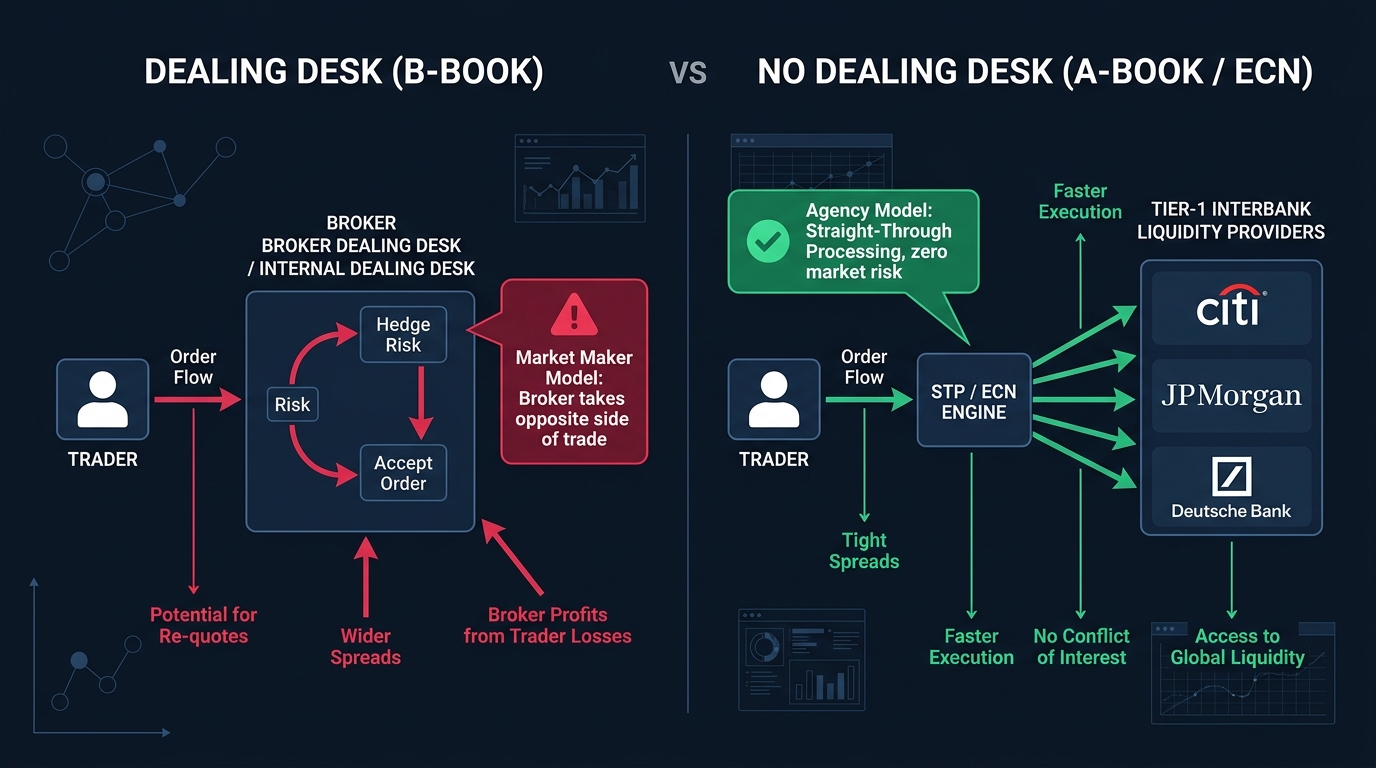
- Retail Market Makers (Dealing Desk Brokers): Retail forex brokerages that maintain an internal order book, taking the opposing side of client transactions (acting as principal to the trade) rather than routing tickets to external interbank liquidity providers.
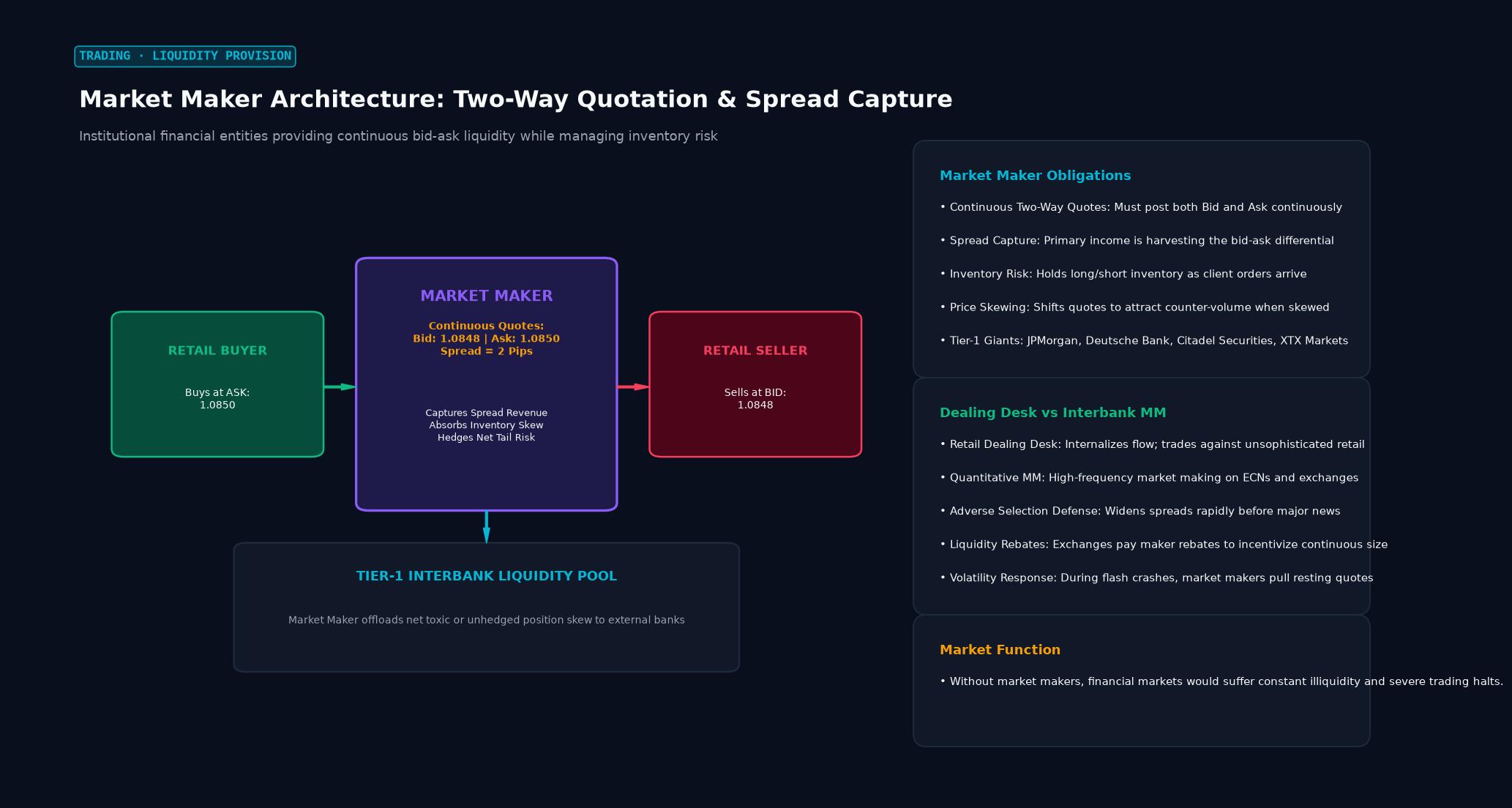 Figure: Institutional financial entities providing continuous bid-ask liquidity while managing inventory risk
How Market Makers Generate Revenue
Market makers do not operate as charitable liquidity providers. They structure their operations to capture risk-adjusted profits through three primary mechanisms:
1. Capturing the Bid-Ask Spread
The foundational source of market maker revenue is the spread—the differential between the price at which they buy and the price at which they sell:
$$\text{Spread Profit} = \text{Ask Price} - \text{Bid Price}$$
If a retail market maker quotes EUR/USD at 1.0850 / 1.0852, and simultaneously buys 10 lots from Client A at 1.0850 and sells 10 lots to Client B at 1.0852, the dealer has zero directional market risk and locks in 2 pips ($200 USD) in riskless spread capture.
2. Internal Order Crossing (Internalization)
In high-volume retail brokerages, thousands of clients execute opposing trades simultaneously. Market makers cross these orders internally within their proprietary liquidity pool. By netting off long client orders against short client orders internally, the brokerage avoids paying execution fees or clearing commissions to external prime brokers.
3. B-Book Execution and Inventory P&L
When client order flow is unbalanced, the market maker absorbs the opposing position onto its own balance sheet (known in the industry as B-Book execution). Because statistical industry metrics consistently show that between 70% and 80% of retail traders lose capital over multi-month horizons due to overleveraging and poor risk discipline, retail market makers generate substantial profits when client accounts incur net trading losses.
The Mechanics of Inventory Risk and Quote Shading
Market makers face inventory risk: the hazard that prices will trend sharply against positions held on their balance sheet before an offsetting buyer or seller can be found.
To neutralize inventory imbalances, dealers utilize quote shading:
- Scenario: A market maker’s book becomes dangerously over-allocated with long EUR/USD positions after aggressive retail selling.
- Action: The market maker “shades” its quote slightly lower than the broader interbank market (e.g., quoting 1.0848 / 1.0850 instead of 1.0850 / 1.0852).
- Result: The lower ask price attracts external buyers seeking cheap euros, while the depressed bid price discourages further selling, successfully rebalancing the dealer’s inventory back to neutral.
Quote Shading to Clear Heavy Inventory:
Dealer Holds Excessive Inventory  ===> Shades Ask Price Lower
Attracts Inbound Buyers           ===> Offloads Long Exposure ===> Inventory Balanced
If an inventory imbalance exceeds internal risk tolerance limits, the market maker offloads the excess net directional exposure by hedging directly with Tier-1 institutional prime brokers.
Market Makers vs. Agency (ECN / STP) Brokers
| Feature | Market Maker (Dealing Desk) | ECN / STP Broker (No Dealing Desk) |
|---|---|---|
| Execution Model | Principal (takes opposing side of trade) | Agent (routes order directly to external bank) |
| Primary Revenue | Bid-Ask spread & internal client net P&L | Fixed transaction commission per lot |
| Spread Type | Fixed or variable artificially smoothed | Floating raw interbank spreads (from 0.0 pips) |
| Conflict of Interest | Potential (broker gains when client loses) | None (broker profits solely from trading volume) |
| Execution Speed | Instant execution (internal server) | Market execution (subject to network latency) |
| Requotes | Possible during high volatility news | Never requotes; orders execute with slippage |
The Vital Role of Market Makers in Financial Markets
Despite frequent retail skepticism regarding Dealing Desk brokers, market makers are indispensable to modern finance. Without market makers committing their own capital to quote two-sided prices, market liquidity would evaporate during periods of panic. Market makers guarantee that retail traders can execute buy and sell orders in fractions of a second without waiting for a natural counterparty to appear on the other side of the globe.
Modern regulatory frameworks (enforced by the UK FCA, Australian ASIC, and European CySEC) enforce rigorous best-execution audits, algorithmic fairness rules, and capital adequacy requirements to prevent market makers from engaging in unfair price manipulation or artificial stop hunting.
Key Takeaways
- A market maker guarantees market liquidity by continuously quoting two-sided bid and ask prices.
- Primary revenue comes from capturing the bid-ask spread and internalizing opposing client order flow.
- Market makers manage inventory risk by shading quotes and hedging excess exposure with Tier-1 banks.
- Unlike agency ECN brokers that charge commissions to route orders externally, Dealing Desk market makers act as principal.
- Strict regulatory oversight ensures transparent execution while preserving essential market liquidity.
Frequently Asked Questions
Is it safe to trade with a market maker broker?
Yes, provided the broker is regulated by top-tier financial authorities such as the US CFTC/NFA, UK FCA, or Australian ASIC. Highly regulated market makers maintain multi-million-dollar capital reserves and undergo regular independent audits to verify fair order execution.
What is the difference between A-Book and B-Book broker execution?
An “A-Book” broker routes client orders straight-through (STP) to external liquidity providers, taking zero market risk and earning commission. A “B-Book” broker internalizes client trades, taking the opposing side on its own balance sheet and absorbing client profits or losses.
Why do market makers widen spreads during major news releases?
During volatile events like US Non-Farm Payrolls, prices move violently and counterparty risk spikes. Market makers widen their spreads to protect their inventory from toxic institutional order flow and fast-moving adverse price slippage.
Ready to trade forex?
Open a free demo account with a regulated broker. Practice with virtual funds before risking real money.