Abandonment Option
An abandonment option is a real option in corporate finance and capital budgeting granting management the contractual or strategic right to prematurely terminate an unprofitable project and realize its liquidation or salvage value, capping downside financial risk.
What Is an Abandonment Option?
In corporate finance, strategic management, and project valuation, an abandonment option is a category of real option that gives an enterprise the unilateral right to cease operations on a project, decommission capital equipment, and liquidate assets for their salvage or secondary market value.
Traditional discounted cash flow (DCF) and Net Present Value (NPV) models assume passive management—calculating cash flows as if the firm is irreversibly committed to operating an asset until the end of its useful life, regardless of how poorly economic conditions deteriorate. Real options theory recognizes that proactive corporate management can terminate projects early if operating cash flows fall below salvage recovery value, effectively embedding a protective American put option directly into the project’s capital structure.
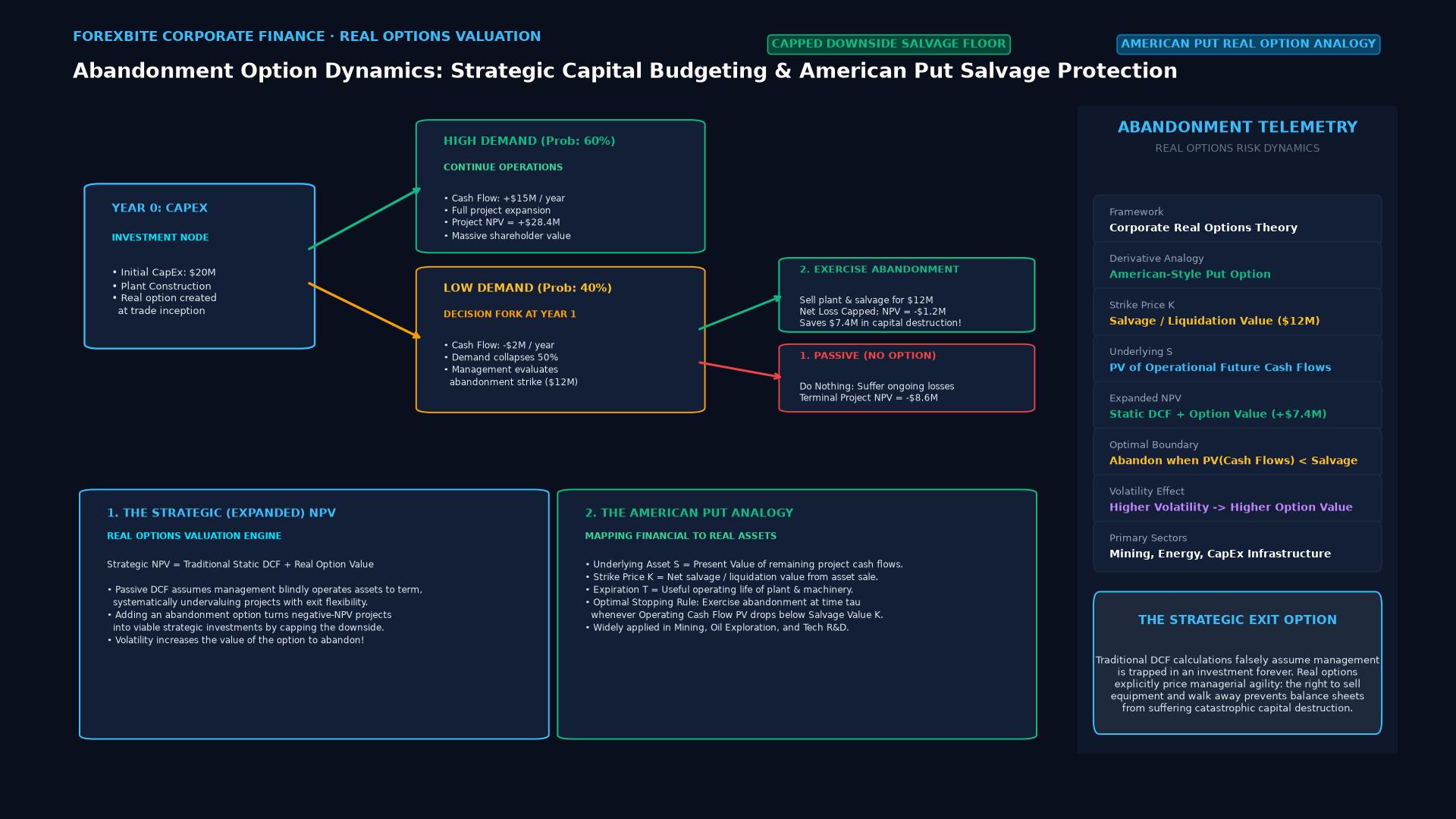 Figure: Decision tree analysis of an abandonment real option, contrasting passive capital loss vs active salvage exercise equivalent to an American put option.
Technical Mechanics & Option Valuation
An abandonment option functions mathematically as an American-style put option written on the present value of the project’s future cash flows:
- Underlying Asset ($S$): The present value of expected operating cash flows from continuing the project.
- Strike Price ($K$): The salvage value, liquidation price, or alternative deployment value of the project’s physical and intellectual assets.
- Maturity ($T$): The economic life of the equipment or the contractual duration of exit clauses.
1. Expanded (Strategic) NPV Formulation
The total strategic value of a capital project is the sum of its static discounted cash flow valuation and the value of managerial flexibility:
$$NPV_{\text{Strategic}} = NPV_{\text{Static}} + \text{Value of Abandonment Option}$$
Where:
- $NPV_{\text{Static}} = \sum_{t=1}^T \frac{CF_t}{(1 + WACC)^t} - \text{Initial Investment}$
- $\text{Value of Abandonment Option} \ge 0$
2. Optimal Exercise Rule
At any evaluation period $t$, management compares the continuation value of the project ($V_{\text{Continuation}, t}$) against the net abandonment payoff ($K_t$):
$$\text{Project Value}t = \max \left( V{\text{Continuation}, t}, K_t \right)$$
If $K_t > V_{\text{Continuation}, t}$, the rational, wealth-maximizing decision is to immediately exercise the abandonment option, shut down operations, and collect the salvage proceeds.
Comparative Matrix: Corporate Real Options
| Real Option Type | Financial Option Analogy | Key Managerial Decision | Primary Driver of Option Value | Real-World Application |
|---|---|---|---|---|
| Abandonment Option | American Put Option | Terminate project; recover salvage value | Asset resale liquidity & salvage floor | Mining closure, manufacturing plant decommissioning |
| Expansion Option | American Call Option | Scale up production capacity if demand surges | Volatility and upside market demand | Modular data center buildouts, pharmaceutical scaling |
| Timing / Deferral Option | American Call Option | Delay initial capital expenditure to gather data | Uncertainty reduction over time | Commercial real estate development, oil drilling leases |
| Switching Option | Compound / Exchange Option | Alter input fuels or output product mix | Input price differentials (e.g., spark spread) | Dual-fuel power plants, flexible chemical refineries |
Real-World Case Study: Offshore Oil Field & Floating Production Units (FPSO)
An international offshore energy consortium evaluated a $400 million deepwater oil field development:
- The Static Dilemma: Building a permanent fixed offshore platform carried a static NPV of -$15 million based on prevailing oil prices ($65/barrel), as a collapse in oil prices would result in 100% loss of the unrecoverable platform infrastructure (sunk costs).
- Structuring the Abandonment Option: Rather than installing an irreversible fixed platform, the engineering team leased a Floating Production Storage and Offloading (FPSO) vessel under a flexible charter contract with a cancellation exit fee:
- If Brent crude traded above $70, operations continued.
- If oil plunged below $45, the consortium had the contractual right to disconnect the FPSO, plug the subsea wells, and terminate the lease, capping maximum potential losses at $45 million instead of $400 million.
- Valuation Impact: Black-Scholes and binomial tree modeling calculated the market value of this built-in abandonment put option at +$38 million.
- Final Decision: $$NPV_{\text{Strategic}} = -$15\text{M} + $38\text{M} = \mathbf{+$23\text{M}}$$ The project was approved solely because the abandonment option truncated downside exposure, making an otherwise unviable capital project commercially attractive.
Frequently Asked Questions (FAQ)
How does asset specificity affect the value of an abandonment option?
Asset specificity is the degree to which an asset is customized for a single specific purpose. Highly specific assets (such as a custom subterranean railway tunnel or bespoke drug-testing machinery) have zero secondary market utility, resulting in a salvage value near zero and rendering the abandonment option virtually worthless. Conversely, standardized assets (like commercial aircraft, cargo vessels, or standard warehouse real estate) hold substantial secondary resale value, maximizing abandonment option value.
Why do traditional DCF models systematically undervalue projects with abandonment options?
Traditional DCF models assume fixed expected cash flows discounted at a constant hurdle rate, assuming management remains completely passive regardless of how catastrophic future outcomes become. Because management in reality exercises exit options when things go wrong, DCF overestimates downside risk and penalizes volatile but flexible projects.
What are exit costs, and how do they impact abandonment?
Exit costs include severance packages for dismissed employees, environmental remediation penalties, and early contract termination fees. In the real option equation, exit costs directly diminish the net strike price ($K_{\text{Net}} = \text{Gross Salvage} - \text{Exit Costs}$), reducing the financial incentive to abandon early.
Ready to trade forex?
Open a free demo account with a regulated broker. Practice with virtual funds before risking real money.