Abandon
In derivatives trading and commercial law, to abandon means deliberately permitting an out-of-the-money options contract to expire unexercised, or surrendering legal ownership of heavily damaged property to an insurer to claim a constructive total loss.
What Does Abandon Mean in Finance?
In financial markets, contract law, and insurance underwriting, abandon refers to the voluntary or intentional relinquishment of a legal right, option, or asset without assigning or transferring it to another counterparty:
- Derivatives & Options Trading: The act of allowing an options contract (call or put) to expire without exercising it. When an option’s strike price is out-of-the-money at expiration, exercising would result in a financial loss compared to prevailing spot market prices; hence, the holder simply abandons the contract, allowing it to lapse worthless.
- Insurance & Maritime Law: The formal surrender of rights to damaged property (such as a cargo vessel or industrial facility) to the insurer under a Notice of Abandonment, enabling the insured to claim a constructive total loss.
- Corporate Real Options: The strategic corporate decision to terminate and liquidate a capital investment project early when continuing operations yields negative expected net present value.
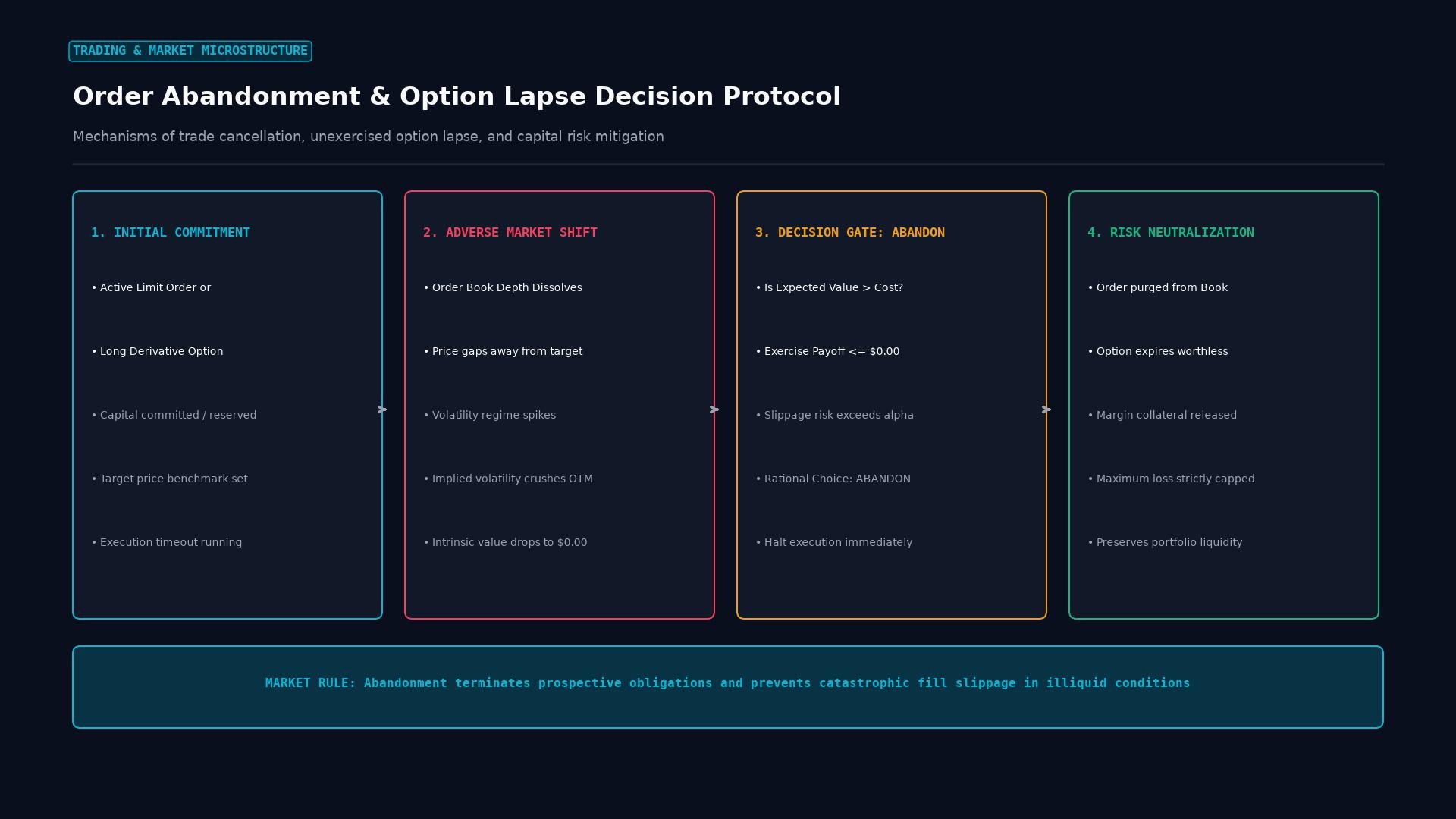 Figure: Decision-making pipeline for order abandonment and out-of-the-money option lapse: evaluating expected payoff, preventing adverse execution, and releasing margin capital.
Technical Mechanics in Options Clearing
In modern centralized equity and index options markets, the decision to exercise or abandon an option is governed by strict clearinghouse rules:
1. Options Clearing Corporation (OCC) Exercise by Exception
Under OCC Rule 805, clearing members enforce an automated Exercise by Exception (Ex-by-Ex) protocol:
- Any equity option that is in-the-money by $0.01 or more at market close on expiration day is automatically exercised by the clearinghouse.
- Any option that is out-of-the-money or at-the-money is automatically abandoned without requiring trader intervention.
2. Notice of Abandonment / Contrary Exercise Advice (CEA)
Traders can actively override clearinghouse auto-exercise rules by submitting a Contrary Exercise Advice (CEA) or Notice of Abandonment:
- Scenario: A trader holds a Call option with a $100 strike on a stock that closes at $100.05 at 4:00 PM EST (in-the-money by $0.05).
- Post-Market Shock: At 4:15 PM EST, devastating earnings news hits, driving after-hours stock trading down to $85.00.
- Action: If the auto-exercise went through, the trader would be forced to buy shares at $100 that are now worth only $85. The trader immediately instructs their broker to file a Notice of Abandonment with the OCC before the 5:30 PM cutoff, abandoning the option and capping their loss strictly at the original option premium paid.
Comparative Matrix: Contractual Inaction States
| Term / Status | Applicable Market | Financial Loss Incurred | Asset Claim Retained? | Reversible Action? |
|---|---|---|---|---|
| Abandon | Derivatives / Real Options | Limited to initial premium / sunk costs | No (rights extinguished) | No (irrevocable once expired) |
| Exercise | Derivatives | Premium paid + strike capital deployed | Converts into underlying asset | No |
| Lapse | Insurance / Warrants | Prior premiums forfeit | No | Occasionally reinstated within grace period |
| Surrender | Annuities / Whole Life | Surrender charges deducted | No (cash surrender value returned) | No |
Real-World Case Study: The Post-Earnings After-Hours Ambush
On October 25, an options swing trader held 100 call contracts on a major technology company expiring that afternoon:
- Contract Parameters: Strike price of $150.00; premium paid was $2.50 ($25,000 total outlay).
- Close of Regular Trading (4:00 PM EST): The stock settled at $150.15. Under standard clearing procedures, the position was in-the-money by $0.15, flagging it for automated OCC exercise to purchase 10,000 shares for $1,500,000.
- After-Hours Collapse (4:05 PM EST): The company released quarterly earnings revealing massive cloud infrastructure margin compression. In after-hours trading, the stock immediately plunged to $132.00.
- The Abandonment Intervention: Recognizing that taking delivery of 10,000 shares at $150 would immediately generate an unrealized overnight loss of $180,000 ($10,000 \times [$150 - $132]$), the trader called the trade desk at 4:35 PM to file an explicit Contrary Instruction / Notice of Abandonment.
- Outcome: The OCC canceled the exercise instruction. The calls expired abandoned and worthless. The trader lost only the initial $25,000 premium, saving $155,000 through rapid tactical abandonment.
Frequently Asked Questions (FAQ)
What is the maximum loss when an investor abandons an option?
For a long option buyer (calls or puts), the maximum loss upon abandonment is strictly limited to 100% of the initial premium paid plus any minor trading brokerage commissions. The buyer faces zero further liability or capital obligations.
Can an option writer (seller) choose to abandon a contract?
No. Abandonment is an exclusive right reserved for the option holder (buyer). Option writers accept legal obligations; if the option buyer exercises, the option writer is bound by assignment and must fulfill the trade regardless of adverse market conditions.
What is a Notice of Abandonment in marine insurance?
In marine cargo insurance, a Notice of Abandonment is an unconditional legal declaration provided by a shipowner or cargo owner to the insurance underwriter stating that the insured property has been so severely damaged that repair costs exceed its repaired value (constructive total loss). By abandoning the vessel to the insurer, the insured collects the full insured value, and the insurer takes salvage rights.
Ready to trade forex?
Open a free demo account with a regulated broker. Practice with virtual funds before risking real money.