ABMT
ABMT stands for Account-Based Money Transfer, an electronic payment mechanism that transfers funds directly between verified bank deposit accounts across domestic clearing systems or international remittance corridors without requiring physical cash handling.
What Does ABMT Stand For?
ABMT stands for Account-Based Money Transfer. In modern payment processing, commercial banking, and international remittances, ABMT designates an electronic fund transfer protocol where capital moves directly between authenticated bank deposit accounts.
Unlike legacy remittance methods that rely on physical over-the-counter cash deposits and retail counter pickups at third-party agent locations, an Account-Based Money Transfer integrates directly into interbank clearinghouse rails, online banking portals, and mobile financial applications. This structure dramatically lowers settlement friction, reduces regulatory anti-money laundering (AML) compliance overhead, and provides near-instantaneous account-to-account (A2A) reconciliation.
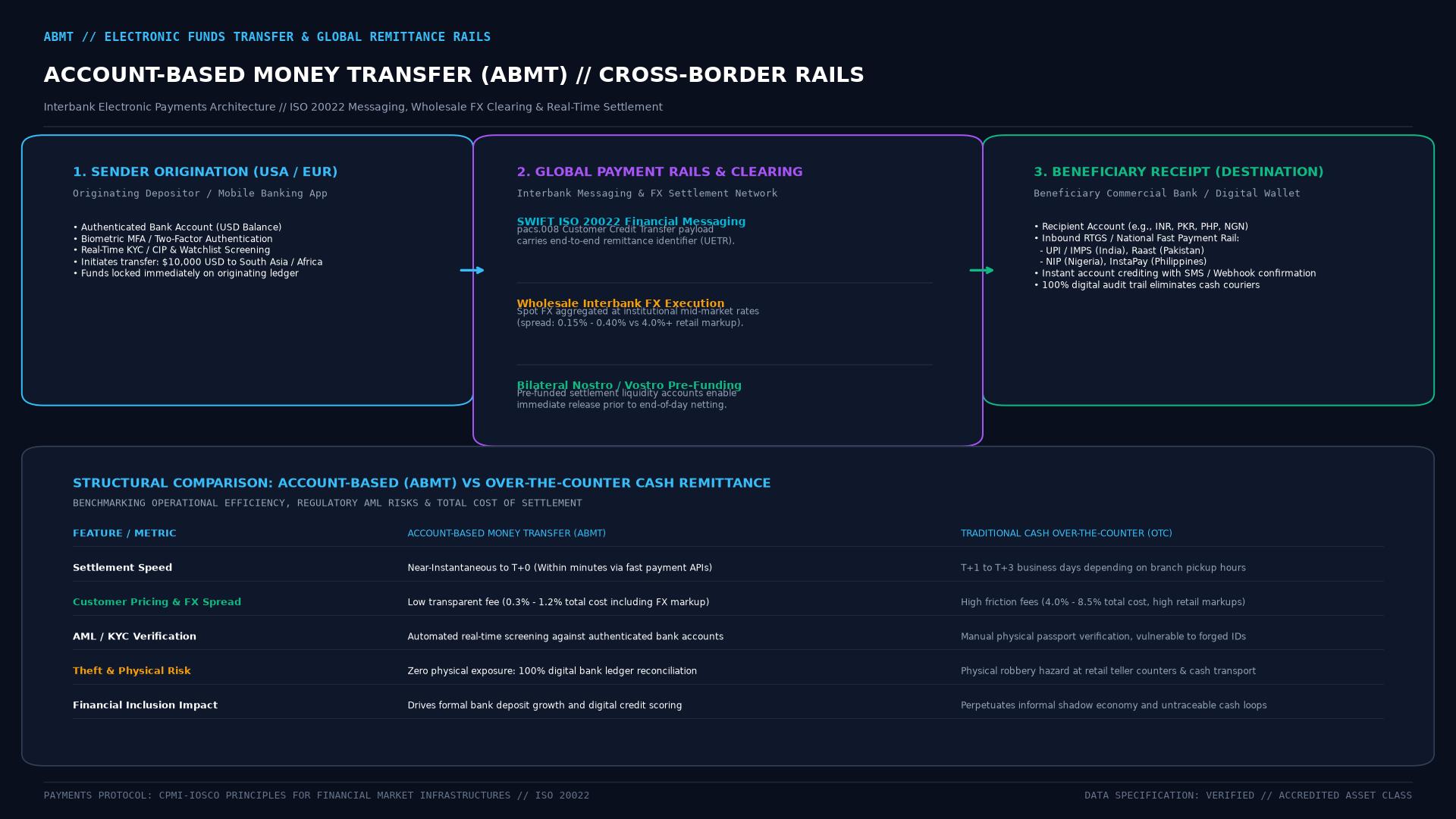 Figure: Account-Based Money Transfer (ABMT) global settlement infrastructure detailing end-to-end processing across sender authentication, SWIFT ISO 20022 messaging, wholesale FX netting, and local central bank fast-payment crediting.
Technical Mechanics of an Account-Based Money Transfer
An ABMT transaction routes through four mandatory operational stages to ensure financial finality, liquidity availability, and legal compliance:
1. Account Authentication and Identity Verification
Before initiating an ABMT, financial institutions run the transaction through automated Know Your Customer (KYC) and Office of Foreign Assets Control (OFAC) sanction screening engines. Both the sender’s International Bank Account Number (IBAN) or routing transit number and the beneficiary’s domestic bank identifier are validated against central bank clearing registries.
2. Messaging and Financial Data Standards
Global ABMT systems are standardizing on the ISO 20022 XML messaging protocol:
- pacs.008 (Customer Credit Transfer): Conveys the complete structured debtor and creditor details, transaction reference, remittance purpose code, and fee allocation.
- camt.054 (Bank-to-Customer Notification): Transmits automated credit advisories to the recipient bank upon settlement.
3. Foreign Exchange (FX) Conversion and Liquidity Management
In cross-border corridors, ABMT providers partner with correspondent liquidity banks or maintain pre-funded nostro/vostro accounts in destination countries. When a user sends $1,000 from the United States to Pakistan or India, the transfer system quotes a locked-in foreign exchange rate, converts the balance via wholesale liquidity pools, and instructs the local partner bank to disburse local currency (such as PKR or INR) immediately.
4. Clearinghouse Settlement
Domestically, ABMT flows route through national automated clearinghouses or real-time gross settlement (RTGS) systems:
- United States: Automated Clearing House (ACH) and FedNow.
- Eurozone: Single Euro Payments Area (SEPA) Credit Transfer and SEPA Instant.
- Developing Markets: Immediate Payment Service (IMPS/UPI) in India, Raast in Pakistan, and InstaPay in the Philippines.
Comparative Matrix: ABMT vs. Cash-to-Cash Remittances
| Operational Metric | Account-Based Money Transfer (ABMT) | Cash-to-Cash Counter Transfer | Cryptocurrency Transfer |
|---|---|---|---|
| Fund Source | Bank deposit, debit card, or verified wallet | Physical physical banknotes at agent kiosk | Self-custodial digital asset wallet |
| Settlement Speed | Seconds (instant rails) to 1 business day | 15 minutes to several hours | 2 to 30 minutes (blockchain finality) |
| Transaction Fees | Low (0.5% to 1.8% average corridor fee) | High (4.0% to 9.0% total markup + retail fee) | Variable network gas fee + off-ramp cost |
| Security & Fraud | High; tied to verified bank credentials | Moderate; vulnerable to fraud and theft | Moderate; irreversible if sent to wrong address |
| Financial Inclusion | Promotes formal banking adoption | Supports unbanked populations | Requires digital and cryptographic literacy |
Real-World Case Study: Expatriate Remittance Corridor Optimization
In 2024, a major international financial institution servicing the Gulf Cooperation Council (GCC) to South Asia remittance corridor upgraded its legacy cash remittance platform to an automated Account-Based Money Transfer infrastructure.
Expatriate workers in Dubai and Riyadh had previously paid an average of 4.8% in fees and waited up to 48 hours for relatives in Karachi and Lahore to travel to physical exchange branches to collect cash. By linking the remittance interface directly to Pakistan’s Raast instant payment rail and local commercial bank accounts, the new ABMT system achieved real-time settlement within 12 seconds at an average total cost of 1.1%. In its first full year of deployment, the platform processed over $420 million in volume, cutting consumer transfer costs by $15.5 million and eliminating counterfeit currency exposure.
Frequently Asked Questions (FAQ)
Can an ABMT payment be reversed once completed?
Due to immediate settlement on modern real-time gross payment rails, completed ABMT transfers are generally irreversible once credited to the beneficiary’s bank account. If an error occurs in the recipient account number, the sending bank must initiate a formal recall request through the destination clearinghouse, which requires the beneficiary’s authorization or proof of fraudulent conversion.
What information is required to initiate an international ABMT?
The sender must provide the recipient’s legal name as registered on their bank account, the financial institution name, the domestic bank transit/branch code, and the international account identifier (such as an IBAN, CLABE in Mexico, or account number with SWIFT/BIC code).
How does ABMT support regulatory compliance compared to cash transfers?
Account-Based Money Transfers create an unbroken, traceable digital audit trail linking verified bank account holders at both ends of the transaction. This transparency enables financial institutions to monitor transaction velocity, identify structuring patterns, and comply with Financial Action Task Force (FATF) guidelines far more effectively than cash transactions.
Ready to trade forex?
Open a free demo account with a regulated broker. Practice with virtual funds before risking real money.