ACH
ACH stands for Automated Clearing House, the primary electronic payments network in the United States that coordinates batch-processed direct deposits, vendor disbursements, and consumer bill debits between participating financial institutions.
What Does ACH Stand For?
ACH stands for Automated Clearing House. In commercial banking, treasury operations, and electronic payment infrastructure, the Automated Clearing House is the dominant nationwide electronic funds-transfer (EFT) computer network in the United States.
Governed by operating rules established by Nacha (formerly the National Automated Clearing House Association) and processed by two central operators, the Federal Reserve Banks (FedACH) and The Clearing House (Electronic Payments Network - EPN), the ACH network moves trillions of dollars annually. It coordinates the batch clearing of payroll direct deposits, consumer recurring bill payments, corporate B2B disbursements, peer-to-peer money transfers, and government benefit payments between thousands of depository financial institutions.
Unlike real-time wire systems (such as Fedwire or CHIPS) that process transactions individually with immediate gross settlement, ACH is an aggregated batch-processing system that prioritizes cost efficiency, low transaction fees, and high volume over instant execution.
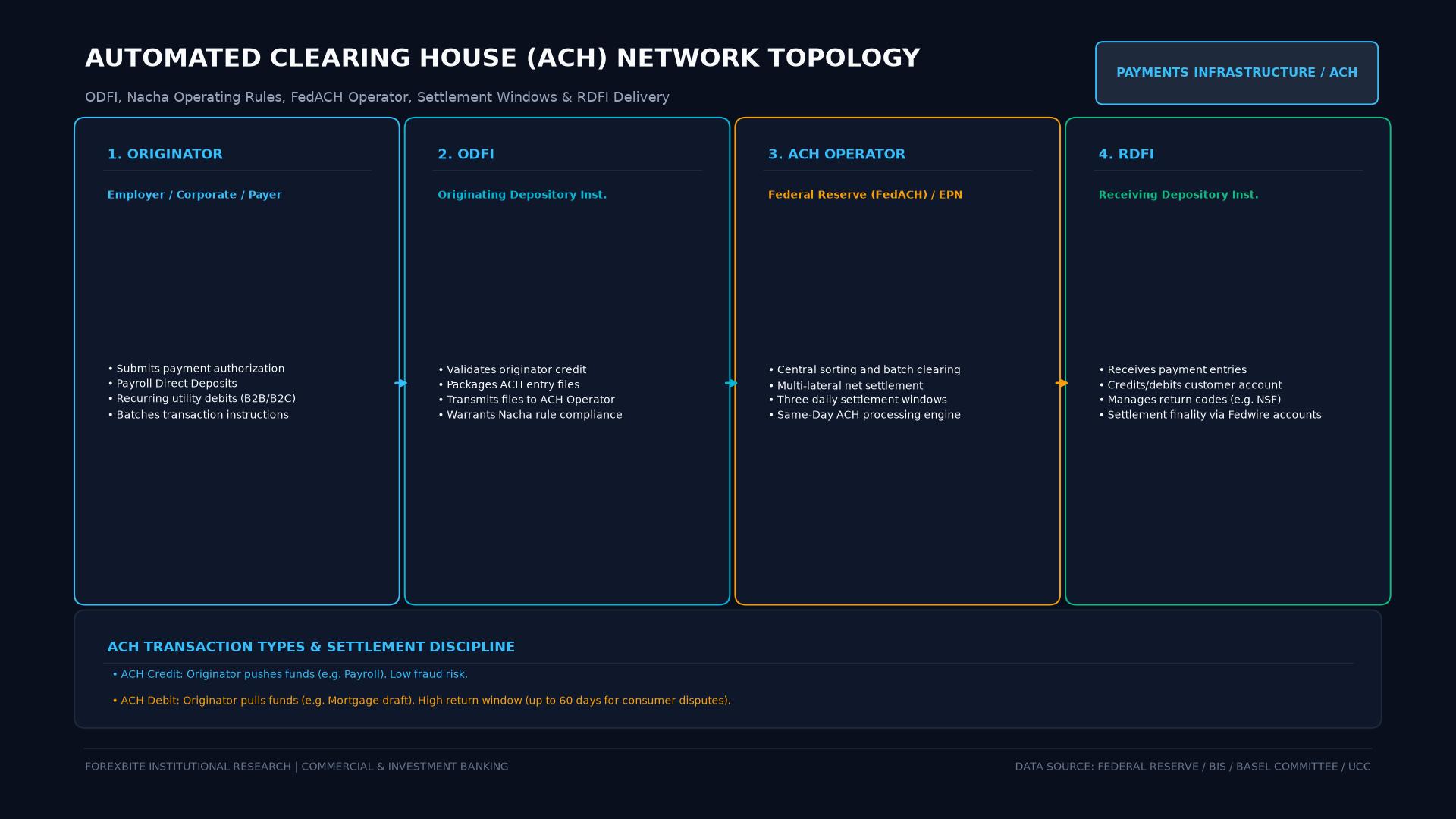 Figure: Four-party Automated Clearing House (ACH) network topology: ODFI, ACH Operator batch sorting, RDFI settlement, and return window timelines.
Technical Mechanics & Core Transaction Flows
The ACH ecosystem operates through two distinct transaction types: ACH Credits and ACH Debits:
1. ACH Credit (Push Transactions)
In an ACH Credit, the payer (Originator) instructs their bank to push funds out of their account directly into the payee’s bank account:
- Typical Use Cases: Payroll direct deposits, corporate vendor bill settlement, dividend payments, and IRS tax refunds.
- Settlement Timeline: Initiated by the sender; funds settle on the scheduled effective date (either same-day or 1 to 2 business days).
2. ACH Debit (Pull Transactions)
In an ACH Debit, the payee (Originator) is authorized to pull funds directly out of the payer’s account:
- Typical Use Cases: Monthly residential mortgage debits, utility bill autopay, insurance premiums, and consumer credit card autopayments.
- Authorization: Nacha rules mandate strict written, verbal, or digital authorization before an entity can originate an ACH debit against an individual or corporate account.
3. Settlement Windows: Standard ACH vs. Same Day ACH
Historically, ACH functioned as an overnight multi-day settlement network. Today, Nacha operates two primary delivery tiers:
- Standard ACH: Processed in overnight batches, settling within 1 to 2 business days.
- Same Day ACH: Operates across three daily clearing windows with a per-transaction limit of $1,000,000, enabling payroll processing, emergency bill settlements, and fast merchant funding within hours on business days.
Comparative Matrix: ACH vs. Wire Transfer vs. FedNow
| Operational Metric | Automated Clearing House (ACH) | Fedwire / Wire Transfer | FedNow / Real-Time Payments (RTP) |
|---|---|---|---|
| Processing Style | Batched electronic files | Real-Time Gross Settlement (RTGS) | Instant Gross Transaction-by-Transaction |
| Settlement Speed | 1 to 2 business days (Same Day: hours) | Instantaneous (typically under 15 mins) | Instant (within seconds, 24/7/365) |
| Transaction Cost | Negligible (pennies per transaction) | Expensive ($15 to $35 retail fee) | Very low (under $0.05 per transfer) |
| Reversibility | Reversible via formal return codes | Irreversible once settled at central bank | Irreversible once funds clear |
| Best Used For | Recurring payroll, B2B invoices, bills | High-value M&A, real estate closings | Urgent consumer P2P, instant payroll |
Real-World Case Study: Automated Payroll Failure Recovery
In September 2024, a national staffing agency employing 4,500 healthcare workers experienced an internal server crash at 4:00 PM on a Thursday, missing the standard ACH cutoff for Friday morning payroll direct deposit.
Facing catastrophic labor dissatisfaction and state regulatory penalties for late wage payment, the treasury team deployed Same Day ACH:
- IT restored systems by 8:30 AM on Friday and transmitted an aggregated $6.2 million payroll batch to their Originating Depository Financial Institution (ODFI).
- The ODFI formatted the batch under the Nacha SEC code PPD (Prearranged Payment and Deposit) and submitted the file during the FedACH morning Same Day window (10:30 AM ET cutoff).
- FedACH processed the file, netted settlement balances between the banks, and distributed the transaction advisories to over 280 Receiving Depository Financial Institutions (RDFIs) nationwide.
- By 1:00 PM local time on Friday, 100% of employees saw their net pay cleared in their respective checking accounts, averting a massive payroll compliance failure without incurring the exorbitant costs of 4,500 individual wire transfers.
Frequently Asked Questions (FAQ)
Can an ACH payment bounce or be returned?
Yes. If an account has non-sufficient funds, is closed, or contains an incorrect routing number, the receiving bank generates an ACH Return Code (such as R01 for Insufficient Funds, R02 for Account Closed, or R03 for Unable to Locate Account). Returns must be transmitted within strict time windows (generally 2 business days for commercial items, up to 60 days for unauthorized consumer debits under Regulation E).
How does ACH handle fraud protection for businesses?
Unlike consumers who enjoy broad statutory protections under Federal Reserve Regulation E, businesses have only a 24-hour return window for unauthorized ACH debits. Corporate treasuries protect accounts by establishing ACH Debit Blocks (blocking all electronic debits) or ACH Positive Pay (authorizing transactions only from pre-approved vendor identification lists).
What is an ACH Routing Number?
An ACH routing number (also known as the American Bankers Association or ABA routing transit number) is a nine-digit numerical code printed at the bottom of checks that uniquely identifies the specific financial institution where an account is held.
Ready to trade forex?
Open a free demo account with a regulated broker. Practice with virtual funds before risking real money.