Settlement
The final, legally binding phase of a financial transaction in which securities or foreign exchange are transferred to the buyer and equivalent payment is delivered to the seller, permanently discharging all contractual obligations.
What Is Settlement?
In global capital markets, settlement is the conclusive, irrevocable stage of a financial trade. While trade execution represents the legal commitment to buy or sell an asset at an agreed price, and clearing represents the subsequent matching, verification, and netting of commitments, settlement represents the actual, physical or electronic fulfillment of the contract.
During settlement:
- The seller delivers the underlying securities, commodities, or base currency to the buyer.
- The buyer transfers the agreed monetary payment (counter-value) to the seller.
- The transaction is recorded as finalized on official central depositories or central bank reserve ledgers, extinguishing counterparty credit exposure.
Settlement finality is legally protected under international insolvency frameworks, ensuring that once funds or securities are credited, the transfer cannot be rescinded or unwound even if one of the institutions collapses into bankruptcy minutes later.
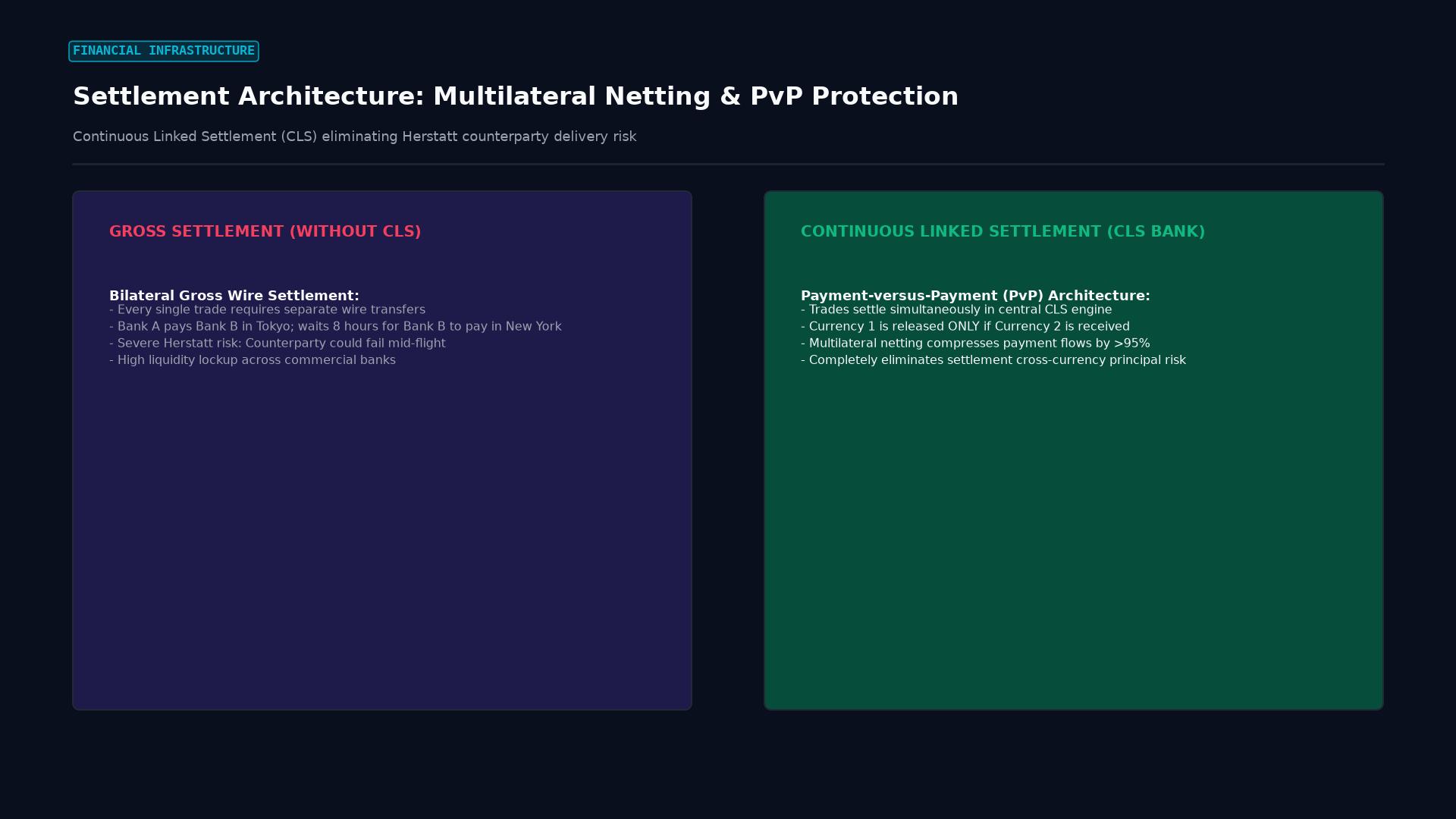 Figure: Systemic risk mitigation: Continuous Linked Settlement (CLS) payment-versus-payment protocol eliminating cross-currency Herstatt settlement risk.
Settlement Methodologies: Gross vs. Net
Modern clearinghouses and financial settlement systems process transactions using two primary structural models:
1. Real-Time Gross Settlement (RTGS)
- Mechanics: Each transaction is settled individually on a continuous, transaction-by-transaction basis immediately upon entry into the system.
- Liquidity Demand: High. Participating banks must maintain significant central bank reserve balances to fund gross outbound payments.
- Risk Profile: Zero intraday credit accumulation. Examples include Fedwire (US), TARGET2 (Eurozone), and CHAPS (UK).
2. Multilateral Net Settlement (CNS)
- Mechanics: Transactions are accumulated over a trading day. At designated cutoff intervals, matching obligations are mathematically netted into a single net debit or credit per participant.
- Liquidity Demand: Low. Reduces total cash transfer volume by up to 90% to 95%.
- Risk Profile: Credit exposure accumulates throughout the day until final end-of-cycle settlement occurs.
Elimination of Settlement Risk: DvP and PvP Frameworks
To prevent one party from delivering an asset without receiving payment, international standards mandate synchronized exchange mechanisms:
          SYNCHRONIZED SETTLEMENT MECHANISMS

  SECURITIES MARKETS:                        FOREIGN EXCHANGE MARKETS:
  Delivery-versus-Payment (DvP)              Payment-versus-Payment (PvP)

   [ Securities Transferred ]                 [ Leg 1: US Dollars Paid ]
              ▲                                           ▲
              │   SIMULTANEOUS &                          │   SIMULTANEOUS &
              │     CONDITIONAL                           │     CONDITIONAL
              ▼                                           ▼
   [ Cash Payment Delivered ]                 [ Leg 2: Euros Delivered ]
(Settled via DTCC / Euroclear) (Settled via CLS Bank)- Delivery-versus-Payment (DvP): Used in equities and debt instruments. Securities transfer occurs if, and only if, cash payment is verified.
- Payment-versus-Payment (PvP): Used in wholesale foreign exchange. The delivery of Currency A occurs if, and only if, Currency B is simultaneously transferred into the clearing system, eliminating principal settlement risk.
Physical Delivery vs. Cash Settlement
| Dimension | Physical Delivery Settlement | Cash Settlement (Mark-to-Market) |
|---|---|---|
| Asset Transfer | Actual physical transfer of title, commodities, or bank deposits | No underlying asset moves; purely financial cash difference |
| P&L Realization | Full purchase price exchanged for physical asset | Account balance credited or debited by net profit or loss |
| Market Segment | Wholesale interbank FX, commercial commodities, physical bonds | Retail margin FX, index futures, cash-settled options |
| Operational Burden | Extreme (vault storage, shipping, nostro accounts, RTGS wires) | Minimal (algorithmic ledger entry in electronic trading platform) |
| Default Risk | Requires strict DvP / PvP protocols to prevent asset theft | Handled through variation margin and broker risk engines |
Real-World Institutional Case Study: The 1974 Bankhaus Herstatt Collapse
On June 26, 1974, German banking regulators abruptly revoked the banking license of Bankhaus Herstatt, a private bank in Cologne, following catastrophic foreign exchange losses.
       THE HERSTATT SETTLEMENT DISASTER (JUNE 26, 1974)

 Frankfurt Business Hours (15:30 CET):
 German Counterparties deliver DEM 618 Million to Herstatt via local clearing.

 Interbank Shock (16:00 CET):
 German Regulators force Herstatt into liquidation; all accounts frozen.

 New York Morning Hours (10:30 EST):
 Herstatt's correspondent bank halts all outgoing USD payments.

 The Aftermath:
 New York counterparty banks suffered complete loss of their USD 156 Million
 without ever receiving their purchased Dollars.
The Herstatt disaster exposed the fatal vulnerability of cross-time-zone settlement. Because Frankfurt closed before New York opened, European banks released Deutsche Marks hours before receiving U.S. Dollars. This time-lag vulnerability—officially termed Herstatt Risk or Cross-Currency Settlement Risk—shocked global financial authorities and directly catalyzed two historic transformations:
- The creation of the Basel Committee on Banking Supervision (BCBS).
- The establishment of Continuous Linked Settlement (CLS Bank) in 2002, which introduced Payment-versus-Payment (PvP) settlement across major global currencies, virtually eliminating FX settlement defaults.
The Modern Migration: The $T+1$ and $T+0$ Settlement Era
For decades, standard financial settlement operated on a $T+5$ or $T+3$ basis, eventually compressing to $T+2$ across global equities and foreign exchange.
In May 2024, the U.S. Securities and Exchange Commission (SEC) and Canadian regulators officially mandated a $T+1$ settlement cycle for equities, corporate debt, and municipal securities. This accelerated timeframe brought significant benefits and operational friction:
- Collateral Reduction: Compressed the clearinghouse margin required from brokerages, freeing up billions in capital.
- FX Synchronization Headwinds: Foreign asset managers buying U.S. equities must now execute foreign exchange conversions on a tight intraday deadline to fund stock settlement within 24 hours, often forcing them to trade outside liquid European hours or utilize same-day FX swaps.
Frequently Asked Questions
What happens if a financial settlement fails?
A settlement fail occurs when one counterparty fails to deliver securities or cash by the designated settlement date. While not an immediate insolvency default, the failing party is penalized with daily fail fees (such as TMPG fail charges in the U.S. Treasury market), must compensate the counterparty for overdraft interest, and may be subjected to mandatory “buy-in” procedures where the clearinghouse purchases the replacement asset in the open market at the failing party’s expense.
Why do spot forex trades take two days ($T+2$) to settle?
The historical reason for the $T+2$ spot convention stems from the era of physical telex communications, paper checks, and cross-border bank clearance. It allowed banks sufficient time to confirm transactions across global time zones (e.g., Tokyo, London, and New York) and transmit telegraphic transfer instructions through correspondent banking networks. While modern electronics can settle instantly, $T+2$ remains the international standard to facilitate multilateral netting and liquidity management.
How does CLS Bank eliminate settlement risk in foreign exchange?
CLS operates a specialized settlement engine connected directly to the RTGS systems of 18 major central banks. Using a Payment-versus-Payment (PvP) protocol, CLS simultaneously debits the selling currency account and credits the buying currency account across multi-currency member accounts. If one side fails to fund its commitment, the settlement does not execute, and both parties retain their original capital.
Ready to trade forex?
Open a free demo account with a regulated broker. Practice with virtual funds before risking real money.