ABN
ABN stands for Algemene Bank Nederland, a historic Dutch commercial bank that merged in 1991 to form ABN AMRO Bank, a global financial institution renowned for its dominant footprint in international trade financing, foreign exchange, and global derivatives clearing.
What Does ABN Stand For?
ABN stands for Algemene Bank Nederland (General Bank of the Netherlands). In global financial markets, banking history, and institutional trading, ABN is most widely recognized as the foundational predecessor of ABN AMRO Bank N.V., one of Europe’s largest banking groups headquartered in Amsterdam.
Originally formed in 1964 through the merger of the Nederlandsche Handel-Maatschappij (Netherlands Trading Society, established in 1824 by King William I) and De Twentsche Bank, ABN played a central role in financing international maritime trade, agricultural commodities, and cross-border currency exchange. In 1991, ABN executed a landmark merger with Amsterdam-Rotterdam Bank (AMRO Bank) to create ABN AMRO, creating a global powerhouse across commercial banking, private wealth management, and securities execution.
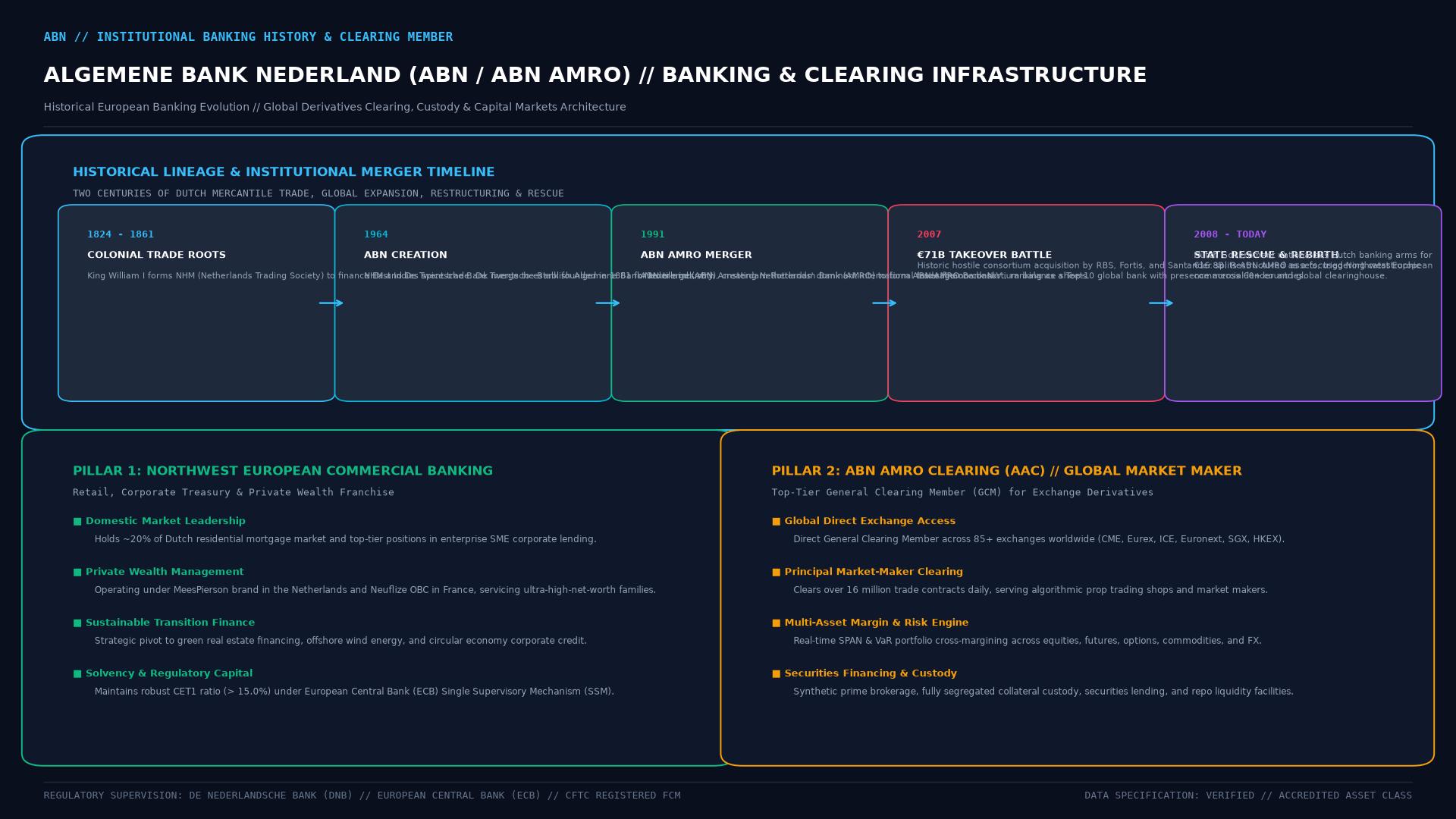 Figure: Algemene Bank Nederland (ABN / ABN AMRO) bicentennial evolutionary timeline and modern dual-pillar structure: Northwest European commercial banking and top-tier global derivatives clearing member (ABN AMRO Clearing).
Technical Significance: ABN AMRO Clearing in Global Markets
While retail consumers recognize ABN AMRO as a Dutch universal bank, financial market professionals and proprietary trading desks interact daily with ABN AMRO Clearing:
1. General Clearing Member (GCM) Dominance
ABN AMRO Clearing is one of the world’s top three multi-asset general clearing firms, processing over 18 million trades daily across more than 85 major financial derivatives and commodity exchanges globally (including CME, ICE, Eurex, Euronext, and SGX).
2. Third-Party Clearing and Risk Intermediation
For high-frequency trading (HFT) firms, quantitative market makers, and systematic hedge funds, ABN AMRO Clearing acts as the central risk counterparty:
Trading Desk / Fund ---> ABN AMRO Clearing (GCM) ---> Central Counterparty Clearinghouse (CCP)The firm provides real-time intraday margin monitoring, collateral management, and multi-currency liquidity facilities, ensuring that broker-dealers meet continuous margin calls at central clearinghouses without systemic settlement defaults.
3. Prime Brokerage and FX Liquidity
In foreign exchange markets, ABN AMRO operates specialized prime brokerage and foreign exchange settlement lines, granting institutional clients synthetic liquidity access and netting services to reduce counterparty credit risks.
The 2007 Consortium Acquisition and 2008 Restructuring
The name ABN is forever associated with a defining moment in modern banking history:
- The Record Buyout: In October 2007, a consortium comprising Royal Bank of Scotland (RBS), Fortis, and Banco Santander acquired ABN AMRO for €71 billion ($98 billion), the largest bank takeover in global history.
- The Unwinding: The consortium fragmented the bank’s assets. RBS absorbed wholesale investment banking, Fortis took Dutch retail operations, and Santander acquired Brazilian operations (Banco Real).
- The Solvency Crisis: The acquisition closed immediately before the 2008 global financial crisis. Overpaying for ABN AMRO severely depleted the capital reserves of RBS and Fortis, forcing the British government to inject £45 billion into RBS and the Dutch government to rescue and nationalize the Dutch components of Fortis and ABN AMRO for €16.8 billion.
- Relaunch: The bank was restructured into a focused, well-capitalized commercial bank serving retail, private banking, and corporate clients in Northwestern Europe, returning to the Euronext Amsterdam stock exchange through an IPO in November 2015.
Comparative Matrix: Global Clearing Broker Roles
| Institutional Function | General Clearing Member (e.g., ABN AMRO Clearing) | Executing Broker | Prime Broker |
|---|---|---|---|
| Primary Mandate | Guarantees trade settlement with CCP clearinghouses | Executes buy/sell orders in the order book | Provides multi-asset financing, leverage, and custody |
| Capital Requirement | Massive balance sheet with CCP default fund contributions | Modest; regulatory minimum capital for trade routing | Substantial balance sheet for securities lending |
| Client Type | Market makers, algorithmic trading desks, proprietary funds | Institutional funds, corporations, retail traders | Long/short equity hedge funds, macro fund managers |
| Revenue Model | Per-contract clearing fees and interest on margin float | Commissions per share / per lot executed | Margin loan interest, borrowing fees, swap financing |
Real-World Case Study: Market Volatility Buffer in March 2020
During the extreme financial volatility of the March 2020 COVID-19 panic, equity index and commodity futures volumes surged to historic records. Individual proprietary trading desks experienced margin calls multiplying fivefold within a 48-hour trading window.
ABN AMRO Clearing’s real-time risk engine monitored thousands of trading portfolios across global exchanges. While a single non-clearing US client engaged in volatility dispersion strategies experienced catastrophic losses, ABN AMRO’s pre-funded margin buffers and automated liquidating algorithms contained the default. The firm absorbed the client shortfall without breaching central clearinghouse covenants, demonstrating the critical role global clearing members serve as systemic shock absorbers during liquidity crises.
Frequently Asked Questions (FAQ)
What is the relationship between ABN and AMRO?
ABN represented Algemene Bank Nederland and AMRO represented Amsterdam-Rotterdam Bank. The two Dutch financial institutions operated independently until their landmark merger in 1991, which created ABN AMRO Bank N.V.
Is ABN AMRO an active foreign exchange dealer?
Yes. ABN AMRO provides spot, forward, FX swap, and currency options execution for corporate treasuries, institutional investors, and sovereign wealth entities, specializing particularly in G10 currencies and European trade settlement.
Why is ABN AMRO Clearing critical to non-bank financial institutions?
Most hedge funds and electronic market makers cannot maintain direct membership at global clearinghouses due to strict regulatory balance sheet rules requiring hundreds of millions of euros in dedicated capital. ABN AMRO Clearing provides the institutional conduit that allows these firms to trade on exchanges worldwide under its regulatory umbrella.
Ready to trade forex?
Open a free demo account with a regulated broker. Practice with virtual funds before risking real money.