ABOM
ABOM stands for Association of Bank Officers Malaysia, a registered trade union established in 1962 that represents executive, supervisory, and managerial personnel across commercial and Islamic banking institutions in Malaysia.
What Does ABOM Stand For?
ABOM stands for Association of Bank Officers Malaysia (Persatuan Pegawai-Pegawai Bank Malaysia). In Southeast Asian financial systems and employment regulation, ABOM is the primary statutory trade union representing supervisory officers, assistant branch managers, credit analysts, and operational executives working within Malaysia’s commercial and Islamic banking sector.
Established in October 1962 under Malaysia’s Trade Unions Act, ABOM was created to provide collective bargaining representation for mid-level financial professionals who fell outside the scope of non-executive clerical labor unions like the National Union of Bank Employees (NUBE). Over six decades, ABOM has played an instrumental role in shaping banking compensation structures, dispute resolution frameworks, and labor standards across one of Southeast Asia’s most prominent financial and Islamic finance hubs.
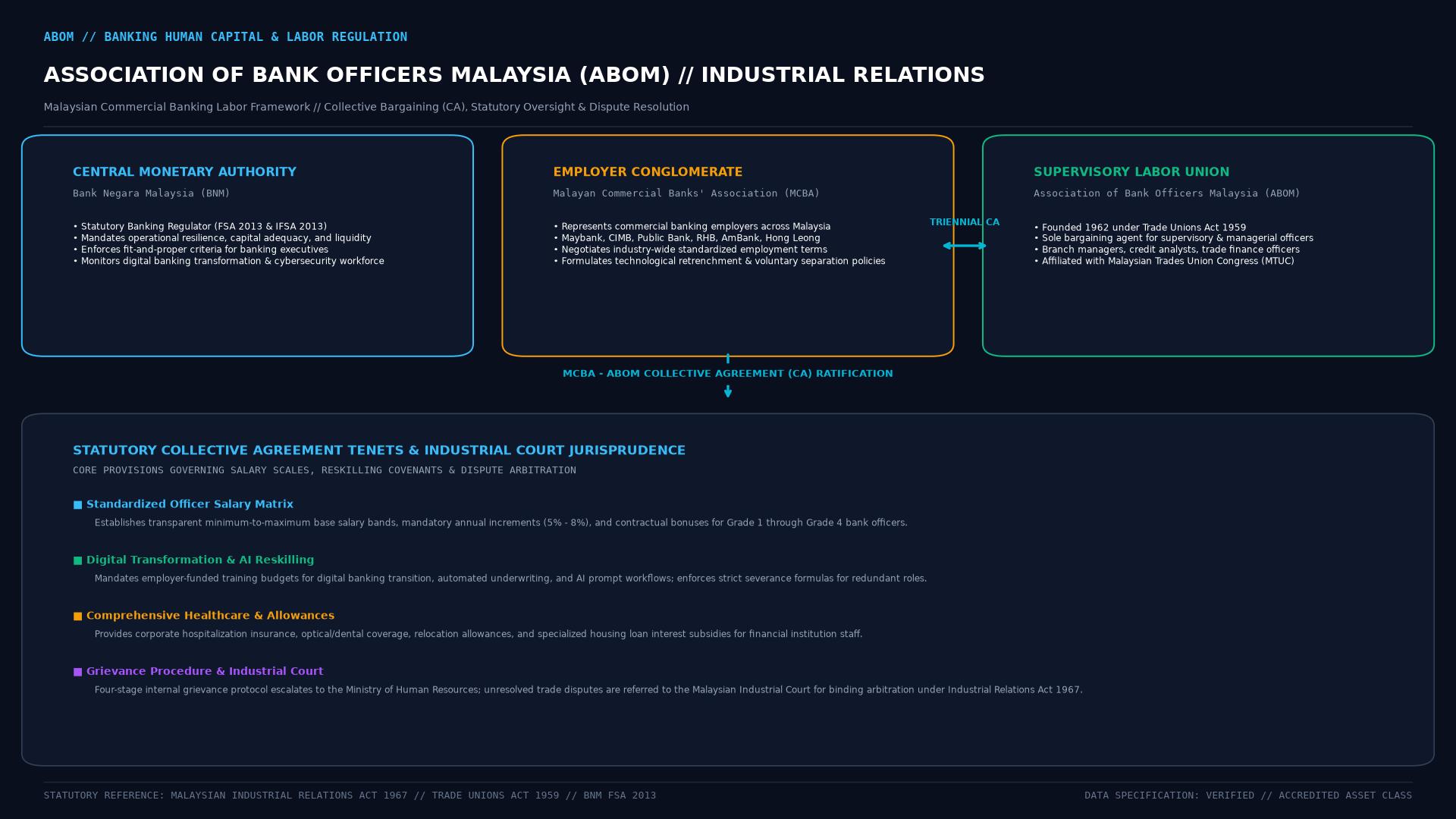 Figure: Industrial relations framework in Malaysian commercial banking showing tripartite interactions between Bank Negara Malaysia (BNM), the Malayan Commercial Banks’ Association (MCBA), and the Association of Bank Officers Malaysia (ABOM).
Technical Mechanics: Collective Bargaining & Industrial Relations
ABOM functions within a highly structured tripartite industrial relations framework governing Malaysia’s financial institutions:
1. The Triennial Collective Agreement (CA)
Every three years, ABOM negotiates a comprehensive Collective Agreement with the Malayan Commercial Banks’ Association (MCBA), which represents domestic and international commercial bank employers (such as Maybank, CIMB, Public Bank, Standard Chartered Malaysia, and HSBC Malaysia):
- Wage Adjustments & Salary Bands: Standardized salary increments, cost of living allowances (COLA), and performance bonuses tied to inflation and economic output.
- Housing & Personal Financing: Preferential staff loan rates on residential mortgages and automotive financing, a staple benefit for bank officers in the region.
- Medical & Social Protections: Comprehensive hospitalization coverage, maternity allowances, and retirement severance schemes supplementing the statutory Employees Provident Fund (EPF).
2. Digital Transformation and Reskilling Covenants
With Bank Negara Malaysia’s accelerated drive toward cashless payments, digital banking licenses, and automated credit scoring, ABOM negotiates protective transition protocols for bank officers whose traditional manual functions face technological displacement. These agreements mandate corporate funding for officer retraining into compliance, AML investigations, wealth management, and cybersecurity specializations.
3. Grievance Mechanisms and Dispute Arbitration
When bilateral disputes arise regarding officer appraisals, disciplinary procedures, or branch restructuring, ABOM represents its members through formal conciliation at the Department of Industrial Relations under the Ministry of Human Resources. If conciliation fails, disputes escalate to the Industrial Court of Malaysia, whose binding awards possess statutory enforcement authority.
Comparative Matrix: Financial Labor Bodies in Malaysia
| Labor Body | Target Membership Scope | Primary Role & Legal Mandate | Affiliated Employer Counterpart |
|---|---|---|---|
| Association of Bank Officers Malaysia (ABOM) | Junior executives, bank officers, branch supervisors | Collective bargaining for officer-grade professional staff | Malayan Commercial Banks’ Association (MCBA) |
| National Union of Bank Employees (NUBE) | Clerical, customer service, and non-executive staff | Collective bargaining for non-executive banking workers | Malayan Commercial Banks’ Association (MCBA) |
| Association of Commercial Banks (ABM) | Corporate banking institutions and licensed banks | Commercial policy coordination and consumer education | Bank Negara Malaysia / Financial Consumers |
| Association of Islamic Banking Institutions Malaysia (AIBIM) | Islamic licensed commercial and investment banks | Shariah-compliant industry standards and policy promotion | Shariah Advisory Council / Regulators |
Real-World Case Study: Banking Officer Digital Reskilling Accord
In 2023, following the issuance of Malaysia’s initial digital banking consortium licenses by Bank Negara Malaysia, brick-and-mortar retail banks announced plans to consolidate physical branch footprints across several regional states. Over 1,200 branch operations officers faced potential redundancy as routine cash handling and counter verification transitioned to self-service portals and mobile applications.
ABOM initiated structured negotiations with the MCBA under the auspices of the Ministry of Human Resources. Rather than resorting to retrenchments or industrial action, the parties executed a supplementary collective accord. The agreement established a dedicated RM 25 million banking transformation retraining fund funded by employer banks. Over 90% of affected officers completed certified training pathways in anti-financial-crime compliance, digital mortgage underwriting, and customer relationship management, successfully transitioning into expanding specialized divisions without salary loss.
Frequently Asked Questions (FAQ)
Can senior bank managers and division heads join ABOM?
Under Section 27 of Malaysia’s Trade Unions Act, managerial personnel exercising confidential or managerial executive authority (such as branch directors, division heads, and HR directors) are prohibited from union membership to prevent conflicts of interest during collective bargaining. ABOM represents intermediate supervisory and junior executive officers.
What is the role of Bank Negara Malaysia in relation to ABOM?
Bank Negara Malaysia (the central bank) regulates financial stability, capital requirements, and licensing for banks, rather than labor relations directly. However, BNM policies on branch automation, governance standards, and fit-and-proper criteria directly shape the operational environment within which ABOM negotiates.
How does ABOM handle the distinction between conventional and Islamic bank officers?
ABOM represents officers in both conventional commercial banks and Islamic banking subsidiaries. The core employment covenants, compensation bands, and labor protections apply uniformly, with specific provisions accommodating Shariah compliance certifications and specialized Islamic banking training curricula.
Ready to trade forex?
Open a free demo account with a regulated broker. Practice with virtual funds before risking real money.