Arbitrage
Arbitrage is the simultaneous purchase and sale of equivalent assets or currency pairs across different markets or venues to exploit temporary price discrepancies for a near-riskless profit. In foreign exchange, common variants include triangular arbitrage, spatial arbitrage, and covered interest arbitrage.
What Is Arbitrage in Financial Markets?
Arbitrage represents one of the foundational pricing mechanisms in modern economics. At its core, the principle is straightforward: buy an asset in one venue where it trades at a discount, and simultaneously sell the exact same asset in another venue where it commands a premium. The difference between the two prices, minus transaction fees, constitutes pure profit.
In an efficient market, identical assets should trade at identical prices regardless of where the transaction takes place. This concept, known as the Law of One Price, does not hold true by magic. It holds because arbitrageurs constantly scan global networks, spot pricing anomalies, and execute offsetting trades that force prices back into alignment. When an arbitrageur buys the cheaper asset, their demand nudges its price upward. When they sell the pricier asset, the selling pressure pushes its price downward. Through this aggressive activity, discrepancies vanish within milliseconds.
In modern foreign exchange markets, retail manual arbitrage has virtually ceased to exist. High-frequency trading (HFT) firms, algorithmic market makers, and institutional banks deploy microwave transmission towers, fiber-optic cross-connects, and collocated servers located within data centers like Equinix LD4 in London and NY4 in New Jersey to capture micro-pip discrepancies before retail quote feeds even register them.
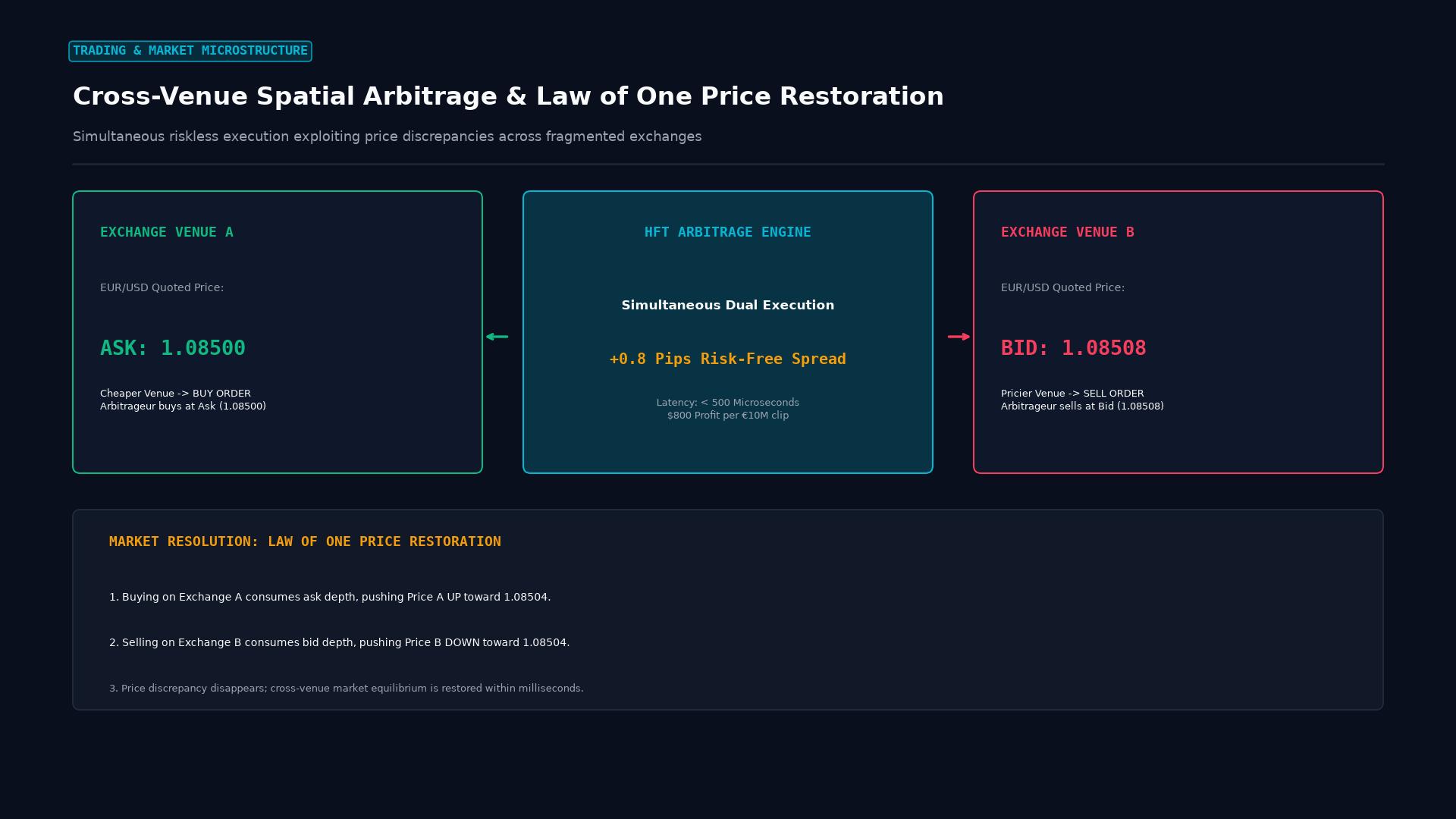 Figure: High-frequency spatial arbitrage mechanics: simultaneous dual execution exploiting fleeting price dislocations across fragmented venues to restore market equilibrium.
Types of Forex Arbitrage
Currency markets feature several distinct forms of arbitrage, ranging from pure mechanical pricing imbalances to complex interest rate calculations.
Triangular Arbitrage
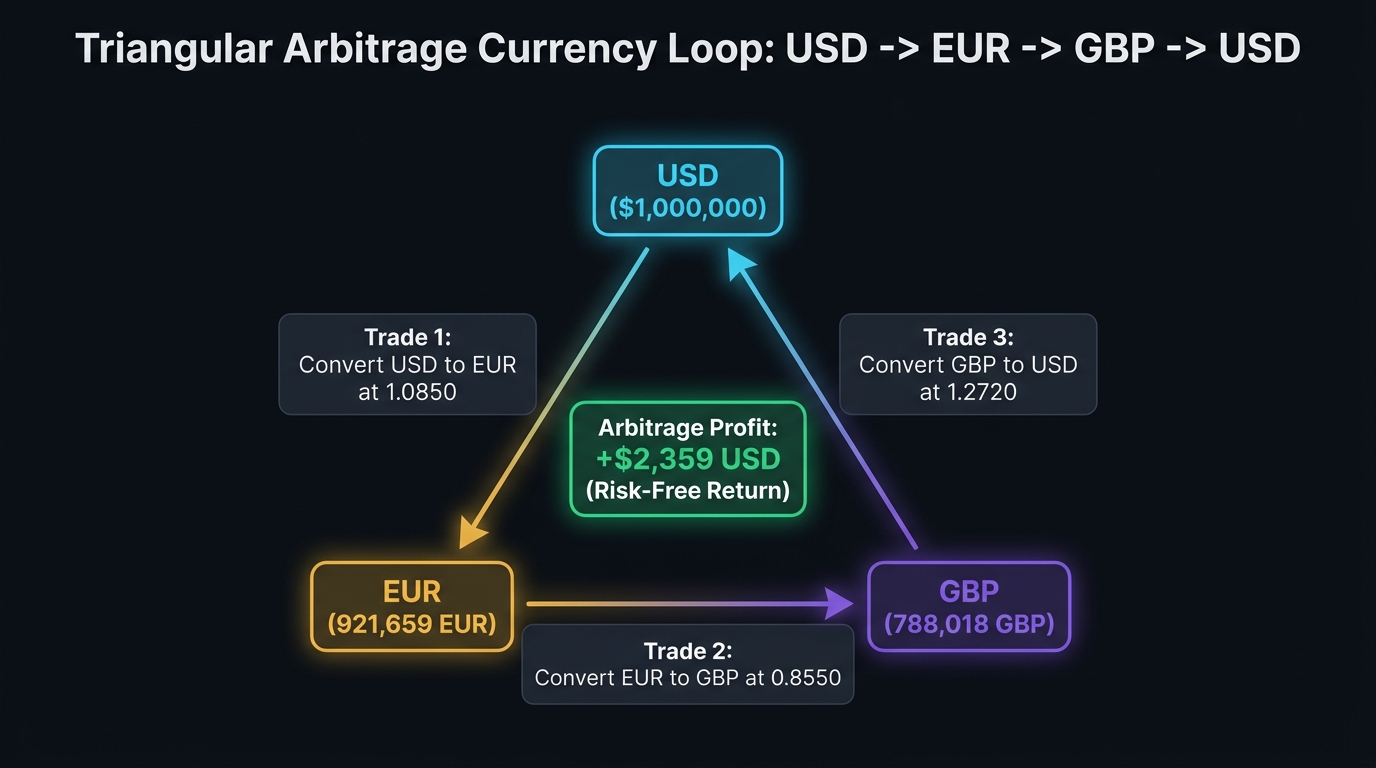
Triangular arbitrage occurs when the exchange rate between three currencies falls out of mathematical balance. Because currencies trade in pairs, the synthetic rate formed by two pairs must equal the quoted rate of the third cross pair.
Consider three currency pairs: EUR/USD, GBP/USD, and EUR/GBP. If the direct market quote for EUR/GBP differs from the implied cross-rate calculated by dividing EUR/USD by GBP/USD, a risk-free circular trade exists:
- Convert USD into EUR at the EUR/USD offer rate.
- Convert that EUR into GBP at the EUR/GBP offer rate.
- Convert that GBP back into USD at the GBP/USD bid rate.
If the ending USD balance exceeds the initial principal after paying the bid-ask spreads and liquidity taker fees on all three transactions, the trader locks in an instant profit.
Covered Interest Arbitrage (CIA)
Covered interest arbitrage links the spot currency market, the forward currency market, and international money market interest rates. According to the theory of Covered Interest Parity (CIP), the interest rate differential between two countries should equal the forward premium or discount on their exchange rate.
When forward contracts deviate from this theoretical equilibrium, an institutional desk can borrow funds in a low-interest currency, swap them into a higher-yielding currency at the current spot rate, invest the proceeds in risk-free sovereign debt, and simultaneously sell a forward contract to lock in the future conversion rate back to the borrowed currency. Because the future exchange rate is locked in advance with a binding contract, market risk is eliminated. The investor earns a return higher than domestic rates without taking exchange rate risk.
Latency Arbitrage
Latency arbitrage exploits differences in the speed at which price updates reach different execution venues or retail brokers. A proprietary trading firm receiving direct interbank tier-1 price feeds (from platforms like EBS or Currenex) may spot a price shift 50 to 100 milliseconds before a slow retail broker updates its client terminal. The firm fires an order into the lagging broker at the stale price, expecting an immediate profit when the broker catches up.
Retail brokerages aggressively combat latency arbitrage by employing virtual dealer plugins, slippage parameters, and asymmetric execution delays. Most broker user agreements strictly ban this practice and cancel profits generated through quote delays.
A Practical Triangular Arbitrage Example
Let us examine the math behind a theoretical triangular mismatch between USD, EUR, and GBP.
Assume an institutional desk observes the following spot rates:
- EUR/USD: 1.0850 (1 EUR buys 1.0850 USD)
- GBP/USD: 1.3000 (1 GBP buys 1.3000 USD)
- EUR/GBP: 0.8320 (1 EUR buys 0.8320 GBP)
To test for arbitrage, calculate the synthetic cross-rate: $$ \text{Synthetic EUR/GBP} = \frac{\text{EUR/USD}}{\text{GBP/USD}} = \frac{1.0850}{1.3000} = 0.834615 $$
The direct market quote for EUR/GBP is 0.8320, while the synthetic cross rate is 0.8346. The market is underpricing EUR relative to GBP.
Execution with $1,000,000 capital:
- Sell $1,000,000 to buy EUR at 1.0850: $$ $1,000,000 / 1.0850 = €921,658.98 $$
- Sell €921,658.98 to buy GBP at 0.8320: $$ €921,658.98 \times 0.8320 = £766,820.27 $$
- Sell £766,820.27 to buy USD at 1.3000: $$ £766,820.27 \times 1.3000 = $996,866.35 $$
In this scenario, trading in this direction yields a loss of $3,133.65. Reversing the circular flow:
- Sell $1,000,000 to buy GBP at 1.3000: $$ $1,000,000 / 1.3000 = £769,230.77 $$
- Sell £769,230.77 to buy EUR at the inverted cross rate: $$ £769,230.77 / 0.8320 = €924,556.21 $$
- Sell €924,556.21 to buy USD at 1.0850: $$ €924,556.21 \times 1.0850 = $1,003,143.49 $$
Gross profit: $3,143.49 on a $1,000,000 cycle. In real trading, spreads across all three legs typically eat 1.5 to 2.5 pips, leaving a thin net margin that requires automated millisecond execution to capture.
Realities for Retail Traders
While the concept of riskless profit captivates beginners, retail traders face insurmountable structural hurdles when attempting arbitrage:
- Execution latency: Interbank algos operate in microseconds (millionths of a second). Retail internet connections and MetaTrader bridges introduce 20 to 100 milliseconds of latency.
- The spread hurdle: Retail accounts pay wider spreads than tier-1 prime brokers. A retail spread of 0.8 pips on EUR/USD wipes out triangular opportunities that exist within 0.2-pip interbank bands.
- Slippage and rejection: Price quotes can change while the order travels over the network. If two legs fill and the third slips or rejects, the trader holds unhedged currency risk.
- Broker restrictions: “Arbitrage software” marketed online frequently leads to account closure or trade cancellation under broker terms of service.
Key Takeaways
- Arbitrage exploits price discrepancies of identical or equivalent instruments across different markets.
- In forex, the main variants are triangular arbitrage, covered interest arbitrage, and latency arbitrage.
- Arbitrageurs serve an essential market role by restoring equilibrium and keeping prices aligned globally.
- Real-world execution demands sub-millisecond network speeds, zero-latency co-location, and institutional-grade liquidity.
- Retail traders rarely succeed at direct price arbitrage due to broker spreads, commission costs, and network latency.
FAQ
Can retail traders make money with automated arbitrage software? Generally, no. Commercial “arbitrage bots” sold to retail traders attempt to exploit latency between broker price feeds. Regulated brokers detect these rapid round-trip patterns immediately through automated server monitoring and will widen spreads, apply artificial delays, or void trades according to their toxic flow policies.
What is the difference between arbitrage and speculation? Speculation involves taking on market risk by forecasting that a price will move up or down over time. Arbitrage involves locking in offsetting positions simultaneously to harvest a known mathematical mispricing, theoretically carrying zero market directional risk.
Does triangular arbitrage still occur in today’s markets? Yes, but discrepancies last for mere fractions of a millisecond. High-frequency algorithmic systems constantly monitor billions of price combinations, capturing anomalies before human eyes or standard retail charting platforms can register the change.
Ready to trade forex?
Open a free demo account with a regulated broker. Practice with virtual funds before risking real money.