Accredited Investor
An Accredited Investor is an individual or business entity authorized under securities regulations to invest in complex, unregistered private offerings such as venture capital, private equity, and hedge funds based on meeting defined financial thresholds or professional expertise criteria.
What Is an Accredited Investor?
An Accredited Investor is an individual or legal institutional entity legally permitted under securities regulatory frameworks—most notably the U.S. Securities and Exchange Commission (SEC) under Rule 501 of Regulation D—to invest in unregistered, exempt securities offerings.
In standard public financial markets, securities must be registered with regulatory authorities, demanding extensive disclosures, prospectus delivery, and recurring public filings (such as 10-K and 10-Q reports).
However, private investment offerings—including venture capital funding rounds, private equity syndications, hedge funds, real estate syndicates, and angel investments—bypass standard registration requirements. Regulatory bodies establish accredited investor qualification criteria on the principle that participants possess sufficient financial net worth, income stability, or professional financial acumen to withstand total loss of capital without requiring consumer regulatory protections.
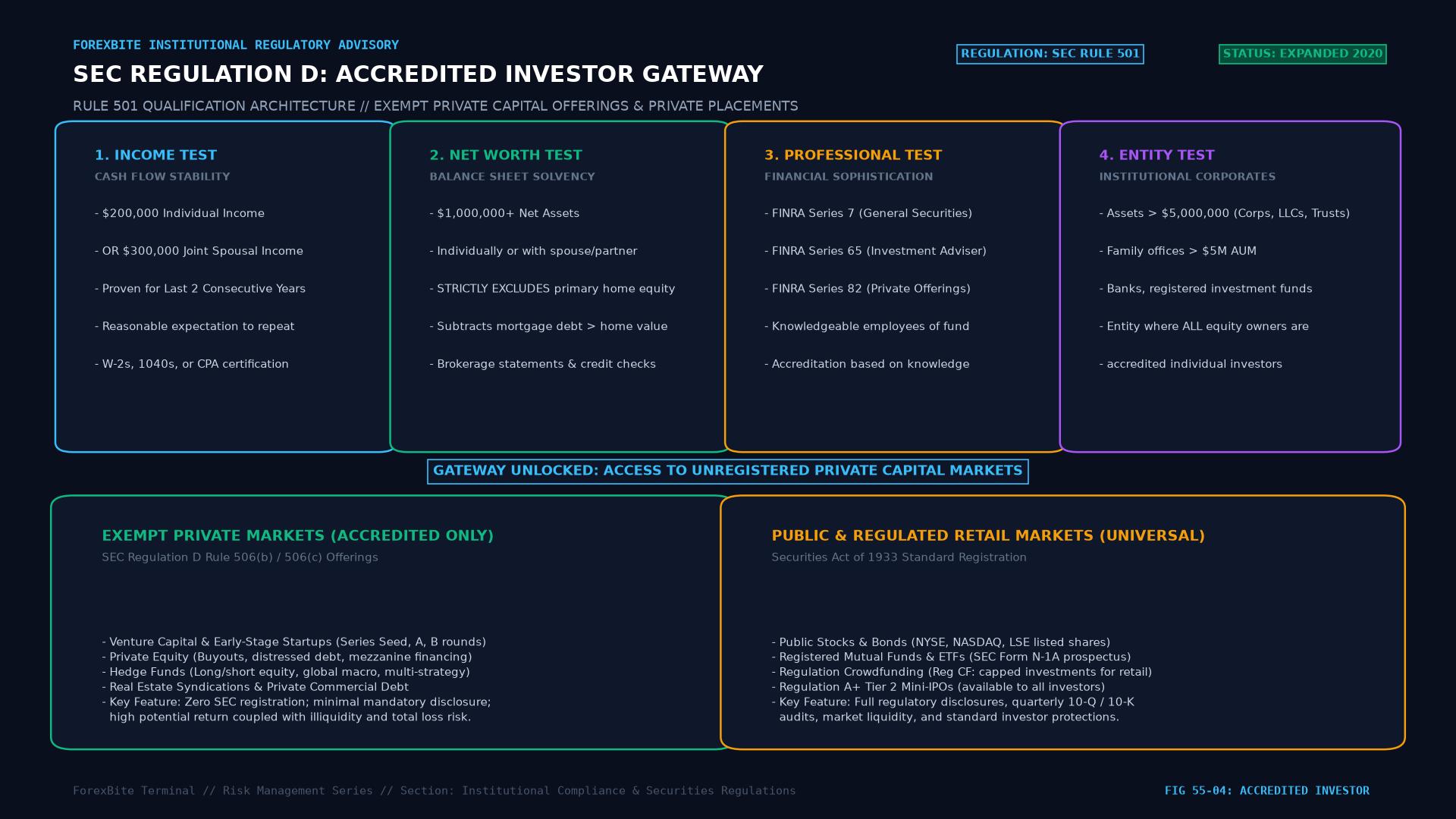 Figure: SEC Rule 501 qualification architecture across income, net worth, and professional sophistication tests granting access to exempt private capital offerings.
Technical Mechanics & Qualification Standards
Under SEC regulations (amended in 2020 to expand qualification beyond net wealth to include professional certifications), an investor qualifies as accredited through the following standardized tests:
1. The Income Threshold
An individual must demonstrate annual earned income exceeding specific thresholds across the two most recent calendar years, with a reasonable expectation of reaching the same income tier in the current year: $$\text{Individual Income} > $200,000 \quad \text{or} \quad \text{Joint Income with Spouse/Partner} > $300,000$$
Single and joint income tests cannot be combined across different tax years.
2. The Net Worth Threshold
An individual or married couple must maintain a verifiable net worth exceeding $1,000,000, calculated strictly excluding the equity value of their primary residence: $$\text{Qualifying Net Worth} = \text{Total Assets} - \text{Primary Residence Fair Value} - \left( \text{Total Liabilities} - \text{Mortgage Debt on Primary Residence} \right)$$
If the mortgage debt on the primary residence exceeds the estimated fair market value of the home, the excess liability must be subtracted from net worth.
3. Professional Knowledge & Institutional Entities
- Licensing Credentials: Individuals holding active credentials in good standing: FINRA General Securities Representative (Series 7), Investment Adviser Representative (Series 65), or Private Securities Offerings Representative (Series 82).
- Institutional Entities: Any entity (corporation, partnership, LLC, or trust) with total investments or assets exceeding $5,000,000, provided the entity was not formed solely for the purpose of acquiring the specific securities.
- Entity Rule: Any business or partnership where 100% of the equity owners are accredited investors individually.
Comparative Matrix: Investor Qualification Classifications
| Parameter | Retail / Non-Accredited | Accredited Investor | Qualified Client | Qualified Purchaser (QP) |
|---|---|---|---|---|
| Governing Regulation | Standard Securities Act | SEC Rule 501 (Reg D) | Advisers Act Rule 205-3 | Investment Company Act § 2(a)(51) |
| Net Worth Threshold | No minimum | $1,000,000 (excl. home) | $2,200,000 net worth | $5,000,000 investable assets |
| Income Test | None | $200,000 / $300,000 | None | None |
| Performance Fees | Prohibited in funds | Subject to fund rules | Allowed (carry / fees) | Allowed |
| Permitted Investments | Public stocks, ETFs, mutual funds | Reg D private rounds, hedge funds, VC | Performance-fee PE & Hedge Funds | § 3(c)(7) private funds, mega-PE |
Real-World Case Study: Capital Formation Under Regulation D 506(c)
In 2023, an enterprise AI startup raised $15 million through a Regulation D Rule 506(c) offering.
Unlike traditional private placements under Rule 506(b), Rule 506(c) permits the company to engage in general solicitation and public advertising across podcasts, digital channels, and industry conferences:
- The Verification Mandate: Under 506(c), the issuer cannot rely on self-certification. The startup engaged an SEC-compliant verification platform to inspect W-2s, 1099 tax transcripts, CPA-certified net worth attestations, and credit reports for all 140 prospective backers.
- Exclusion of Non-Accredited Backers: Despite receiving 600 applications from retail tech enthusiasts, the issuer rejected non-accredited participants to protect its exemption status.
- Execution: By strictly onboarding verified accredited investors, the company closed the round in 45 days, avoiding the millions in legal and registration expenses associated with an initial public offering (IPO).
Frequently Asked Questions (FAQ)
Does being an accredited investor require a formal registration certificate?
No. There is no official government agency that issues an “Accredited Investor ID” or card. Instead, when an investor intends to purchase private placements, the issuer, broker-dealer, or fund manager conducts due diligence by reviewing tax returns, bank statements, or third-party CPA/attorney verification letters.
Can retirement account assets (401k or IRA) be counted toward the net worth test?
Yes. Vested balances in traditional IRAs, Roth IRAs, 401(k)s, and self-directed retirement vehicles count toward the $1,000,000 net worth requirement, provided they represent verifiable financial holdings.
Why do regulatory bodies restrict non-accredited investors from private offerings?
Private placements lack statutory disclosure requirements, carry high liquidity lock-up periods (often 5–10 years), and present severe failure rates. Regulations restrict access to protect retail investors from fraudulent schemes and catastrophic losses where legal recourse is constrained.
Ready to trade forex?
Open a free demo account with a regulated broker. Practice with virtual funds before risking real money.