Hedge Fund
A hedge fund is an actively managed private pooled investment fund that deploys complex, alternative strategies—including leverage, short-selling, and derivatives—aiming to deliver absolute returns across all market environments.
What Is a Hedge Fund?
A hedge fund is a private, actively managed investment partnership open exclusively to institutional investors and accredited, high-net-worth individuals. Unlike retail mutual funds, which are bound by strict regulatory constraints regarding portfolio diversification and long-only mandates, hedge funds operate with immense strategic flexibility. Fund managers can take leveraged long and short positions, trade complex derivatives, execute cross-border arbitrage, and deploy algorithmic trading architectures to generate profit regardless of whether broader financial markets are rising or falling.
The concept was pioneered in 1949 by sociologist and financial writer Alfred Winslow Jones. Jones established the first “hedged fund” by purchasing equities he believed were undervalued while simultaneously shorting equities he deemed overvalued. By neutralizing broad market direction (market beta), Jones insulated the portfolio from systemic crashes and isolated pure managerial stock-picking skill (alpha).
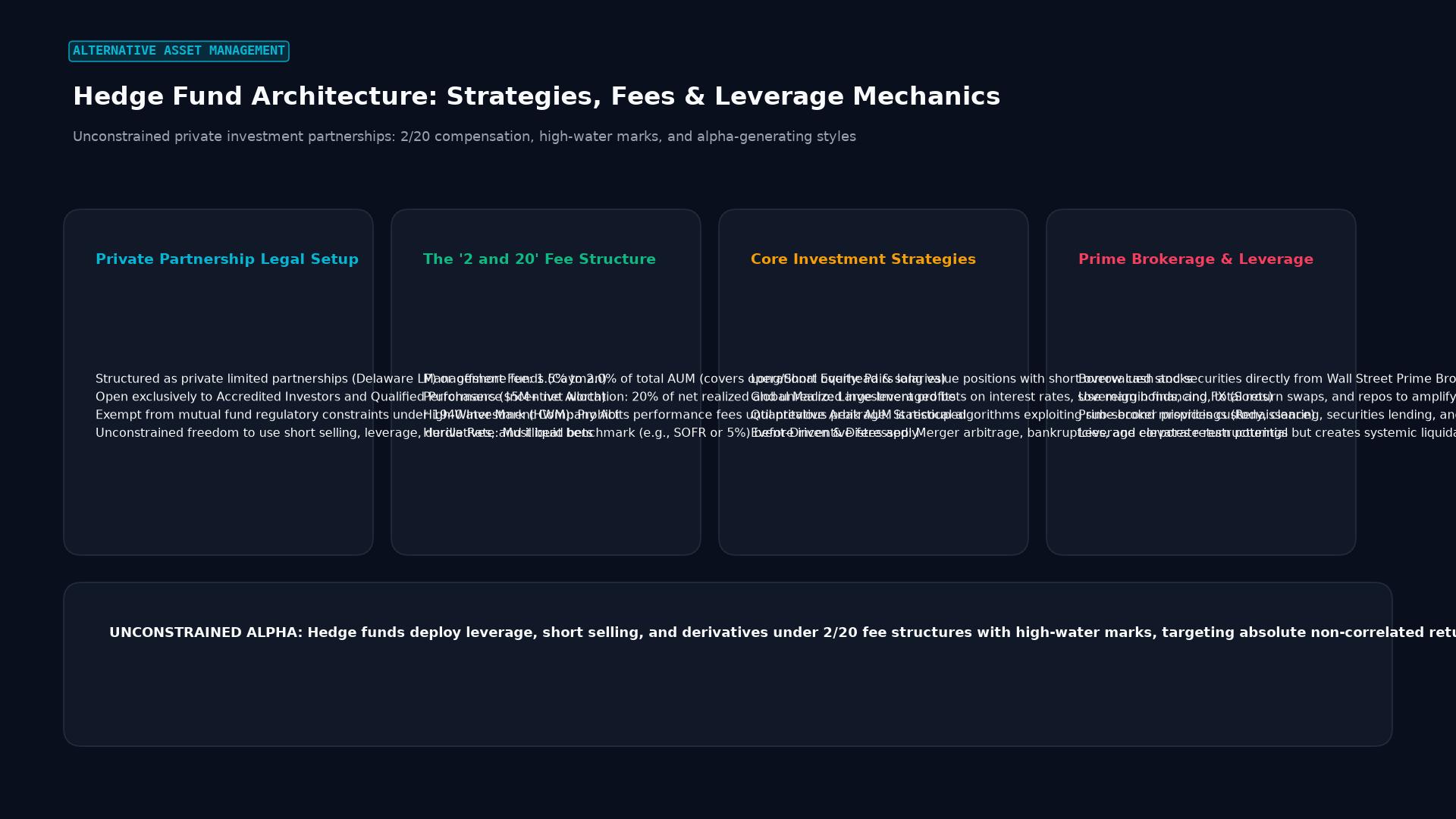 Figure: Unconstrained private investment partnerships: 2/20 compensation, high-water marks, and alpha-generating styles
Primary Hedge Fund Strategies in Foreign Exchange
Foreign exchange represents one of the primary arenas for global hedge funds due to its 24-hour liquidity, absence of trading halts, and deep derivative markets:
1. Global Macro
Global Macro funds represent the most famous tier of hedge funds in foreign exchange. Managers analyze macroeconomic data—including central bank monetary policies, interest rate differentials, sovereign fiscal deficits, and geopolitical shifts—to take massive, directional leveraged bets across global currencies, sovereign bonds, and commodities.
- Legendary Example: In September 1992, George Soros and Stanley Druckenmiller’s Quantum Fund executed a multi-billion-dollar short position against the British Pound (“Breaking the Bank of England”), netting over $1 billion in profit in a single day as the UK was forced out of the European Exchange Rate Mechanism.
2. Quantitative & CTA (Trend Following)
Commodity Trading Advisors (CTAs) and quantitative funds rely entirely on mathematical models, algorithmic execution, and machine learning. These funds identify multi-week statistical trends, breakout momentum, or mean-reversion channels across hundreds of liquid currency pairs and futures contracts simultaneously, removing human psychological bias from execution.
3. Relative Value & Arbitrage
Relative value funds seek to exploit minute pricing inefficiencies between mathematically related instruments:
- Covered Interest Arbitrage: Capturing minor spreads between cash spot rates, forward contracts, and money market interest rates.
- Cross-Currency Basis Swaps: Exploiting temporary dollar funding shortages among European or Japanese commercial banks.
The Economics of Hedge Funds: Fees and Alignment
Hedge funds operate under private partnership agreements designed to align managerial incentives with investor profitability:
Hedge Fund Compensation Structure
------------------------------------------------------------------------
1. Management Fee (typically 1.5% to 2.0% of AUM):
   Covers operational overhead, research analysts, data feeds, and compliance.
2. Performance / Incentive Fee (typically 20% of net new profits):
   Rewards outperformance and alpha generation.
Investor Protection Mechanisms:
- High-Water Mark (HWM): A mandatory contractual clause ensuring that fund managers only collect a 20% performance fee on net new profits. If a fund suffers a 15% drawdown, the manager cannot charge any performance fee until the portfolio recovers 100% of past losses and sets a new all-time high in net asset value.
- Hurdle Rate: An agreed minimum benchmark return (such as the Secured Overnight Financing Rate, SOFR, or a flat 5%) that the fund must surpass before the performance fee activates.
Hedge Funds vs. Traditional Mutual Funds
| Feature | Hedge Funds | Traditional Mutual Funds |
|---|---|---|
| Target Investors | Accredited / Institutional only | General retail public |
| Regulatory Oversight | Light; private placement exemptions | Strict; SEC / UCITS oversight |
| Target Return | Absolute Return (profit in any market) | Relative Return (outperform benchmark index) |
| Short Selling & Derivatives | Extensively utilized | Strictly limited or prohibited |
| Leverage | Substantial (via prime broker margin) | Very low to zero |
| Liquidity & Redemption | Quarterly or annual redemption lock-ups | Daily liquidity (T+1 redemptions) |
Market Impact: How Hedge Funds Move Currency Markets
Hedge funds wield disproportionate influence over global foreign exchange markets:
- Liquidity Provision and Price Discovery: By actively trading across illiquid exotic pairs, cross-rates, and multi-year forward horizons, hedge funds provide critical counterparty liquidity to commercial banks and corporate treasuries.
- Amplifying Macro Momentum: When systematic CTAs and discretionary macro funds reach consensus on a theme—such as shorting the Japanese Yen during a widening US-Japan interest rate gap—their collective multi-billion-dollar positioning can sustain powerful multi-month trends.
- Cascading Liquidation Risks: When an unexpected macroeconomic shock occurs (such as an emergency central bank rate hike), highly leveraged hedge funds are forced into rapid de-risking. Unwinding crowded trades simultaneously can trigger violent currency flash crashes.
Key Takeaways
- A hedge fund is an alternative private investment partnership that pursues absolute returns using leverage and short selling.
- Global Macro hedge funds are major participants in foreign exchange, trading interest rate divergence and sovereign macro trends.
- The standard fee model is “Two and Twenty,” governed by High-Water Marks to protect investors from paying fees on capital recoveries.
- Hedge funds target absolute returns regardless of market direction, unlike traditional retail mutual funds focused on relative index outperformance.
- Because of substantial leverage, hedge fund positioning can accelerate powerful currency trends and trigger rapid cascade liquidations.
Frequently Asked Questions
What does the term “hedge” mean in a hedge fund?
Originally, “hedge” referred to neutralizing broad market risk by pairing long bets on strong assets with short bets on weak assets. Today, the term is applied broadly to private alternative investment funds, even those that take unhedged, highly leveraged directional bets.
Who is eligible to invest in a hedge fund?
In the United States, investors must qualify as an “Accredited Investor” (having a net worth exceeding $1 million excluding primary residence, or annual income exceeding $200,000) or a “Qualified Purchaser” (possessing at least $5 million in investable assets). Similar wealth thresholds apply in Europe and the UK.
How do retail forex traders track hedge fund positioning?
Retail traders monitor the weekly Commitments of Traders (COT) report published by the US Commodity Futures Trading Commission (CFTC). The “Non-Commercial” category in the COT report reflects the aggregate net long or net short speculative positioning of hedge funds across major currency futures.
Ready to trade forex?
Open a free demo account with a regulated broker. Practice with virtual funds before risking real money.