ADV Form
Form ADV is the mandatory statutory disclosure document submitted by investment advisers to the SEC and state regulators under the Investment Advisers Act of 1940, detailing fee schedules, assets under management, and disciplinary history.
What Is Form ADV?
Form ADV is the primary statutory disclosure and registration document that professional investment advisory firms must submit to register with the United States Securities and Exchange Commission (SEC) or state securities regulators under the Investment Advisers Act of 1940.
In the wealth management and asset management industry, Form ADV functions as the regulatory and public window into an investment adviser’s fiduciary operations. It provides comprehensive, legally audited disclosures detailing an adviser’s Assets Under Management (AUM), corporate ownership structure, fee schedules, investment strategies, material conflicts of interest, affiliate relationships, and any past regulatory, civil, or criminal disciplinary sanctions.
Form ADV is publicly accessible to any investor via the SEC’s Investment Adviser Public Disclosure (IAPD) digital database, making it the most important due-diligence tool retail and institutional investors possess when vetting a wealth manager or hedge fund sponsor.
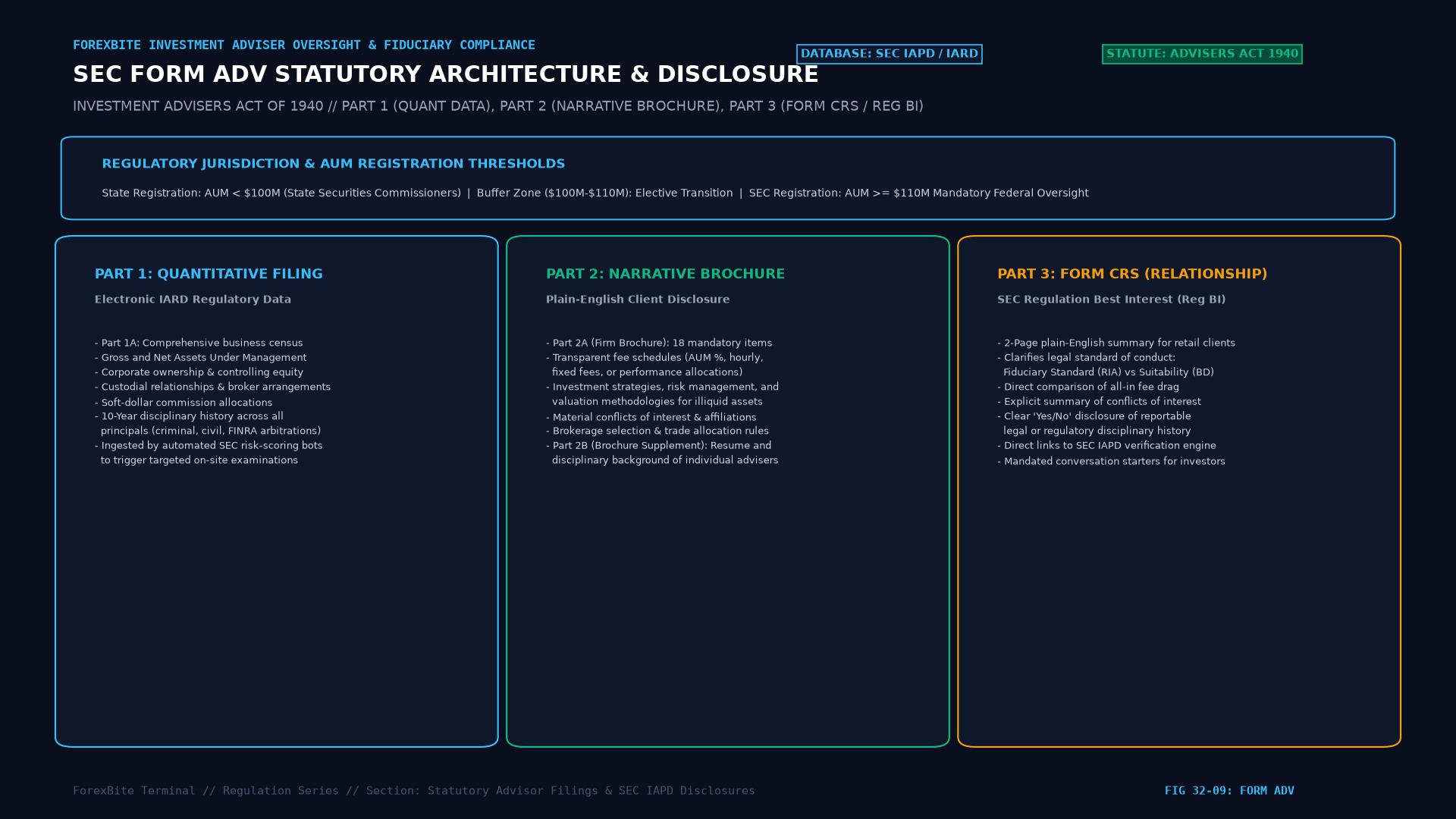 Figure: The multi-part structure of SEC Form ADV across Part 1 quantitative regulatory filing, Part 2 narrative client brochure, and Part 3 Form CRS relationship summary.
Technical Mechanics: The Three Core Components
Form ADV is structured into three distinct statutory parts, each serving a targeted compliance and transparency function:
1. Form ADV Part 1 (The Quantitative Regulatory Filing)
Part 1 is an online, structured data form submitted through the Investment Adviser Registration Depository (IARD) system:
- Part 1A: Covers basic business identity, corporate address, legal structure, total gross and net AUM, number of client accounts, and detailed questions regarding past criminal indictments, SEC sanctions, or FINRA arbitration awards.
- Part 1B: Filed exclusively by state-registered advisers, answering state-specific regulatory questions and bonding requirements.
2. Form ADV Part 2 (The Narrative Client Brochure)
Part 2 is written in narrative plain English and must be delivered directly to prospective clients before executing an advisory agreement:
- Part 2A (The Firm Brochure): Dissects 18 mandatory disclosure items, including fee schedules (hourly, percentage of AUM, or performance fees), methods of investment analysis, brokerage practices (such as trade aggregation and soft-dollar arrangements), and custody policies.
- Part 2B (The Brochure Supplement): Functions like a resume and background check for each individual financial adviser providing advice to clients, detailing their formal education, business background, outside business activities, and personal disciplinary record.
3. Form ADV Part 3 (Form CRS - Client Relationship Summary)
Mandated under SEC Regulation Best Interest (Reg BI), Form CRS is a concise two-page document designed for retail consumers. It answers fundamental consumer questions regarding whether the firm acts as a broker-dealer or a fiduciary investment adviser, what fees the client will pay, and whether the firm’s financial professionals have reportable legal or disciplinary disclosures.
Regulatory Jurisdictions: SEC vs. State Registration
A firm’s regulatory jurisdiction is dictated by its regulatory Assets Under Management (RAUM):
| Regulatory Level | AUM Threshold | Primary Regulatory Agency |
|---|---|---|
| Small Adviser | Below $25 Million | State Securities Authorities in firm’s home state |
| Mid-Sized Adviser | $25 Million to $100 Million | State Securities Authorities in states where firm operates |
| Buffer Zone | $100 Million to $110 Million | Discretionary choice: can remain state or register with SEC |
| Large Adviser | Over $110 Million (Mandatory) | Federal SEC Oversight (Division of Examinations) |
| Internet-Only Adviser | Any AUM size (if fully digital) | Direct SEC Registration under specialized exemption |
Real-World Case Study: Uncovering Hidden Conflicts of Interest
In 2024, an institutional pension trustee conducted fiduciary due diligence on a prominent wealth management firm managing $1.8 billion in assets that claimed to provide independent, unbiased asset allocation for a 1.0% annual AUM advisory fee.
The trustee inspected the firm’s Form ADV Part 2A (Item 12 - Brokerage Practices) on the SEC IAPD portal:
- The Conflict Revealed: Item 12 disclosed that the firm routed client trades through a designated broker-dealer that provided the adviser with “soft dollars” (indirect credits that paid for the adviser’s commercial office market data terminals and executive travel to investment conferences).
- Proprietary Fund Kickbacks: Item 5 revealed that the adviser invested over 40% of client portfolios into affiliated proprietary mutual funds, collecting both the 1.0% wealth management fee and a 0.85% internal fund management fee (double-dipping).
- Outcome: Armed with the statutory disclosures extracted directly from Form ADV, the pension board rejected the firm and selected a fee-only independent RIA whose Form ADV confirmed zero soft-dollar arrangements, zero proprietary funds, and strict adherence to fee-only fiduciary practices.
Frequently Asked Questions (FAQ)
How often must an investment adviser update Form ADV?
Investment advisers must file an Annual Updating Amendment within 90 days of the close of their fiscal year (typically by March 31 for calendar-year firms). In addition, if any information in Part 1 or Part 2 becomes materially inaccurate (such as a change in ownership, a new disciplinary event, or an altered fee schedule), the firm must file an other-than-annual amendment promptly.
Is Form ADV required for hedge fund managers?
Yes. Under Dodd-Frank Act reforms, managers of private equity funds and hedge funds managing more than $150 million in private fund assets must register with the SEC and file Form ADV. Smaller private fund advisers file as Exempt Reporting Advisers (ERAs), submitting a truncated version of Form ADV Part 1.
Where can an investor review a wealth manager’s Form ADV?
Any investor can view, search, and download a firm’s Form ADV free of charge by visiting the SEC’s official website: adviserinfo.sec.gov. Entering the firm’s name or Central Registration Depository (CRD) number provides immediate access to their complete public disclosure history.
Ready to trade forex?
Open a free demo account with a regulated broker. Practice with virtual funds before risking real money.