Risk Management
Risk management in forex is the systematic process of identifying, measuring, and controlling the financial risks inherent in trading leveraged currency positions. Effective risk management is not a single technique — it is a framework of rules covering position sizing, stop-loss placement, drawdown limits, and portfolio-level exposure that determines whether a trader survives long enough to be profitable.
The Uncomfortable Truth About Forex Risk
Most traders spend the majority of their time and energy searching for better entries — better indicators, better patterns, better strategies. Professional traders know that entry quality is far less important than what you do after the entry. A mediocre system with excellent risk management will consistently outperform an excellent system with mediocre risk management. The reason: in trading, losses are inevitable. Risk management determines whether those inevitable losses are survivable.
This is not an abstraction. Prop trading firms, hedge funds, and institutional desks have sophisticated risk management departments that are completely separate from the trading department. Risk managers have authority to override traders. Position limits, drawdown thresholds, and concentration limits are enforced automatically, not suggested. This is how institutions survive market shocks that blow up retail traders.
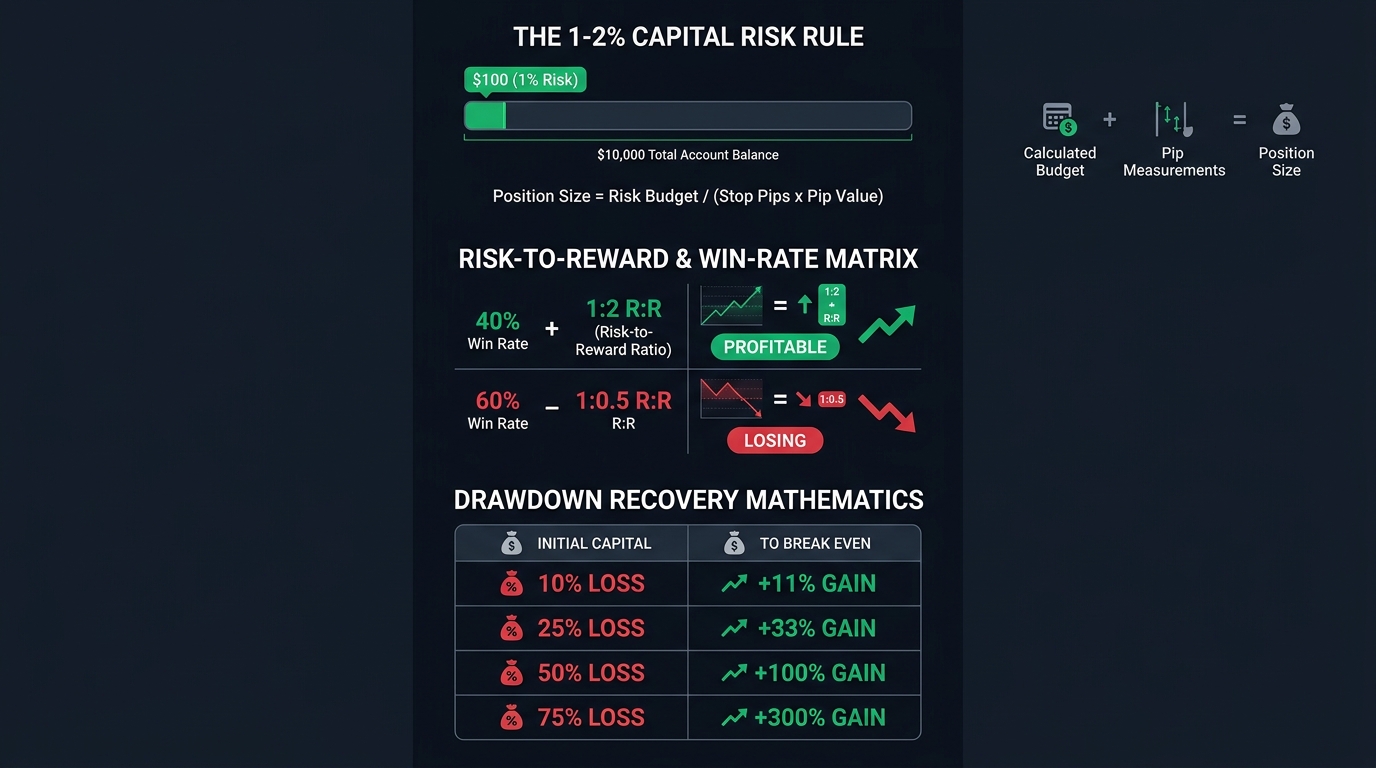
The 1-2% Rule: Position Sizing Foundation
The most fundamental risk management principle: never risk more than 1-2% of your trading capital on a single trade.
If you have a $10,000 account:
- 1% risk = $100 maximum loss per trade
- 2% risk = $200 maximum loss per trade
This seems conservative. It is conservative. That’s the point. With 1% risk per trade, you can lose 20 consecutive trades and still have 82% of your capital. Your account is damaged but survivable. With 10% risk per trade, you can lose 20 consecutive trades and have essentially zero. These runs of 20 consecutive losses aren’t common, but they do occur — especially during strategy drawdown periods that every system experiences.
Position Sizing: The Calculation
The 1-2% rule determines your dollar risk budget. Position size is then calculated backward from your stop-loss distance:
Position Size = (Account × Risk%) / (Stop Distance in pips × Pip Value)
Example: $10,000 account, 1% risk ($100), stop-loss 30 pips, EUR/USD pip value $10/standard lot:
- $100 / (30 pips × $10) = 0.33 standard lots
This is the only correct way to size positions. Trading round lot sizes (0.1, 0.5, 1.0) without calculating from your actual risk parameters means you’re guessing at your risk, not controlling it.
The Risk-Reward Ratio
Every trade has an implied risk-reward ratio: how many dollars you stand to gain for every dollar you risk. A trade with a 30-pip stop and 90-pip target has a 1:3 risk-reward ratio.
A minimum of 1:2 is considered necessary for a viable trading system. Here’s the math: at 1:2 risk-reward with a 40% win rate:
- 4 losses × -1 = -4 units
- 6 wins × +2 = +12 units
- Net: +8 units
The system is profitable even though it loses 60% of the time. This is a fundamental insight: win rate alone doesn’t determine profitability — the combination of win rate and risk-reward ratio does.
At 1:1 risk-reward, you need a 55%+ win rate just to break even (after spread costs). Most traders can’t achieve this consistently. At 1:2, you need only a 35% win rate to be break-even — far more achievable.
Maximum Drawdown Limits
Beyond per-trade risk, professional risk management sets portfolio-level limits:
Daily loss limit: If you lose 3-5% in a single day, stop trading for the rest of the day. Bad days happen; bad days followed by revenge trading create catastrophic losses.
Weekly/monthly drawdown limit: Many prop firms enforce a maximum 10% drawdown from peak equity. If hit, the trader stops until reviewed. Self-directed traders should apply the same discipline.
Correlation risk: If you hold EUR/USD long and GBP/USD long simultaneously, you effectively have two correlated USD-short positions. True diversification requires trading pairs with low correlation, not simply trading multiple pairs that move together.
Common Risk Management Mistakes
Moving stop-losses: Widening a stop because “it’ll come back” is the single most common way traders turn small losses into large ones. The stop-loss was placed at a logical level based on analysis. Moving it is overriding your own analysis with emotion.
Overtrading: Taking 15 trades in a day because you had 2 losers in a row and want to “recover.” Each trade has its own risk. Trading more doesn’t reduce previous losses; it compounds risk.
Ignoring correlation: Holding 5 USD-short positions during a risk-off event doesn’t make you diversified. A sudden dollar rally hits all 5 at once.
Using maximum leverage: Just because your broker allows 500:1 doesn’t mean you should approach it.
Key Takeaways
- The 1-2% rule: never risk more than 1-2% of capital on a single trade
- Position size is calculated from risk budget divided by (stop distance × pip value) — not chosen arbitrarily
- Minimum 1:2 risk-reward ratio allows profitability even with a sub-50% win rate
- Set and enforce daily and monthly drawdown limits; stop trading when limits are hit
- Account for pair correlation — similar pairs held simultaneously multiply risk, not diversify it
FAQ
What risk percentage do professional traders use? It varies by strategy. High-frequency systems with many trades per day typically use 0.25-0.5% per trade. Swing and position traders often use 1-2%. Some trend-following systems use even less, compensating with large position sizes on high-conviction setups. The consistent theme: professionals never bet a percentage large enough to threaten account survival.
Is it possible to manage risk perfectly and still lose money? Yes. Risk management doesn’t eliminate losses — it controls their size. Even a perfectly risk-managed account will have losing periods. The objective is to keep losses small enough that the account survives to benefit from winning periods. Long-term survival enables long-term profitability.
Ready to trade forex?
Open a free demo account with a regulated broker. Practice with virtual funds before risking real money.