Base loan amount
The original agreed principal sum borrowed in a debt or mortgage contract before the addition of financed closing costs, upfront mortgage insurance premiums, or capitalized guarantee fees.
What is Base Loan Amount?
The base loan amount represents the core principal sum an applicant borrows to purchase property, acquire equipment, or fund a commercial enterprise before adding ancillary financed costs. In consumer mortgage underwriting, commercial real estate finance, and corporate debt syndication, lenders establish credit terms around this primary sum. It reflects the pure funding gap between the transaction purchase price (or appraised asset value) and the borrower cash down payment or equity contribution.
Financial contracts carefully distinguish between the base loan amount and the total loan amount. While the base loan amount finances the physical asset directly, government agencies and commercial lenders frequently allow borrowers to finance mandatory upfront insurance charges, origination fees, or administrative guarantee premiums. Adding those fees directly onto the debt produces the total loan amount, which governs the amortization schedule and monthly debt service obligations.
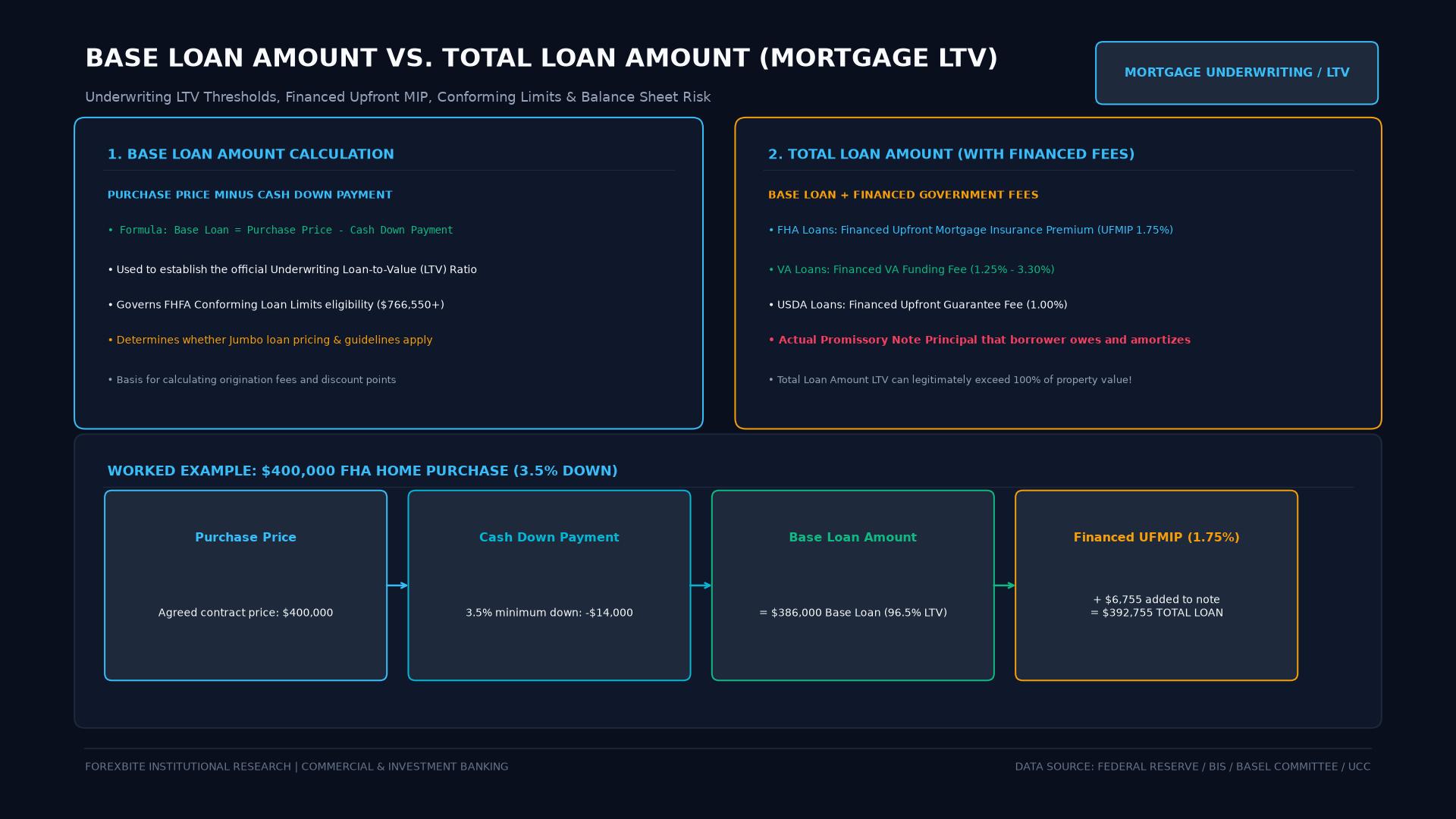 Figure: Mortgage underwriting balance structure: net base purchase loan calculated against home price down payment, plus financed upfront mortgage guarantee fees.
Mechanics: Base Loan Amount vs. Total Loan Amount
To understand mortgage and credit structuring, examine how upfront federal guarantee fees alter nominal loan balances. Government-backed mortgage programs in the United States permit borrowers to roll mandatory insurance fees into the loan balance:
Federal Housing Administration (FHA) Loans
FHA loans require an Upfront Mortgage Insurance Premium (UFMIP), set statutorily at 1.75% of the base loan amount. A homebuyer purchasing a property for $400,000 with the minimum statutory down payment of 3.5% ($14,000) generates the following figures:
- Base Loan Amount: $$400,000 - $14,000 = $386,000$
- Financed UFMIP (1.75%): $$386,000 \times 0.0175 = $6,755$
- Total Note Loan Amount: $$386,000 + $6,755 = $392,755$
Veterans Affairs (VA) Loans
The Department of Veterans Affairs guarantees loans that frequently require zero down payment. Qualified veterans must pay a statutory VA Funding Fee, ranging from 1.25% to 3.30% depending on service branch, prior usage, and down payment percentage:
- Purchase Price: $500,000
- Down Payment: $0
- Base Loan Amount: $500,000
- VA Funding Fee (2.15% for first-time use with zero down): $10,750
- Total Loan Amount: $510,750
In both cases, monthly principal and interest payments derive from the total loan amount amortized over the contractual loan term (such as 360 months), whereas underwriting qualification ratios anchor back to the base loan amount.
Loan-to-Value (LTV) Calculation Metrics
Underwriters use loan-to-value calculations to measure structural credit risk. The coexistence of base and total loan amounts creates two distinct ratios:
$$\text{Base LTV} = \frac{\text{Base Loan Amount}}{\min(\text{Purchase Price}, \text{Appraised Value})} \times 100$$
$$\text{Total LTV} = \frac{\text{Total Loan Amount}}{\min(\text{Purchase Price}, \text{Appraised Value})} \times 100$$
Statutory lending rules impose strict caps on Base LTV to enforce minimum equity cushions:
- Conforming Conventional Mortgages: Fannie Mae and Freddie Mac establish maximum Base LTV limits, typically 95% to 97% for primary residences. Loans exceeding 80% Base LTV trigger mandatory Private Mortgage Insurance (PMI).
- FHA Financing: Maximum Base LTV stands at 96.5% for standard purchases. Because the 1.75% UFMIP is financed above this cap, the Total LTV often reaches 98.19%, exceeding the home purchase price without violating statutory limits.
- VA Financing: Allows a Base LTV of 100%. Capitalizing the funding fee pushes the Total LTV to 101.5% or 103.3%, meaning the borrower enters the transaction with negative initial equity before home appreciation.
Conforming Loan Limits and Agency Securitization
In the secondary mortgage market, the base loan amount dictates whether a mortgage qualifies as a conforming loan eligible for purchase and securitization by Government-Sponsored Enterprises (GSEs) Fannie Mae and Freddie Mac.
The Federal Housing Finance Agency (FHFA) publishes annual baseline Conforming Loan Limits (CLL) indexed under the Housing and Economic Recovery Act of 2008 (HERA). The index adjusts baseline caps across standard and high-cost designated counties.
+------------------------------------+------------------------------------+
| Conforming Mortgage Characteristics| Jumbo Loan Characteristics         |
+------------------------------------+------------------------------------+
| Base loan amount falls within      | Base loan amount exceeds the local |
| statutory FHFA county caps.        | FHFA conforming ceiling.           |
|                                    |                                    |
| High secondary market liquidity    | Non-conforming paper held in bank  |
| via Fannie Mae and Freddie Mac MBS.| portfolio or private-label MBS.    |
|                                    |                                    |
| Standard underwriting through      | Stringent underwriting: higher FICO|
| automated systems (DU / LP).       | thresholds, 12-24 months reserves. |
|                                    |                                    |
| Lower risk spreads and competitive | Higher interest margins reflecting |
| retail mortgage interest rates.    | liquidity and securitization risks.|
+------------------------------------+------------------------------------+
When evaluating conforming eligibility, GSE guidelines evaluate the base loan amount rather than the financed fees. If a borrower in a standard county structures a loan where the base loan amount is $1 below the FHFA ceiling, the loan maintains conforming status even if capitalized closing fees elevate the final promissory note balance above the threshold.
Corporate Finance and Syndicated Debt Applications
In corporate lending, the base loan amount represents the committed credit facility tranche agreed upon in the credit agreement. Syndicated loan agreements structure multiple tranches around distinct base amounts:
  Tranche Type          Commitment Base ($)    Margin Spread    Maturity
  -----------------------------------------------------------------------
  Revolving Credit (RCF)    $250,000,000       SOFR + 175 bps   5 Years
  Term Loan A (TLA)         $500,000,000       SOFR + 200 bps   5 Years
  Term Loan B (TLB)         $750,000,000       SOFR + 275 bps   7 Years
  -----------------------------------------------------------------------
  Total Facility Base:    $1,500,000,000
Corporate borrowers utilize accordion features to expand the base facility without executing a completely new credit agreement. Upfront syndication fees paid to lead arranger investment banks are accounted for under ASC 310-20 or IFRS 9 as debt issuance costs, presented as a direct deduction from the carrying amount of the debt liability rather than capitalized into the nominal base repayment obligation.
Underwriting Impact and Borrower Strategy
The base loan amount serves as the foundation for multiple underwriting assessments:
- Debt-to-Income (DTI) Qualification: While DTI calculations evaluate the total monthly debt service derived from the total loan amount, the base loan amount sets the initial principal balance from which scheduled interest accrues.
- Refinancing Break-Even Points: In rate-and-term refinances, borrowers calculate whether lowering their interest rate compensates for rolling transaction costs into a new total loan amount. If the new total loan amount significantly exceeds the remaining base balance on the existing mortgage, the payoff horizon lengthens.
- Appraisal Shortfalls: If an appraisal valuation falls short of the purchase price, lenders recalculate the permitted base loan amount based on the lower appraised figure. The homebuyer must either bridge the shortfall with additional cash equity or negotiate a purchase price reduction with the seller.
Frequently Asked Questions
Does the base loan amount determine the private mortgage insurance (PMI) premium?
Yes. For conventional mortgages exceeding 80% LTV, private mortgage insurance companies price monthly PMI coverage factors as a percentage of the base loan amount. The resulting monthly premium is divided by 12 and collected inside the borrower monthly escrow payment alongside taxes and hazard insurance.
Can closing costs be rolled into the base loan amount on conventional purchases?
No. On standard conventional purchase transactions, Fannie Mae and Freddie Mac do not allow standard third-party closing costs (such as title insurance, transfer taxes, and escrow reserves) to be financed into the base loan amount. Those costs must be paid out-of-pocket at settlement, funded via seller concessions within statutory limits, or offset through lender credits generated by accepting a higher interest rate.
How does an appraisal deficit affect the base loan amount?
Lenders determine maximum loan percentages using the lower of the contract purchase price or the appraised property value. If an appraisal comes in $20,000 below contract price on a 90% LTV loan, the maximum allowable base loan amount drops by 90% of that deficit ($18,000). The borrower must supply the additional cash to complete settlement unless the transaction terms are amended.
Ready to trade forex?
Open a free demo account with a regulated broker. Practice with virtual funds before risking real money.