Principal
In financial markets, principal refers to: (1) a market maker, dealer, or firm that executes trades for its own proprietary account and assumes inventory risk as counterparty to the client; or (2) the original capital sum invested, borrowed, or face value of a debt instrument upon which interest is calculated.
What Is a Principal?
In finance, corporate law, and market microstructure, the term principal holds two foundational definitions depending on whether it describes trading execution or debt capital:
- Market Microstructure & Trading (Principal vs. Agent): A principal is a financial institution, bank dealing desk, or broker-dealer that trades securities, derivatives, or foreign exchange currencies for its own proprietary account and at its own risk. When executing a trade on a principal basis, the firm does not act as a neutral matchmaker; it acts directly as the counterparty to the customer, buying from the client for its own inventory or selling to the client from its own books.
- Fixed Income, Banking & Lending: In lending and credit agreements, the principal is the original baseline sum of money deposited, borrowed, or invested—distinct from the interest, fees, or capital gains that accrue over time. In bond markets, the principal is synonymous with the bond’s par value or face value (typically $1,000) that the issuer is contractually obligated to repay at maturity.
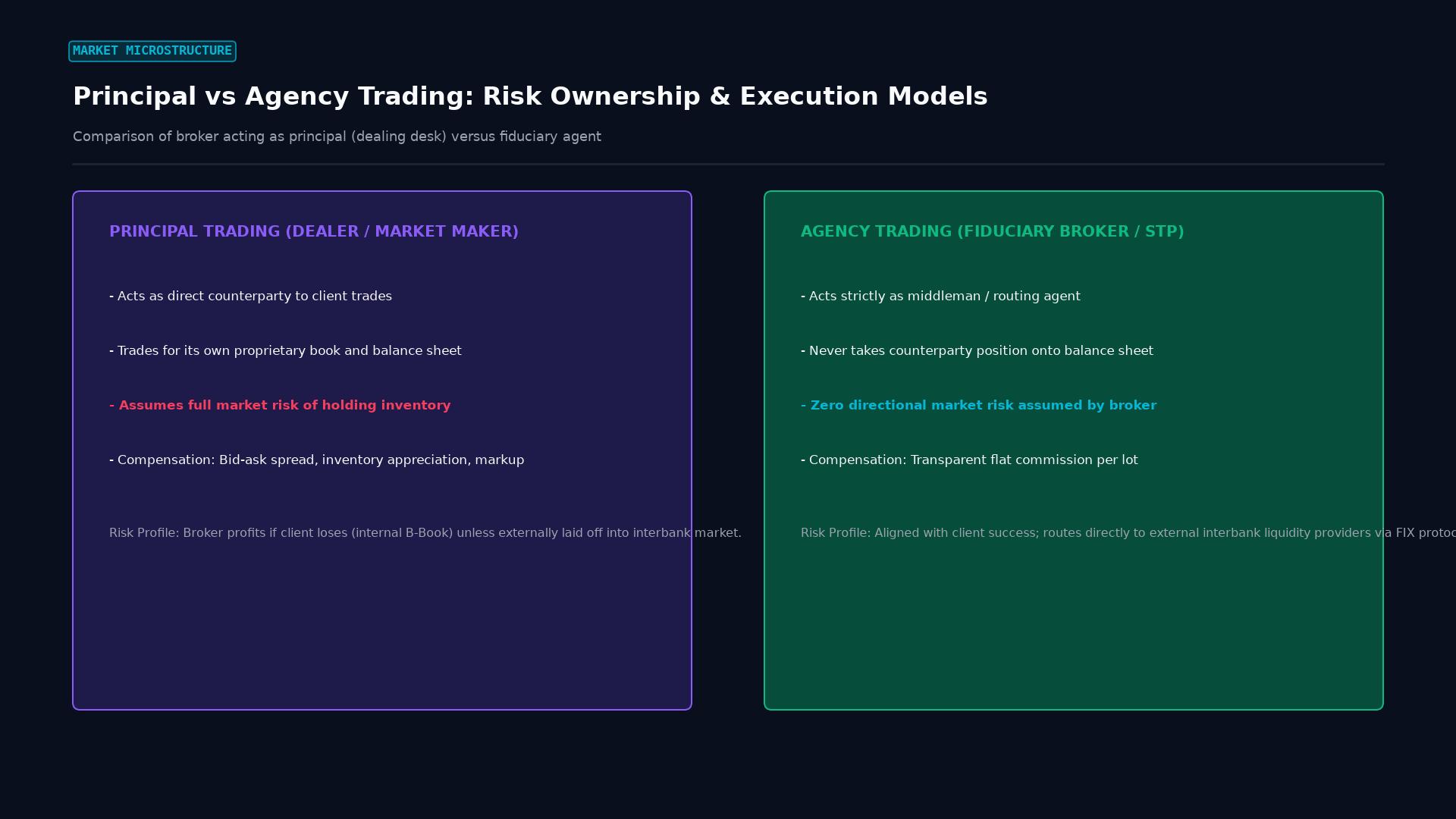 Figure: Execution models comparison: broker trading as principal on proprietary inventory vs acting as a fiduciary agent routing directly to interbank pools.
Principal Trading vs. Agency Trading
When an institutional or retail trader submits an order to a brokerage or investment bank, the execution model determines counterparty risk and fee transparency:
| Operational Feature | Principal Trading (Dealer / Market Maker) | Agency Trading (Broker / Matchmaker) |
|---|---|---|
| Capacity of the Firm | Trades as a Principal for its own account. | Acts strictly as an Agent for the client. |
| Counterparty Identity | The firm itself is the buyer or seller. | An external third-party liquidity provider is the counterparty. |
| Inventory Risk | High: Firm holds position on its balance sheet and absorbs market volatility. | Zero: Firm holds no position and assumes zero market price risk. |
| Compensation Structure | Earns the bid-ask spread markup or trading profit from market movements. | Charges an explicit, transparent commission or per-ticket routing fee. |
| Conflict of Interest | Potential conflict: dealer gains if client loses (internal B-Book model). | Fully aligned: broker profits solely from client trading volume. |
| Regulatory Protections | FINRA Rule 2121 / MiFID II Principal Best Execution rules. | Best execution duty to achieve optimal price routing across external venues. |
The Principal Capacity in Foreign Exchange: B-Book vs. A-Book
In retail and institutional foreign exchange, the capacity under which a broker operates defines its business model:
1. Principal Dealing (B-Book / Market Maker)
The vast majority of retail forex brokerages operate as primary dealers or counterparty principals under their regulatory licenses (e.g., Retail Foreign Exchange Dealer - RFED in the US). When a client clicks “Buy,” the broker takes the other side (“Sell”) as principal.
- The broker nets client orders internally.
- Residual imbalances are either warehoused on the broker’s balance sheet or hedged externally only when total net open position (NOP) limits are exceeded.
2. Agency Execution (A-Book / STP / ECN)
Under Straight-Through Processing (STP), the broker acts strictly in an agency capacity. The client’s order is routed instantaneously to Tier-1 bank liquidity providers (Citigroup, Deutsche Bank, UBS). The broker clears the transaction without taking proprietary principal risk, marking up the raw interbank spread or charging an explicit commission.
Principal in Debt and Fixed Income Markets
In fixed income and banking loans, the principal represents the core liability on the balance sheet:
$$\text{Total Loan Payment} = \text{Principal Repayment} + \text{Interest Charge}$$
Key Concepts in Debt Principal:
- Amortizing Principal: Traditional mortgages and corporate loans require periodic monthly payments that consist of both interest and a partial reduction of the loan principal balance over time.
- Bullet / Balloon Principal: Typical of corporate bonds and sovereign Treasuries. The borrower pays interest-only coupons semi-annually, and repays 100% of the original principal in a single lump-sum bullet payment on the final maturity date.
- Principal Protection: Structured investment products and capital-guaranteed notes guarantee that the investor will receive 100% of their initial principal deposit back at maturity, while offering participation in equity or currency upside.
Real-World Case Study: Principal Front-Running Enforcement
In 2015, global regulatory investigations by the US Department of Justice (DOJ) and the UK Financial Conduct Authority (FCA) revealed widespread abuses by major investment banks operating in a principal capacity on foreign exchange benchmark fixings (such as the 4:00 PM London WMR Fix).
- The Setup: A large sovereign pension fund placed a massive fixing order with a global bank’s FX desk to buy $3,000,000,000 USD against GBP at the official 4:00 PM London Fix rate.
- The Principal Conflict: Because the bank agreed to execute the trade as principal, the trading desk knew that filling a $3B order at 4:00 PM would cause spot GBP/USD to appreciate aggressively.
- The Violation (Front-Running): Between 3:45 PM and 3:59 PM, bank traders bought GBP/USD for their own proprietary principal books ahead of the client order (“banging the close”), driving the spot price artificially higher.
- The Execution: At 4:00 PM, the bank executed the client’s order at the inflated benchmark rate and unloaded its proprietary principal inventory for millions in illicit profit.
- Regulatory Consequence: Global authorities levied over $10 billion in fines across six major banks and mandated the adoption of the FX Global Code, strictly prohibiting banks from manipulating benchmark fixes or trading ahead of client orders in a principal capacity.
Frequently Asked Questions
What is the difference between a principal and an agent?
A principal trades using their own capital and inventory, taking on full financial risk as the direct buyer or seller. An agent (or broker) acts merely as an intermediary or representative connecting buyers and sellers, earning a commission without taking ownership or risk in the underlying asset.
Can a broker act as both principal and agent?
Yes. Many large financial institutions operate as broker-dealers. In some transactions, they act as an agent (routing client orders to external stock exchanges), while in other transactions (such as over-the-counter bond trading or foreign exchange market making), they act as a principal, selling securities directly from their own corporate inventory.
What is principal risk in settlement?
In international banking, principal risk (also known as settlement or Herstatt risk) is the danger that one counterparty to a trade will deliver the sold currency or security, but the other counterparty will default or go bankrupt before delivering the reciprocal asset, resulting in a total loss of the principal capital transferred.
Ready to trade forex?
Open a free demo account with a regulated broker. Practice with virtual funds before risking real money.