Base pay rate
The fixed non-incentive compensation paid to an employee per standard unit of time, serving as the statutory baseline for overtime calculation, employee benefit accruals, and macro wage inflation metrics.
What is Base Pay Rate?
The base pay rate is the contractual, fixed minimum compensation an employer agrees to pay an employee before adding performance bonuses, production incentives, overtime premiums, commissions, shift differentials, or health and retirement benefits. It is denominated either as an hourly rate for non-exempt workers or as a periodic baseline salary (weekly, bi-weekly, or monthly) for exempt professional and executive personnel.
In corporate financial planning and macroeconomic analysis, base pay serves as the core determinant of corporate labor costs and structural wage inflation. Unlike discretionary bonuses or profit-sharing distributions, base pay represents a persistent, non-contingent liability. Once established or escalated through annual salary reviews, base pay rates exhibit downward nominal rigidity, meaning companies rarely reduce baseline wages during recessions due to morale risks, contractual obligations, and statutory labor laws.
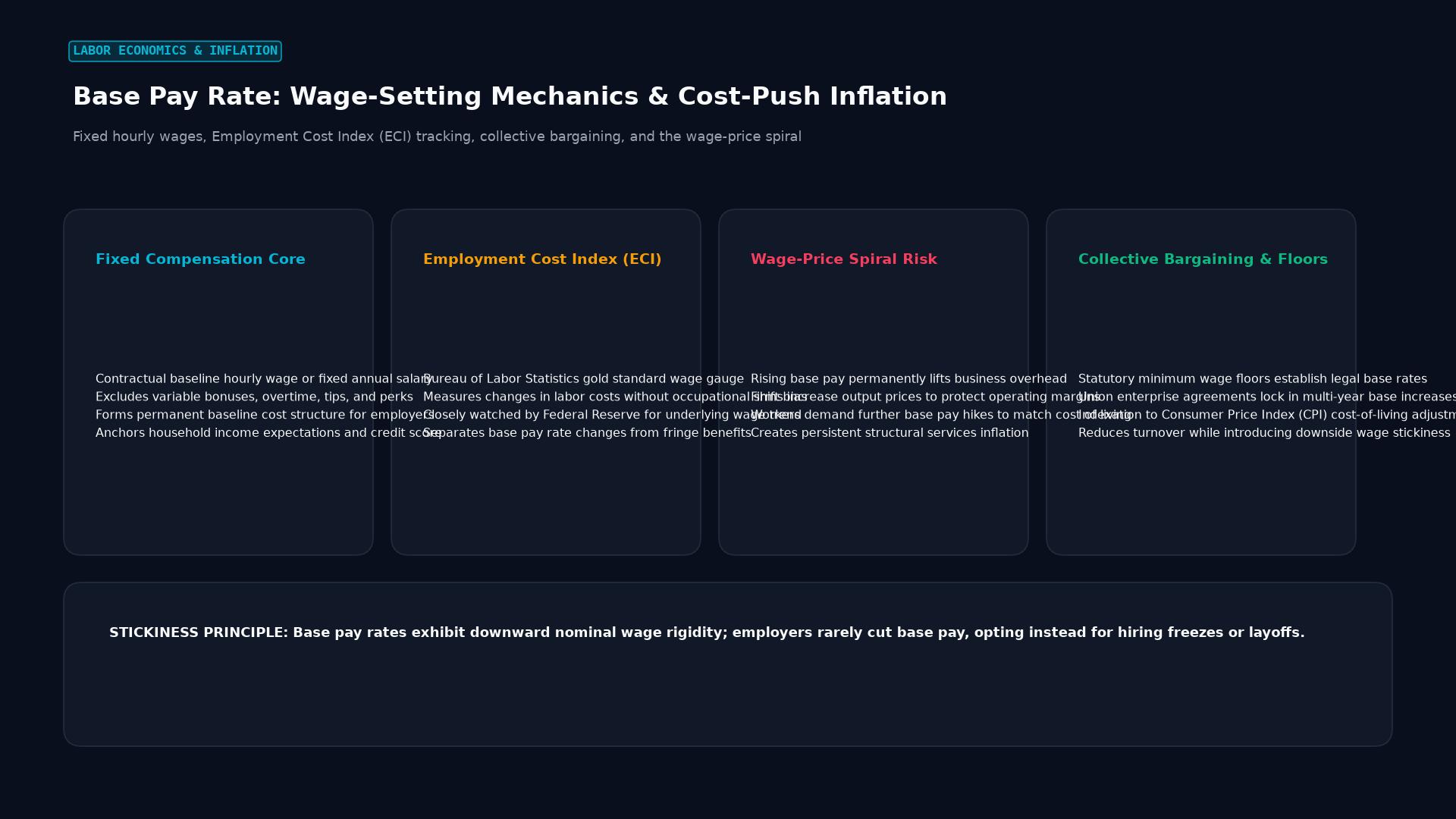 Figure: Fixed hourly wages, Employment Cost Index (ECI) tracking, collective bargaining, and the wage-price spiral
Legal and Regulatory Framework: The FLSA Standard
In the United States, the Fair Labor Standards Act of 1938 (FLSA), codified under Title 29 of the United States Code, establishes federal standards governing minimum base wages, recordkeeping, and overtime requirements.
Under 29 U.S.C. § 207, non-exempt employees who work in excess of 40 hours in a given workweek must receive overtime compensation at a rate not less than one and one-half times their regular rate of pay. The base pay rate forms the fundamental core of this calculation, but statutory guidelines require the regular rate to incorporate certain non-discretionary bonuses and shift premiums:
$$\text{Regular Rate} = \frac{(\text{Hours Worked} \times \text{Base Pay Rate}) + \text{Non-Discretionary Incentives}}{\text{Total Hours Worked in Workweek}}$$
$$\text{Overtime Hourly Rate} = \text{Regular Rate} \times 1.5$$
If a manufacturing technician with a base pay rate of $30.00 per hour works 50 hours in a single week and receives a mandatory $200 non-discretionary safety bonus:
- Base wage earned: $50 \times $30.00 = $1,500$
- Total remuneration: $$1,500 + $200 = $1,700$
- Regular rate of pay: $\frac{$1,700}{50} = $34.00$ per hour
- Overtime premium due: $10 \text{ hours} \times ($34.00 \times 0.5) = $170.00$
- Total gross earnings: $$1,700 + $170 = $1,870.00$
Employers who mistakenly calculate statutory overtime using only the base pay rate while excluding non-discretionary bonuses face severe regulatory penalties, including back pay liabilities, liquidated damages equal to 100% of unpaid wages, and legal sanctions from the Department of Labor (DOL).
Macroeconomic Significance: Central Banking and Inflation
Macroeconomists, bond traders, and central bank policymakers track base pay trends to gauge the persistence of core inflation across the broader economy:
+------------------------------------+------------------------------------+
| Average Hourly Earnings (AHE)      | Employment Cost Index (ECI)        |
+------------------------------------+------------------------------------+
| Published monthly by the BLS in    | Published quarterly by the BLS     |
| the Nonfarm Payrolls (NFP) report. | based on structured employer polls.|
|                                    |                                    |
| Measures gross payroll divided by  | Isolates pure base rate movements  |
| total reported hours worked.       | by holding industry employment     |
|                                    | weights completely fixed.          |
| Subject to compositional shifts    | Eliminates compositional bias; the |
| during economic disruptions.       | preferred wage metric of the Fed.  |
+------------------------------------+------------------------------------+
The Federal Reserve and Wage-Push Inflation
When labor markets tighten and the unemployment rate dips below the Non-Accelerating Inflation Rate of Unemployment (NAIRU), workers demand higher base pay rates to preserve real purchasing power. Unlike one-off bonuses, hikes in base pay permanently reset corporate fixed expense baselines.
To preserve operating margins, corporations pass higher baseline labor costs onto end consumers in the form of higher retail prices for finished goods and commercial services. This dynamic threatens to trigger a wage-price spiral:
- Tight labor supply forces firms to increase contractual base pay rates.
- Higher wage income stimulates consumer spending and aggregate demand.
- Corporate producers lift final consumer prices to offset permanently higher unit labor costs.
- Workers demand subsequent rounds of base pay adjustments to counteract cost-of-living increases.
When the Employment Cost Index reveals accelerating base wages above productivity growth plus the central bank 2.0% inflation target, monetary authorities typically respond by raising policy rates to slow aggregate demand and cool wage pressure.
Operating Leverage and Corporate Margin Compression
From an equity valuation and corporate finance perspective, base pay represents a critical component of fixed operating costs. The proportion of total expenses tied up in fixed base pay dictates a corporation’s degree of operating leverage:
$$\text{Degree of Operating Leverage (DOL)} = \frac{% \Delta \text{ Operating Income}}{% \Delta \text{ Revenue}} = \frac{\text{Sales} - \text{Variable Costs}}{\text{Sales} - \text{Variable Costs} - \text{Fixed Base Pay Costs}}$$
Labor-intensive industries such as healthcare, hospitality, banking branches, and professional consulting carry heavy fixed base pay burdens. In these sectors:
- Revenue Upside: When revenues expand, fixed base costs remain constant in the short run, expanding operating profit margins.
- Revenue Downside: When economic activity slows or revenues drop, fixed base pay obligations cannot easily be downscaled without costly severance programs or public layoffs. Consequently, operating profit margins compress rapidly.
To mitigate this structural vulnerability, modern corporations increasingly calibrate employee compensation toward variable pools (annual bonuses, performance stock units, project-based profit sharing) while maintaining conservative base pay rates.
Frequently Asked Questions
Can an employer legally reduce an employee’s base pay rate?
Yes, but subject to strict legal constraints. In at-will employment jurisdictions, employers can lower an employee’s base pay rate prospectively (for future hours worked) provided they provide advance written notice and the revised rate remains at or above the federal, state, or municipal minimum wage. Employers cannot reduce base pay rates retroactively for hours already completed, as doing so violates wage theft protections.
What is the difference between base pay rate and the living wage?
A base pay rate is a specific contractual figure established between an employer and an employee, bound from below by statutory minimum wage legislation. A living wage is a non-statutory socioeconomic benchmark calculated by policy researchers to estimate the minimum gross hourly income required for an individual or family to afford basic necessities (housing, nutrition, childcare, healthcare, and transportation) in a designated geographic area.
How do collective bargaining agreements affect base pay rates?
In unionized environments, base pay rates are codified within Collective Bargaining Agreements (CBAs). These labor contracts establish standardized step-and-grade wage tables where base rates automatically escalate based on job classification, seniority, and mandatory Cost-of-Living Adjustments (COLA). Management cannot unilaterally adjust or freeze base pay rates during the term of an active CBA without negotiating with union representatives.
Ready to trade forex?
Open a free demo account with a regulated broker. Practice with virtual funds before risking real money.