Non-Farm Payrolls (NFP)
Non-Farm Payrolls (NFP) is the monthly US employment report published by the Bureau of Labor Statistics on the first Friday of each month. It measures the net change in employed persons across all industries except farming, private households, and non-profit organizations. It is the single highest-impact scheduled data release in global forex markets.
Why NFP Moves Markets Like Nothing Else
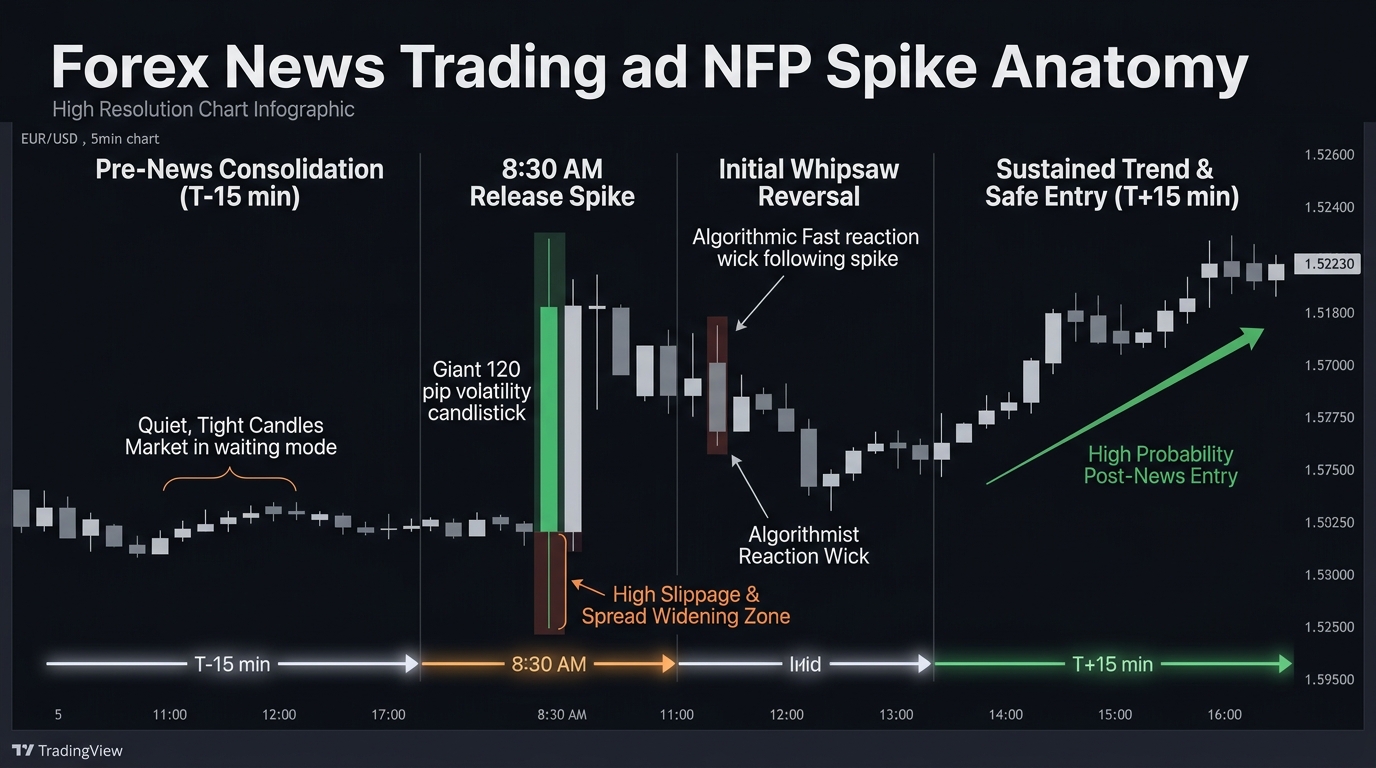
Every major economy publishes employment data. But the US Non-Farm Payrolls report — released at 08:30 EST on the first Friday of every month — is in a category by itself. In a typical NFP release, EUR/USD can move 50-150 pips within the first 60 seconds. During an extreme surprise, 200+ pip moves in seconds are documented. No other scheduled data release comes close to this market impact.
The reason is straightforward: the US economy is the world’s largest, the dollar is the global reserve currency, and employment data is the key input into Federal Reserve decision-making. A strong NFP reading — more jobs than expected — signals a healthy economy and raises the probability of rate hikes or delayed rate cuts. A weak reading signals the opposite.
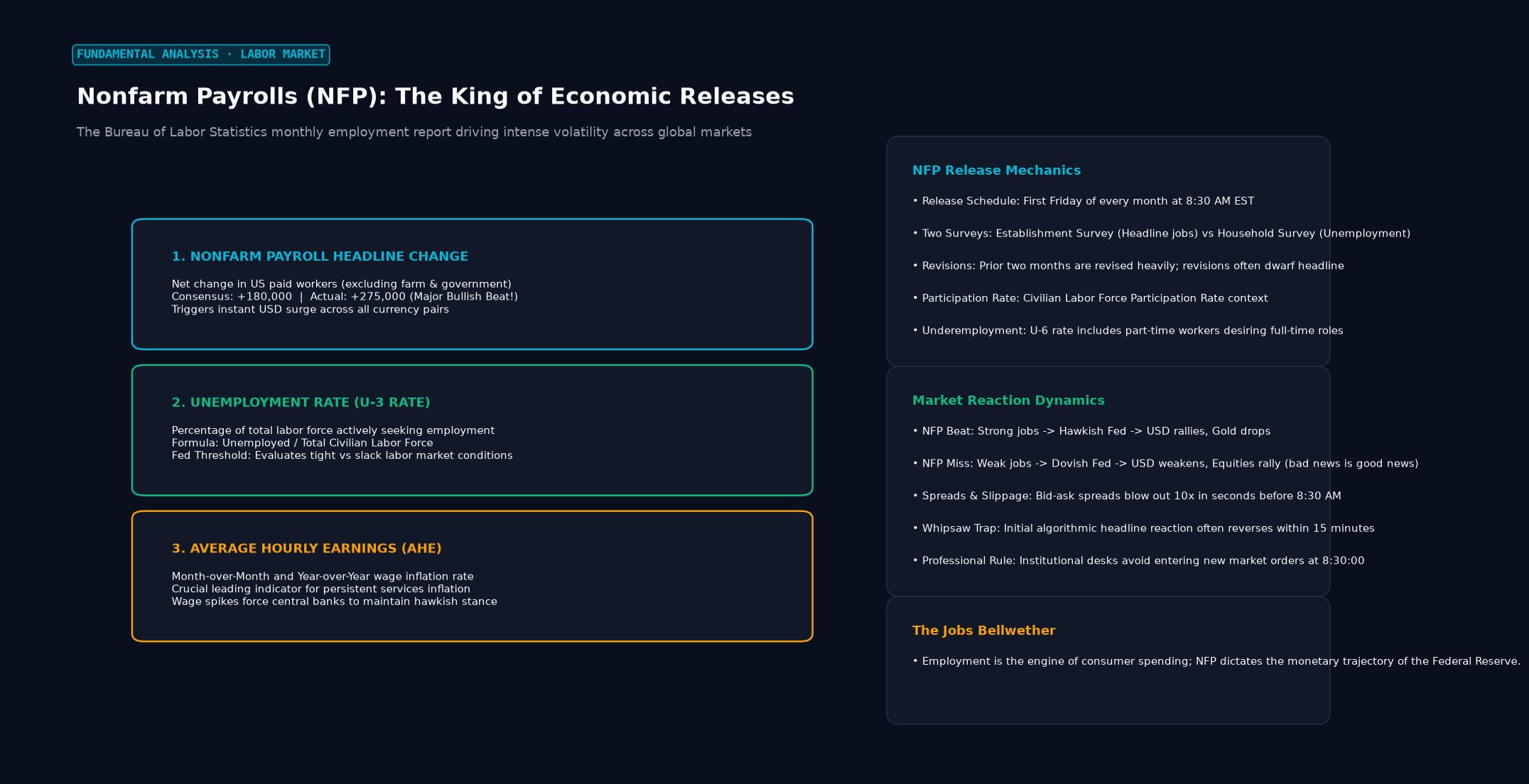 Figure: The Bureau of Labor Statistics monthly employment report driving intense volatility across global markets
What’s Inside the NFP Report
The headline NFP number — “the economy added X jobs last month” — is what generates the immediate reaction. But the full report is more nuanced:
Headline payrolls: Net job additions across all non-farm sectors. Consensus forecasts are published by major financial data providers (Bloomberg, Reuters) in the days before the release. Market reaction is driven by the surprise — the deviation from consensus.
Unemployment rate: The percentage of the labor force actively seeking work but unemployed. Often moves independently from payrolls, because it’s derived from a separate household survey. Surprises in the unemployment rate can override the payrolls reaction.
Average hourly earnings (AHE): The wage component. This is increasingly important because wages are the primary driver of services inflation — the stickiest component of the CPI basket. A strong jobs number with rising wages is more hawkish than a strong jobs number with flat wages.
Participation rate: The percentage of working-age people who are either employed or actively seeking employment. A falling unemployment rate alongside a falling participation rate is less positive — it means people are leaving the workforce, not finding jobs.
Revisions: Prior months’ data is revised with each NFP release. A “disappointing” current reading paired with large upward revisions to prior months can produce a net-positive dollar reaction. Always scan revisions before interpreting the headline.
How to Trade NFP: Approach Options
Pre-release positioning: Entering before the data based on a view on the likely outcome. Very high risk — the data release can immediately move 100+ pips against you. Generally only appropriate for traders with clear conviction and generous stops.
Post-release directional trade: Waiting for the initial spike and reversal to settle (typically 3-5 minutes), then entering in the direction of the dominant trend. This avoids the chaotic first minutes while still capturing the sustained move that often follows.
Fade the initial spike: The first move after NFP is sometimes a false breakout — price spikes one direction, fails to hold, and reverses sharply. Experienced traders watch for this pattern, particularly when the initial spike is driven by the headline but the internals (wages, revisions) tell a different story. Trading fades requires very fast execution and is high-risk.
Avoid entirely: Many professional systematic traders simply turn off their systems around NFP. The bid-ask spread widens dramatically (often 5-20 pips on EUR/USD vs. the normal 0.1-0.3), slippage is unpredictable, and the “correct” market reaction to complex data isn’t always obvious. Sometimes the best trade is no trade.
NFP and the Federal Reserve
The Fed’s dual mandate — maximum employment and price stability — means NFP data directly influences interest rate decisions. A sustained period of strong job creation (consistently above ~150,000-200,000 monthly additions) suggests the labor market is tight, inflationary pressure is building, and the Fed may need to maintain or raise rates.
A sustained period of weak payrolls (below ~100,000) suggests the economy is slowing and the Fed may shift toward cutting rates.
The path from NFP to Fed decision runs through market pricing of the federal funds futures — contracts that price the probability of rate changes at upcoming FOMC meetings. NFP surprises shift these probabilities, which in turn moves the dollar.
Key Takeaways
- NFP is released 08:30 EST on the first Friday of each month — the highest-impact scheduled forex event
- The full report includes payrolls, unemployment rate, average hourly earnings, and revisions
- Market reaction is driven by the surprise vs. consensus, not the absolute number
- Average hourly earnings (wage inflation) is increasingly the most Fed-relevant component
- Options: pre-position (high risk), post-spike entry, fade the spike, or avoid entirely
FAQ
Why are NFP forecasts often wrong? Employment data is notoriously difficult to estimate because it aggregates across hundreds of industries and uses sampling methodologies with inherent error margins. The Bureau of Labor Statistics’ own historical revision pattern shows consistent revisions of 30,000-80,000 from advance to final readings. Forecasters are essentially sampling from a highly complex system with imperfect inputs.
What happens to other markets during NFP? US equity markets, gold, oil, and US Treasury yields all react to NFP simultaneously. A very strong NFP typically: strengthens USD, pressures EUR/USD lower, temporarily pressures gold, boosts equity futures (growth signal), and raises Treasury yields (rate hike expectations). These multi-market reactions create complex cross-asset correlation during the release window.
Ready to trade forex?
Open a free demo account with a regulated broker. Practice with virtual funds before risking real money.