Inflation
Inflation is the sustained increase in the general price level of goods and services over time, which erodes the purchasing power of money. For forex traders, inflation is a critical driver of central bank policy decisions — and therefore of currency direction. Rising inflation typically leads to higher interest rates, which strengthens a currency; falling inflation often signals rate cuts ahead.
Inflation and the Currency Market
When prices rise, each unit of currency buys less than it did before. That’s the textbook definition. But for traders, the more important question isn’t what inflation does to purchasing power — it’s what inflation does to central bank behavior, and therefore to currency rates.
Central banks in most developed economies operate under a price stability mandate. The Federal Reserve, ECB, Bank of England, and most of their peers target roughly 2% annual inflation. When inflation runs meaningfully above that target, the central bank typically responds by raising interest rates — tightening monetary policy to cool demand and bring prices back under control. Higher rates attract capital flows. Capital flows strengthen the currency.
This chain — high inflation → rate hikes → currency appreciation — is why inflation data is one of the most market-moving releases on the economic calendar.
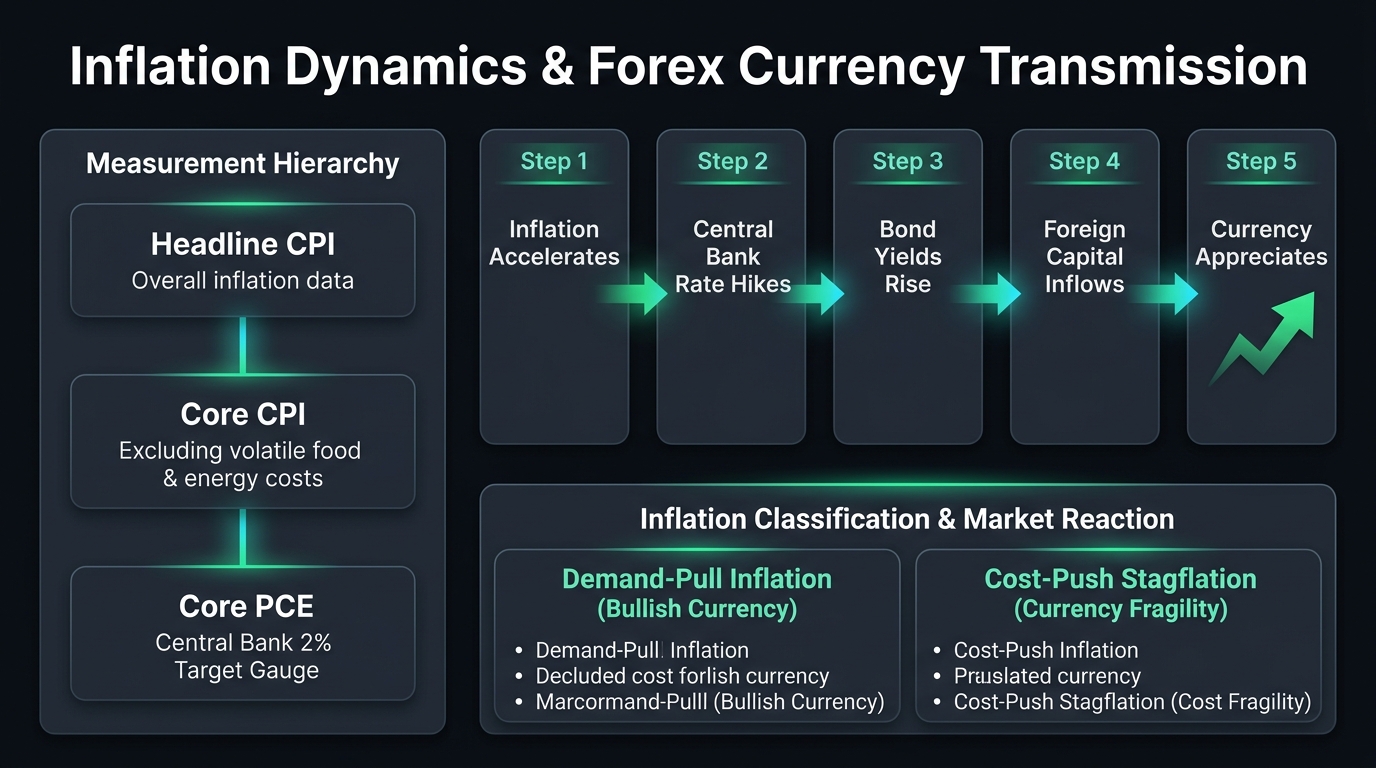
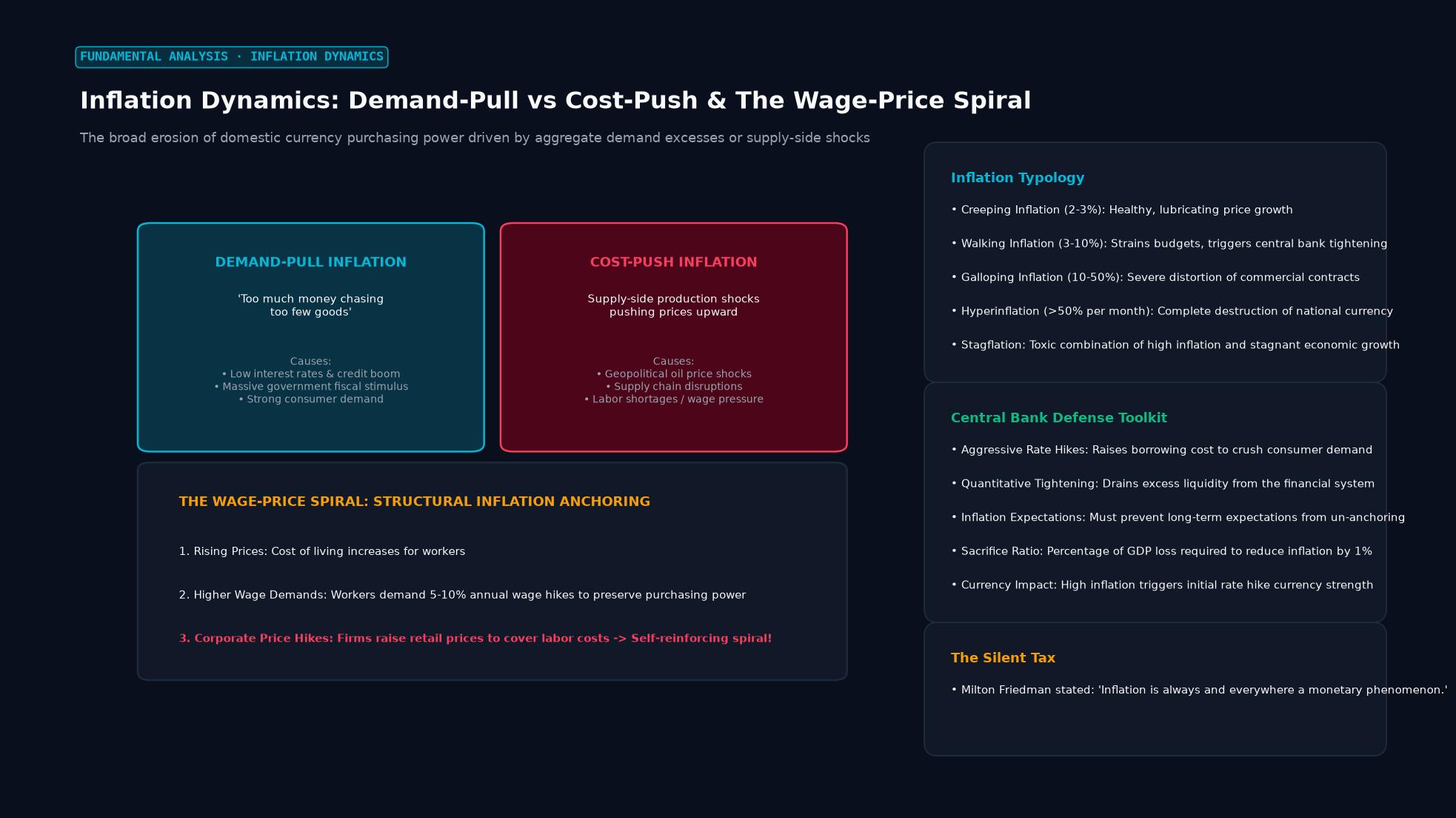 Figure: The broad erosion of domestic currency purchasing power driven by aggregate demand excesses or supply-side shocks
How Inflation Is Measured
Consumer Price Index (CPI): The most widely watched measure. Tracks the price change of a fixed basket of goods and services consumed by households — food, energy, housing, transportation, healthcare. In the US, the Bureau of Labor Statistics releases CPI monthly. The UK’s Office for National Statistics releases it similarly.
Core CPI: CPI stripped of food and energy prices, which are highly volatile and often distort the underlying trend. Central banks often look at core inflation more closely than headline CPI because it better reflects persistent price pressures.
Producer Price Index (PPI): Measures price changes at the wholesale/production level. PPI often leads CPI by a few months — when producers face higher input costs, those costs eventually pass through to consumers.
PCE (Personal Consumption Expenditures): The Federal Reserve’s preferred inflation measure. Unlike CPI which uses a fixed basket, PCE adjusts for changes in consumer spending patterns. The Fed’s 2% target is specifically referenced to core PCE.
The 2022-2023 Inflation Cycle and What It Taught Traders
The post-pandemic inflation surge provided a real-time lesson in how inflation shapes currency markets. US CPI peaked at 9.1% in June 2022 — the highest level since 1981. The Fed responded with the most aggressive rate hiking cycle in 40 years, raising rates from 0.25% to 5.50% in 14 months.
The result: the US Dollar Index (DXY) rallied from around 90 in early 2021 to 114 by September 2022 — a 27% surge driven almost entirely by the rate differential widening between the US and countries where central banks were slower to hike. EUR/USD fell below parity for the first time since 2002.
This episode demonstrated that the speed of rate hiking matters as much as the destination rate. The Fed moving faster than the ECB strengthened the dollar even though both were hiking.
Types of Inflation and Their Currency Implications
Demand-pull inflation: Rising prices caused by excess demand — consumers and businesses spending faster than the economy can produce. Typically accompanies strong growth. Currency-positive in the short term because it suggests a robust economy likely to produce rate hikes.
Cost-push inflation: Rising prices caused by supply-side shocks — energy price spikes, supply chain disruptions, commodity shortages. Typically stagflationary: prices rise but growth slows. Currency-negative or ambiguous, because the central bank faces conflicting pressures (hike to fight inflation, but the economy is already weakening).
Hyperinflation: Extreme, uncontrollable price growth — generally above 50% per month. Destroys a currency’s value rapidly. Examples: Zimbabwe (2008), Weimar Germany (1923), Venezuela (2018). In these scenarios, the currency typically becomes worthless relative to hard currencies.
Inflation Expectations vs. Actual Inflation
Markets don’t just respond to current inflation readings — they respond to where inflation is expected to go. The University of Michigan Consumer Sentiment Survey, 5-year breakeven inflation rates (derived from Treasury Inflation-Protected Securities), and Fed surveys of inflation expectations are watched as leading indicators.
If inflation is running at 5% today but markets believe it will fall to 2% within 12 months, the central bank may pause rate hikes in anticipation — and the currency may weaken despite the high current reading. Conversely, if inflation appears sticky and expectations aren’t anchoring to target, the market prices in more rate hikes and the currency strengthens.
Key Takeaways
- Inflation above the 2% central bank target typically triggers rate hikes, which strengthen currency
- CPI is the primary inflation measure; core CPI (ex food and energy) reveals underlying trends
- Cost-push inflation is currency-ambiguous; demand-pull inflation is typically currency-positive
- Inflation expectations often matter more to currency markets than current inflation data
- The Fed uses core PCE (not CPI) as its primary 2% inflation benchmark
FAQ
Why does high inflation sometimes weaken a currency? If inflation is accompanied by economic stagnation (stagflation), the central bank faces a dilemma: hike rates to fight inflation and risk recession, or hold rates to support the economy and accept persistent inflation. This uncertainty undermines the currency because rate hike expectations are less reliable.
What is disinflation vs. deflation? Disinflation is a falling rate of inflation — prices still rising, but more slowly. Deflation is prices actually falling. Disinflation is generally benign and often allows central banks to cut rates. Deflation is dangerous because it creates incentives to delay purchases (waiting for lower prices), suppressing demand and creating a deflationary spiral.
Ready to trade forex?
Open a free demo account with a regulated broker. Practice with virtual funds before risking real money.