BBD
The ISO 4217 currency code for the Barbados Dollar, the official legal tender of Barbados, pegged to the United States Dollar at a fixed rate of 2:1 since 1975.
What is the BBD (Barbados Dollar)?
BBD is the three-letter international currency code designated under ISO 4217 for the Barbados Dollar, the official legal tender of the Caribbean island nation of Barbados. Denominated with the dollar sign ($) or Bds$ to distinguish it from other dollar currencies, the currency is subdivided into 100 cents. The Central Bank of Barbados (CBB), founded under the Central Bank of Barbados Act of 1972, possesses the exclusive statutory authority to issue banknotes, mint circulation coinage, and manage the nation foreign exchange reserves.
The defining characteristic of the Barbados Dollar in global foreign exchange markets is its fixed exchange rate regime. On July 5, 1975, the government severed its historical peg to the British Pound Sterling (GBP) and established a permanent peg to the United States Dollar (USD) at a parity of exactly 2.00 BBD per 1.00 USD. This parity has remained unbroken for over fifty years, anchoring domestic price stability and international trade in the eastern Caribbean.
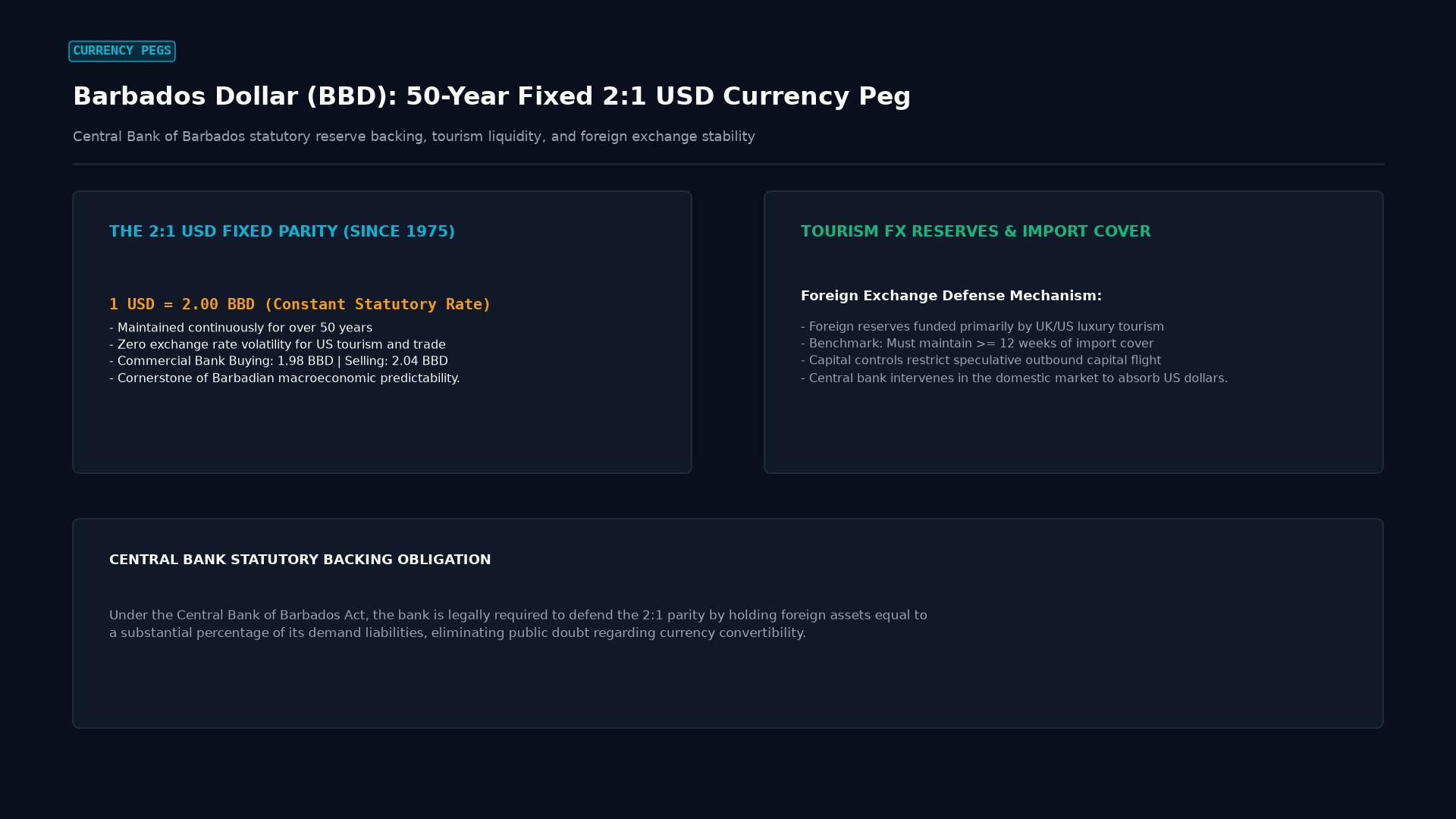 Figure: Fixed parity anchor: Central Bank of Barbados statutory 2:1 USD currency peg maintained since 1975 backed by tourism foreign reserve cushions.
Monetary Architecture: The 2:1 Parity Mechanism
Maintaining a hard currency peg requires the Central Bank of Barbados to operate an active reserve management and exchange control system. Unlike floating currencies whose valuations fluctuate according to supply and demand across global electronic communication networks (ECNs), the value of the BBD is maintained by administrative intervention.
Reserve Backing and Import Cover
The central bank must maintain a substantial cushion of foreign currency assets, denominated predominantly in US Treasury bills, liquid cash deposits with foreign central banks, and Bank for International Settlements (BIS) reserves.
Under macroeconomic monitoring frameworks conducted by the International Monetary Fund (IMF), reserve adequacy for a small island developing state (SIDS) is evaluated through import cover:
$$\text{Import Cover (Weeks)} = \frac{\text{Net Foreign Reserves}}{\text{Average Weekly Cost of Goods and Services Imports}}$$
The CBB targets a minimum reserve buffer of 12 to 14 weeks of import cover. If external shocks compress foreign currency reserves toward critical levels, the central bank implements domestic credit rationing and monetary tightening to suppress import demand, thereby safeguarding the 2:1 peg.
+------------------------------------+------------------------------------+
| Fixed Peg Benefits                 | Structural Vulnerabilities         |
+------------------------------------+------------------------------------+
| Eliminates foreign exchange risk   | Total loss of independent monetary |
| for US investors and tourists.     | policy (must shadow US Fed cycles).|
|                                    |                                    |
| Stabilizes domestic inflation by   | Vulnerable to global energy price  |
| anchoring import price baselines.  | shocks and tourism downturns.      |
|                                    |                                    |
| Fosters confidence in domestic     | Strict exchange controls required  |
| financial institutions and debt.   | to prevent capital flight.         |
+------------------------------------+------------------------------------+
Foreign Exchange Controls and Commercial Regulations
Barbados maintains exchange control regulations administered by the Central Bank of Barbados under the Exchange Control Act:
- Foreign Exchange Fee (FXF): Transactions involving foreign currency purchases incur a statutory foreign exchange transaction fee, implemented to discourage non-essential outflows and generate fiscal revenues.
- Authorized Dealers: All foreign exchange transactions must be conducted through licensed commercial banks acting as authorized dealers. Commercial banks operate within narrow bid-ask margins approved by the central bank (typically buying USD at 1.98 BBD and selling at 2.02 BBD).
- Surrender Requirements and Capital Repatriation: Exporters and hospitality operators generating foreign currencies are required to settle receipts through the domestic banking system. Non-residents investing capital into real estate or registered enterprises must obtain central bank certification to ensure guaranteed profit and principal repatriation.
Economic Drivers of BBD Inflows
Because Barbados is a services-dependent economy with limited natural mineral resources, its balance of payments depends heavily on specific export categories:
  Economic Sector            Primary Currency Inflows    Macroeconomic Sensitivity
  -----------------------------------------------------------------------------------
  Tourism & Hospitality      USD, GBP, CAD               High (Global consumer cycles)
  International Business     USD                         Moderate (Global tax rules)
  Agricultural Exports       USD, CARICOM Currencies     Low (Specialty sugar, rum)
  Diaspora Remittances       USD, GBP, CAD               Counter-cyclical cushion
Tourism represents the dominant engine of foreign currency generation, contributing directly to domestic gross domestic product and tax receipts. When international leisure travel contracts, foreign currency receipts dry up, forcing the central bank to utilize its reserves to satisfy import invoices for petroleum products, manufacturing machinery, and food supplies.
Sovereign Debt Restructuring: The BERT Plan
Between 2010 and 2018, fiscal deficits and debt accumulation drove public debt past 150% of GDP, severely depleting foreign exchange reserves and raising speculation regarding a potential currency devaluation. In 2018, the administration initiated the Barbados Economic Recovery and Transformation (BERT) program, supported by an IMF Extended Fund Facility (EFF).
The program executed a comprehensive domestic and external sovereign debt restructuring while strictly defending the 2.00 BBD peg. The successful execution restored central bank foreign reserves to record levels, proving the political commitment to preserving the currency peg.
Trading Mechanics and Financial Market Access
In international financial markets, the Barbados Dollar is classified as an exotic, illiquid currency. It does not trade on standard retail forex brokerage platforms:
- Non-Deliverable Forwards (NDFs): Large institutional investors and multinational corporations hedging long-term exposure utilize offshore non-deliverable forwards. In an NDF, counterparties agree on an exchange rate at inception and settle the net profit or loss in USD upon maturity, circumventing domestic capital controls.
- Dual-Currency Retail Circulation: Within Barbados, the US Dollar circulates freely alongside the Barbados Dollar in hotels, restaurants, and retail shops. Commercial entities accept USD cash at the standardized rate of 1.00 USD = 2.00 BBD, providing instant liquidity for tourists while channeling physical USD banknotes directly into commercial bank vaults.
- CARICOM Settlement: Within the Caribbean Community (CARICOM), central banks maintain regional clearing arrangements, permitting bilateral trade settlements across regional currencies like the Trinidad and Tobago Dollar (TTD) and Jamaican Dollar (JMD) based on cross-rates anchored back to the US Dollar.
Frequently Asked Questions
Can retail forex traders trade the BBD on MetaTrader or standard online brokerages?
No. Because the Barbados Dollar is bound by capital controls, does not clear via the Continuous Linked Settlement (CLS) system, and is pegged to the USD, retail FX brokerages do not offer spot BBD pairs. Speculative trading volume is practically nonexistent; transactions are confined to commercial settlement, trade finance, and travel exchange.
What is the penalty for exceeding foreign exchange allowances in Barbados?
Exchanging foreign currency without central bank authorization or attempting to smuggle hard currency outside statutory limits violates the Exchange Control Act. Offenses carry significant administrative penalties, forfeiture of the underlying funds, and potential criminal prosecution under national financial statutes.
Why doesn’t Barbados allow the currency to float freely?
A free-floating currency for an import-dependent island economy of roughly 300,000 residents would introduce severe exchange rate volatility. Devaluation would immediately cause sharp increases in the local cost of imported food, medical supplies, and fuel, triggering rapid domestic inflation without boosting physical manufacturing exports.
Ready to trade forex?
Open a free demo account with a regulated broker. Practice with virtual funds before risking real money.