BHD
The ISO 4217 currency code for the Bahraini Dinar, the official legal tender of the Kingdom of Bahrain, pegged to the United States Dollar at 0.376 BHD per 1 USD.
What is the BHD (Bahraini Dinar)?
BHD is the ISO 4217 currency code for the Bahraini Dinar, the national currency of the Kingdom of Bahrain. Denominated with the currency symbol BD or .د.ب and subdivided into 1,000 fils, the Dinar is issued and administered by the Central Bank of Bahrain (CBB), which succeeded the Bahrain Monetary Agency in 2006.
In the hierarchy of global currencies, the Bahraini Dinar commands one of the most distinctive profiles. It ranks as the second highest-valued legal tender unit in the world, surpassed only by the Kuwaiti Dinar (KWD). The high nominal value of the Dinar is anchored by a formal fixed exchange rate to the United States Dollar at the official rate of:
$$1.00 \text{ USD} = 0.3760 \text{ BHD} \quad \Longleftrightarrow \quad 1.00 \text{ BHD} \approx 2.65957 \text{ USD}$$
This peg stabilizes Bahrain’s petrodollar export earnings, underpins its domestic price structure, and provides certainty for its expansive offshore and Islamic banking ecosystem.
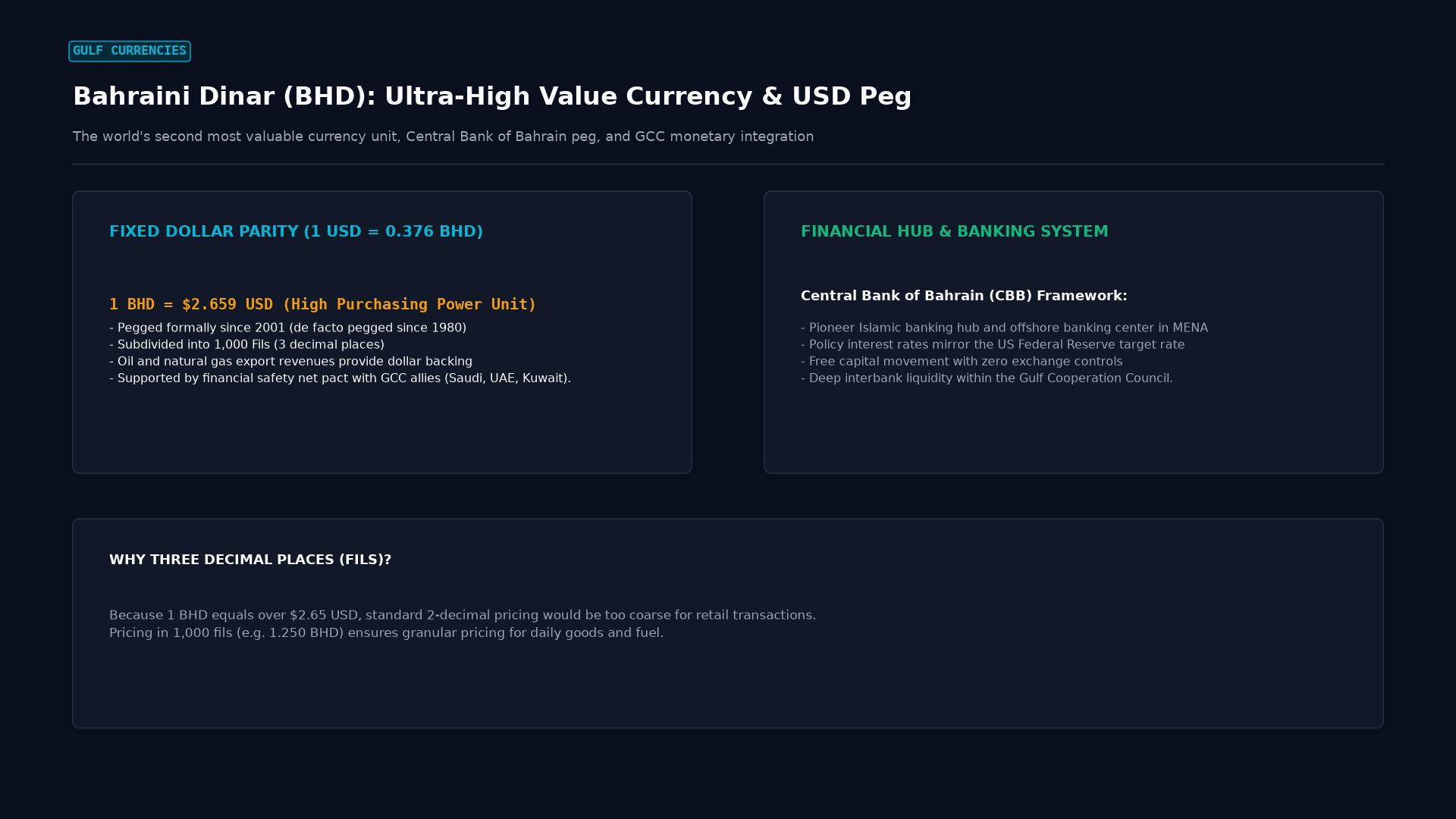 Figure: High-value currency architecture: fixed peg of 0.376 BHD per USD ($2.659 USD purchasing power per dinar), 1,000 fils subdivision, and GCC fiscal safety net.
Historical Context and Currency Evolution
Before the introduction of the modern Dinar, Bahrain, along with several other Persian Gulf states, relied on the Gulf Rupee, a regional currency issued by the Reserve Bank of India pegged at par to the Indian Rupee. In October 1965, Bahrain replaced the depreciating Gulf Rupee with its own currency, introducing the Bahraini Dinar at a rate of 10 Gulf Rupees per 1 Dinar. Between 1966 and 1973, the Bahraini Dinar also served as the official legal tender of the Emirate of Abu Dhabi until the creation of the United Arab Emirates Dirham (AED).
The Dinar was initially pegged to the Special Drawing Right (SDR) of the International Monetary Fund. In practice, because Bahrain’s oil revenues were invoiced in US Dollars, the currency shadowed the greenback. In 2001, Bahrain formalized this relationship by statutorily fixing the Dinar directly to the US Dollar at 0.376 BHD, cementing its role in the global petrodollar recycling system.
Macroeconomic Foundations: Hydrocarbons and Financial Services
While Bahrain was the first Gulf state to discover commercial crude oil in 1932, it possesses smaller petroleum reserves than neighboring Saudi Arabia, Kuwait, or the UAE. Consequently, Bahrain pioneered economic diversification decades ahead of its regional peers:
  Economic Pillar             Gross Output Share    Primary FX Channel
  -----------------------------------------------------------------------------------
  Petroleum & Refining        ~15 - 20% of GDP      Crude oil & refined exports (USD)
  Financial Services          ~17% of GDP           Offshore & Islamic banking flows
  Aluminum Manufacturing      ~12% of GDP           Aluminium Bahrain (Alba) exports
  Logistics & Transport       ~7% of GDP            Khalifa Bin Salman Port hub
Bahrain established itself as the premier hub for Islamic finance in the Middle East, hosting standard-setting bodies including the Accounting and Auditing Organization for Islamic Financial Institutions (AAOIFI). The stability of the 0.376 USD peg ensures that regional cross-border Sukuk issuances and Islamic syndicated loan facilities clear with minimal exchange rate friction.
The 2018 GCC Fiscal Balance Program
Maintaining a hard currency peg requires strong fiscal health and deep foreign exchange reserves. In the mid-2010s, prolonged periods of low global oil prices placed significant pressure on Bahrain’s fiscal budget and balance of payments, causing gross foreign reserves to contract toward critical levels.
+------------------------------------+------------------------------------+
| External Shocks to the Peg         | The GCC Solidarity Shield          |
+------------------------------------+------------------------------------+
| Fiscal deficits widened past       | In October 2018, Saudi Arabia, the |
| 10% of GDP during the oil slump.   | UAE, and Kuwait pledged a $10B     |
|                                    | financial support package.         |
| Foreign reserves dipped below one  |                                    |
| month of prospective import cover. | Capital was tied to structural     |
|                                    | fiscal consolidation (Value-Added  |
| Sovereign bond yields surged as    | Tax introduced, energy subsidies   |
| credit default swap spreads widened| rationalized, spending capped).    |
+------------------------------------+------------------------------------+
The $10 billion GCC financial package demonstrated that the Gulf states view the preservation of member currency pegs as a vital collective interest. The financial backstop replenished the CBB foreign currency reserves, restored market confidence, and eliminated speculative short positions betting against the BHD peg.
Central Bank Monetary Tools and Banking Regulation
Because the Dinar is locked to the dollar, the Central Bank of Bahrain cannot pursue an independent monetary policy. Under the classic monetary policy trilemma, having a fixed exchange rate and free capital mobility requires domestic interest rates to mirror the US Federal Reserve:
- Policy Interest Rate Corridor: When the Federal Reserve adjusts the federal funds rate, the CBB immediately mirrors the move across its key policy rates: the one-week deposit rate, overnight deposit rate, four-week deposit rate, and lending repo rate.
- Bahrain Interbank Offered Rate (BHIBOR): Commercial banks price domestic corporate and retail loans off BHIBOR, which closely tracks USD LIBOR (and its successor, Secured Overnight Financing Rate / SOFR), loaded with a localized liquidity spread.
- Islamic Liquidity Management: Because conventional interest-bearing repos violate Sharia principles, the CBB issues short-term Islamic Sukuk (Sukuk Al-Salam and Sukuk Al-Ijarah) to manage liquidity within Islamic retail and wholesale banks.
Foreign Exchange Market Mechanics
In wholesale foreign exchange markets, trading the BHD involves specific technical conventions:
- Three-Decimal Quotation: Unlike standard major currency pairs (such as EUR/USD or USD/JPY) quoted to four or two decimal places, the Bahraini Dinar is formally quoted to three decimal places. Financial accounting systems and SWIFT transfer messages must support three-decimal arithmetic (e.g., 1 USD = 0.376 BHD, or BD 1,250.750).
- Onshore Interbank Spreads: The Central Bank of Bahrain enforces an interbank trading band, buying US Dollars from commercial banks at 0.3750 BHD and selling at 0.3770 BHD. Retail exchange bureaus operate within slightly wider margins to cover cash handling and compliance overhead.
- Offshore NDF Hedging: Multinational corporations and asset managers hedging Bahrain sovereign risk utilize USD/BHD Non-Deliverable Forwards traded primarily in London and Dubai, where contractual pricing reflects forward interest rate differentials and long-term sovereign risk premiums.
Frequently Asked Questions
Why is the Bahraini Dinar worth more than the US Dollar and Euro?
The nominal value of a single currency unit is an arbitrary historical baseline established when the national currency was designed. In 1965, the Bahrain government set 1 Dinar equal to 10 Gulf Rupees, establishing a high nominal baseline. A high currency unit value does not inherently indicate economic power; rather, it reflects historical unit sizing backed by strict central bank foreign currency reserves.
Does Bahrain impose capital controls on moving Dinars abroad?
No. Bahrain maintains an open capital account with zero restrictions on the repatriation of profits, capital, or foreign currency dividends. Investors can freely convert BHD into USD, EUR, or other major currencies and transfer funds globally through commercial banking channels.
How does the King Fahd Causeway affect currency circulation in Bahrain?
The 25-kilometer King Fahd Causeway links Bahrain directly to the Eastern Province of Saudi Arabia. Due to heavy daily cross-border business and tourism, the Saudi Riyal (SAR) circulates widely throughout Bahrain. Retail merchants, hotels, and restaurants accept SAR cash at the standardized conversion rate of 10 SAR = 1 BHD (as both currencies maintain coordinated pegs to the US Dollar).
Ready to trade forex?
Open a free demo account with a regulated broker. Practice with virtual funds before risking real money.