BTN
The ISO 4217 currency code for the Bhutanese Ngultrum, the official legal tender of the Kingdom of Bhutan, pegged at 1:1 parity with the Indian Rupee.
What is the BTN (Bhutanese Ngultrum)?
BTN is the ISO 4217 currency code for the Bhutanese Ngultrum, the national legal tender of the Kingdom of Bhutan. Represented locally by the symbol Nu and subdivided into 100 chhertum, the Ngultrum was introduced in 1974, replacing the historical Bhutanese Rupee at par. The Royal Monetary Authority (RMA) of Bhutan, established under the Royal Monetary Authority Act of 1982, serves as the central bank responsible for issuing banknotes, regulating the financial sector, and managing the kingdom foreign exchange reserves.
In global foreign exchange and macroeconomics, the Bhutanese Ngultrum is defined by its hard peg to the Indian Rupee (INR). By treaty and monetary policy, the Ngultrum is pegged at an exact 1:1 ratio with the Indian Rupee:
$$1.00 \text{ BTN} = 1.00 \text{ INR}$$
Under this framework, the Indian Rupee circulates as de facto legal tender alongside the Ngultrum throughout the kingdom, reflecting Bhutan’s geographical, historical, and commercial integration with the Indian economy.
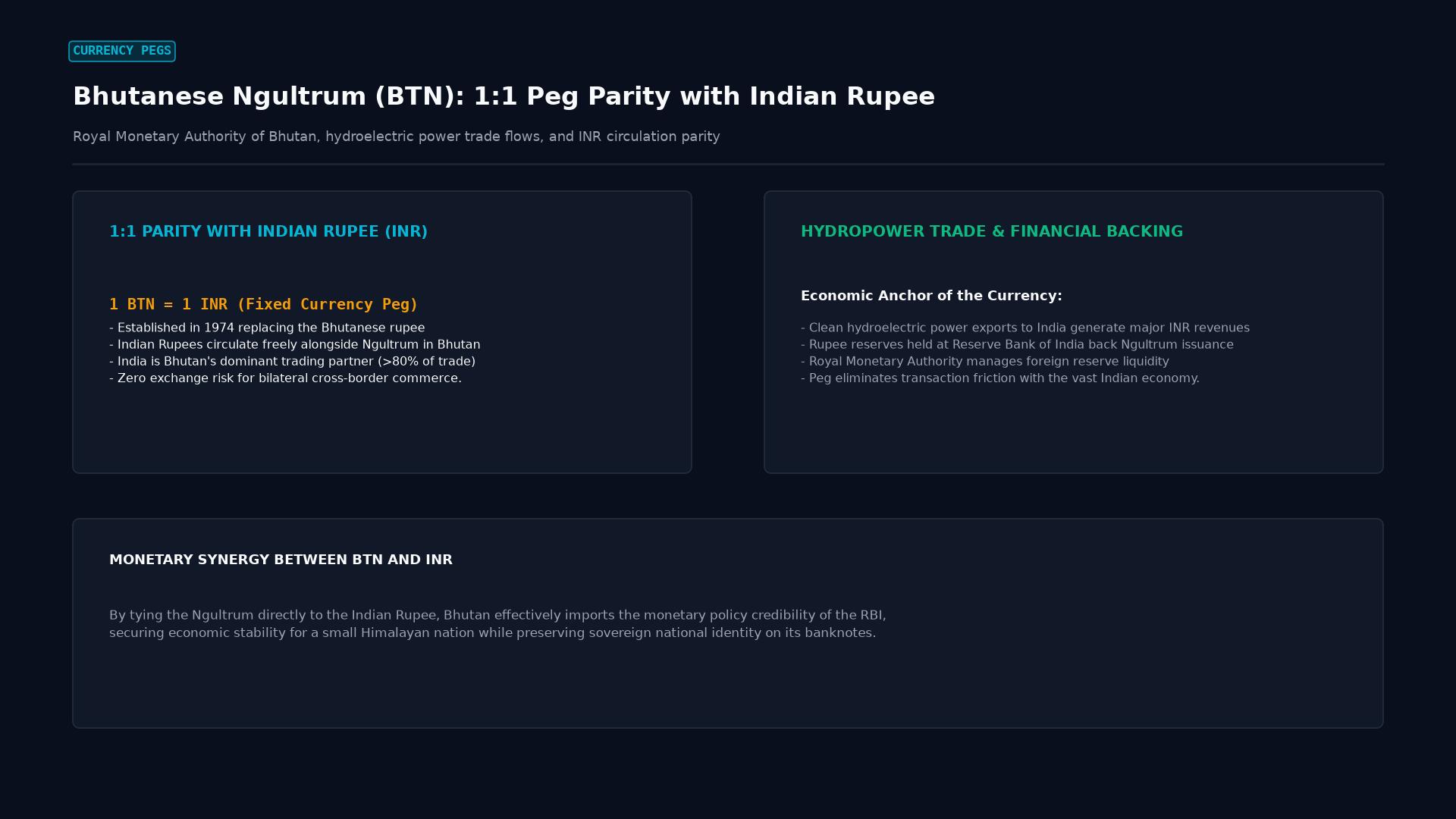 Figure: Bilateral monetary integration: 1:1 parity peg with the Indian Rupee (INR), Royal Monetary Authority reserves, and clean hydroelectric export revenues.
The 1:1 Parity Mechanism with the Indian Rupee
The fixed parity arrangement between the Ngultrum and the Indian Rupee is rooted in trade geography. Landlocked in the eastern Himalayas between India and China, Bhutan conducts over 80% of its total international trade with the Republic of India. Nearly all of Bhutan consumer goods, industrial equipment, petroleum products, and building materials originate from Indian suppliers.
+------------------------------------+------------------------------------+
| Advantages of 1:1 INR Parity       | Vulnerabilities and Pass-Through   |
+------------------------------------+------------------------------------+
| Complete elimination of currency   | Imported Indian inflation: When    |
| risk for bilateral commerce.       | Indian CPI spikes, Bhutanese prices|
|                                    | rise proportionally.               |
|                                    |                                    |
| Seamless cross-border trade        | Total absence of independent       |
| settlement without FX conversion.  | monetary policy (Bhutan mirrors RBI|
|                                    | repo and cash reserve directives). |
|                                    |                                    |
| Guaranteed convertibility backed   | Periodic INR liquidity squeezes if |
| by credit lines with RBI.          | trade deficits outpace power sales.|
+------------------------------------+------------------------------------+
Because of this parity, the Indian Rupee (in denominations up to 100, and often higher notes subject to regulatory accords) is accepted universally across Bhutanese retail markets. Conversely, because Bhutan is a much smaller economic entity, the Ngultrum does not circulate within mainland India, requiring travelers and merchants to convert BTN into INR before departing Bhutan.
Macroeconomic Engine: Hydropower Exports
The cornerstone of Bhutan external economic stability and currency backing is run-of-the-river hydroelectric power. Glacial rivers flowing through steep Himalayan valleys provide massive renewable electricity potential. Developed largely in financial partnership with the Government of India through a mix of bilateral grants and concessional loans, major projects (including Chukha, Tala, Mangdechhu, and Punatsangchhu) generate substantial power:
$$\text{Hydropower Trade Surplus} = \text{Bilateral Power Export Receipts (INR)} - \text{Project Debt Service (INR)}$$
During the summer monsoon months, Bhutan generates substantial surplus electricity, exporting clean power across high-voltage transmission lines into the northern and eastern grids of India. These electricity exports provide a steady, predictable inflow of Indian Rupees, replenishing the RMA reserves and funding the procurement of essential goods.
Constitutional Reserve Mandate and Management
Bhutan possesses a rare and rigorous constitutional requirement regarding foreign reserve adequacy. Under Article 14, Section 7 of the Constitution of the Kingdom of Bhutan:
“A minimum foreign currency reserve that is adequate to meet the cost of not less than one year’s essential imports shall be maintained.”
The RMA manages two distinct pools of foreign reserves to fulfill this constitutional obligation:
- Indian Rupee Reserves: High-liquidity INR accounts held with the Reserve Bank of India and commercial banks, utilized for daily trade settlements and loan servicing.
- Convertible Currency (CC) Reserves: Holdings denominated in United States Dollars, Euros, Japanese Yen, and British Pounds Sterling, utilized to purchase capital goods from non-Indian suppliers and service multilateral debt from the Asian Development Bank (ADB) and the World Bank.
  Reserve Category       Target Assets                           Operational Purpose
  -----------------------------------------------------------------------------------
  Rupee Reserves         Cash balances with RBI, T-bills         Daily Indian trade settlements
  Convertible Reserves   US Treasuries, SDRs, multilateral cash  Global imports & non-INR debt
  Constitutional Rule    >= 12 Months of Essential Imports       National economic security
Exchange Controls, Digital Assets, and Sovereign Mining
The Royal Monetary Authority enforces strict foreign exchange regulations under the Foreign Exchange Rules and Regulations:
- Capital Account Restrictions: The Ngultrum is convertible on the current account for documented trade and educational travel, but capital outflows are tightly controlled. Domestic citizens cannot freely invest in foreign equity markets or offshore bank accounts.
- Convertible Currency Quotas: Commercial banks require central bank approval before allocating US Dollars or other convertible currencies to importers, prioritizing food, medical supplies, and industrial machinery over consumer luxury items.
- Sovereign Green Bitcoin Mining: In a pioneering diversification strategy, Bhutan state investment arm (Druk Holding and Investments / DHI) and the royal government directed surplus zero-carbon hydropower into sovereign Bitcoin mining operations. These digital assets provide an alternative sovereign reserve buffer, generating non-debt convertible asset holdings that can be liquidated into USD during external liquidity shocks.
Trading Conventions and International Clearance
Because the Ngultrum is not traded on international foreign exchange communication networks (such as EBS or Refinitiv Dealing), institutional pricing is derived purely via triangular arbitrage through the USD/INR currency pair:
$$\text{USD/BTN Spot} = \text{USD/INR Spot}$$
$$\text{EUR/BTN Spot} = \text{EUR/INR Spot}$$
If the Reserve Bank of India intervenes to stabilize the Rupee at 83.50 INR per US Dollar, the official exchange rate for the Bhutanese Ngultrum is automatically fixed at 83.50 BTN per US Dollar. International financial institutions, tourism operators, and development agencies settle transactions through correspondent banking accounts maintained by the Bank of Bhutan or Druk PNB Bank with global custodian banks.
Frequently Asked Questions
Can an international tourist use US Dollars or Indian Rupees in Bhutan?
Yes. Indian Rupees are accepted universally across Bhutan at 1:1 parity with the Ngultrum. Major tourist hotels, authorized handicraft retailers, and trekking agencies accept US Dollars cash or major international credit cards, although local rural markets prefer Ngultrum or Rupee cash for smaller transactions.
What is the historic background of the 2012 Rupee liquidity crisis in Bhutan?
In 2012, an explosion in vehicle imports and private construction projects dramatically outpaced hydropower revenues, exhausting Bhutan liquid Indian Rupee reserves. The RMA was forced to borrow commercial INR credit lines and temporarily ban the import of non-essential vehicles and construction materials until rupee reserves were stabilized.
How does the RMA adjust monetary policy if Bhutan experiences high domestic inflation?
Because the currency is pegged 1:1 to the Indian Rupee and capital flows across the Indian border are largely seamless, the RMA has limited room for independent interest rate policy. If Bhutan raises interest rates significantly above Indian rates, capital surges across the border; if it cuts rates too far, capital drains into higher-yielding Indian bank deposits. The RMA relies primarily on regulatory reserve ratios and selective credit quotas rather than headline interest rate shifts.
Ready to trade forex?
Open a free demo account with a regulated broker. Practice with virtual funds before risking real money.