INR
INR is the ISO 4217 currency code for the Indian Rupee, the official legal tender of the Republic of India, regulated under a managed floating exchange rate regime by the Reserve Bank of India.
The Indian Rupee (ISO code: INR, symbol: ₹) is the official currency of the Republic of India, the fifth-largest economy in the world, the most populous nation on earth, and the fastest-growing major economic power in the G20. Regulated by the Reserve Bank of India (RBI), the nation’s central bank established in Mumbai, the rupee operates under a managed floating exchange rate system. Anchored by the RBI’s strategic mandate to contain excessive currency volatility while maintaining an independent inflation-targeting monetary policy, the rupee’s external value reflects a balance between massive service export earnings and family remittances against heavy structural reliance on imported crude oil and industrial electronics.
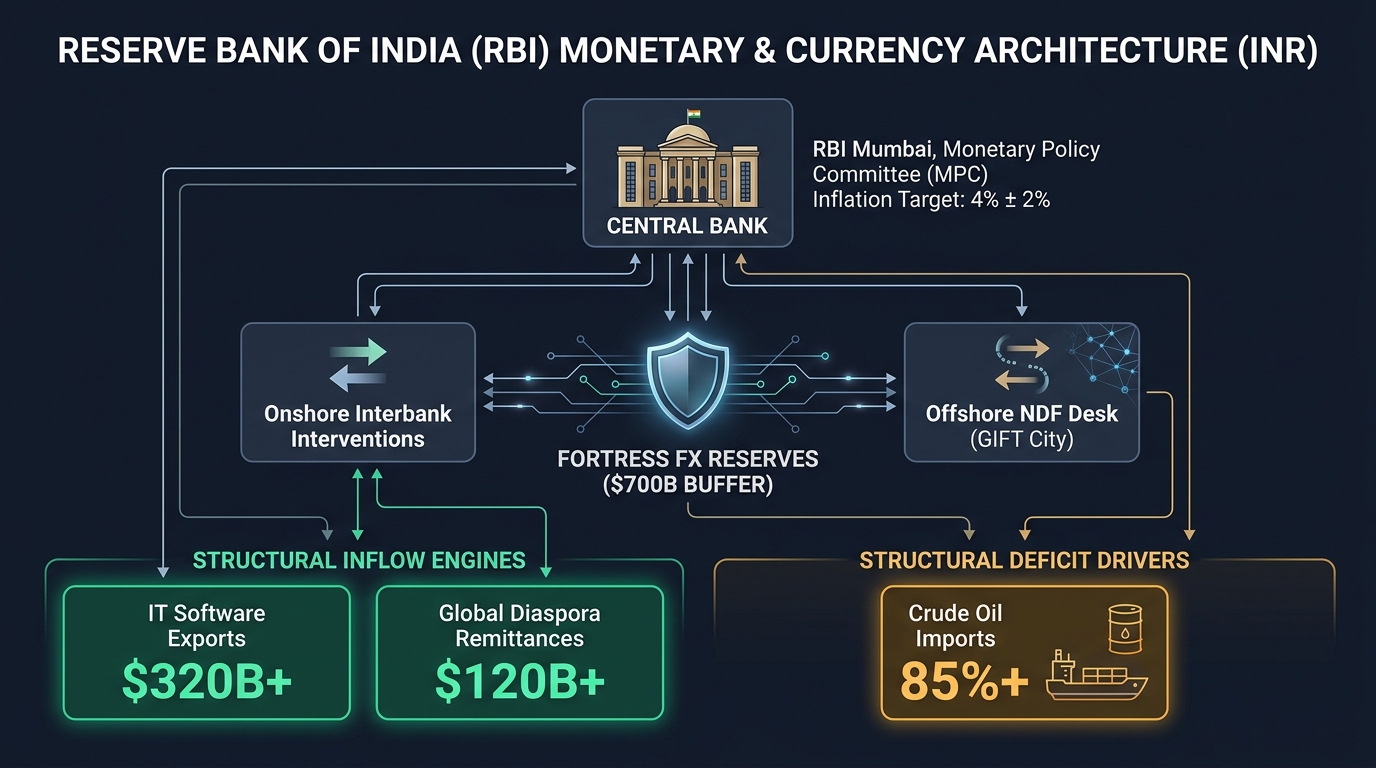
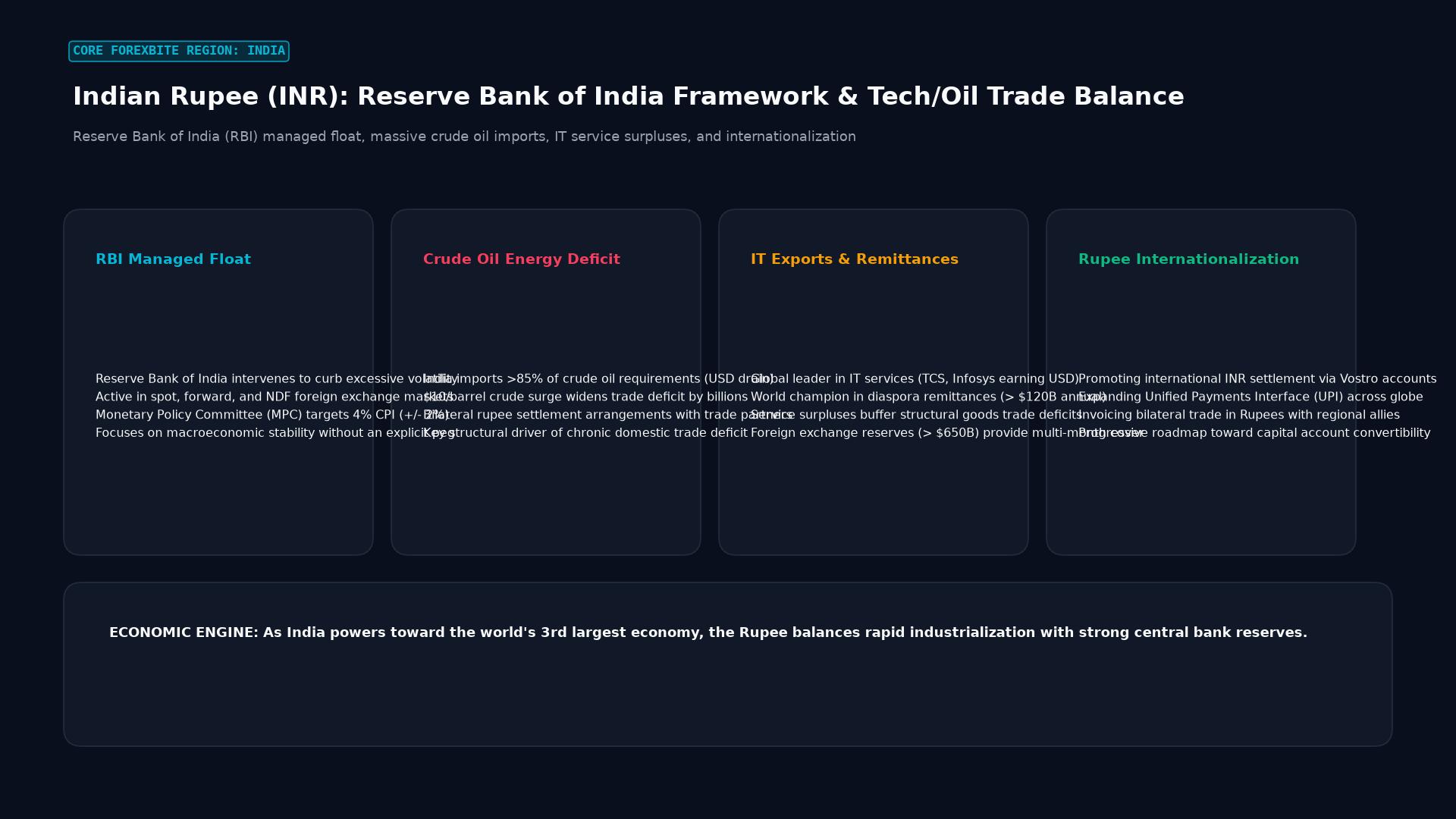 Figure: Reserve Bank of India (RBI) managed float, massive crude oil imports, IT service surpluses, and internationalization
Historical Lineage: From Sher Shah Suri to the 1991 Crisis
The lineage of the rupee traces to the sixteenth century, when Afghan ruler Sher Shah Suri reformed northern India’s monetary system in 1540, introducing a standard silver coin weighing 178 troy grains known as the rupiya (from the Sanskrit rupyakam, meaning “stamped silver”). This silver standard was maintained by the Mughal Empire and adopted by the British East India Company.
Throughout the nineteenth century, the rupee operated on a monometallic silver standard. When global silver discoveries caused the value of silver to collapse relative to gold in the 1870s, the rupee experienced historic depreciation against the gold-backed British Pound Sterling, an episode commemorated in financial history as the “Fall of the Rupee.”
Modern Indian financial history was permanently transformed by the Balance of Payments Crisis of 1991:
- Decades of closed-economy import substitution policies (License Raj) and heavy fiscal deficits exhausted sovereign foreign reserves.
- By mid-1991, India’s gross foreign exchange reserves dropped below 1.2 billion dollars, barely sufficient to finance three weeks of essential imports.
- To avert default, the transitional government executed an emergency airlift of 47 tons of physical gold to the Bank of England and Union Bank of Switzerland as collateral to secure an emergency International Monetary Fund credit facility.
- In July 1991, Prime Minister P.V. Narasimha Rao and Finance Minister Manmohan Singh launched sweeping economic liberalization reforms (Liberalization, Privatization, Globalization, or LPG).
- In March 1993, India unified its exchange rate under the Liberalized Exchange Rate Management System (LERMS), abolishing dual rates and adopting a market-determined managed floating exchange rate.
On November 8, 2016, Prime Minister Narendra Modi enacted history’s most aggressive modern cash demonetization: declaring that all existing ₹500 and ₹1,000 banknotes (accounting for 86 percent of the nation’s total circulating currency) were invalid overnight. Citizens were required to deposit old notes into formal bank accounts within 50 days, an action that temporarily disrupted consumer spending but permanently catalyzed India’s transition to digital banking and mobile payments via the Unified Payments Interface (UPI).
The currency is subdivided into 100 paise. Modern banknotes circulate in denominations of ₹10, ₹20, ₹50, ₹100, ₹200, and ₹500 (with the ₹2,000 banknote formally withdrawn from circulation in 2023). All modern notes feature the portrait of Mahatma Gandhi.
The Reserve Bank of India’s Exchange Rate Doctrine
The official stance of the Reserve Bank of India regarding foreign exchange management is clear: the RBI does not target a specific level or band for the rupee; its sole objective is to contain excess volatility and maintain orderly market conditions.
In operational reality, under governors Raghuram Rajan, Urjit Patel, and Shaktikanta Das, the RBI has developed one of the world’s most proactive central banking intervention architectures:
- Asymmetric Inflow Absorption: When global institutional portfolio capital surges into Indian equities or major Indian corporate debt issuances, the RBI aggressively purchases US dollars in the spot and forward markets. This intervention prevents premature rupee appreciation (which would harm Indian manufacturing and software competitiveness) while systematically building an enormous sovereign foreign exchange reserve fortress.
- Fortress Reserves ($650B - $700B+): As of the mid-2020s, India maintains the fourth-largest foreign exchange reserves on earth, exceeding 650 to 700 billion US dollars. This cushion covers more than 11 to 12 months of projected imports, immunizing the sovereign from speculative balance-of-payments runs.
- Defense Against Depreciation Spikes: When geopolitical conflicts or aggressive Federal Reserve rate hikes trigger emerging market capital flight, the RBI deploys tens of billions of dollars from its reserves into the spot and non-deliverable forward (NDF) markets, dampening panic runs and forcing a smooth, gradual depreciation path.
$$\text{RBI Volatility Buffer} = \frac{\text{Gross Foreign Exchange Reserves (USD)}}{\text{Short-Term External Debt by Residual Maturity}} \ge 2.0$$
The Offshore NDF Market and GIFT City Onshoring
A crucial structural dimension of the Indian Rupee is the tension between onshore exchange controls and offshore derivative trading:
- Capital Controls: India maintains a non-convertible capital account for domestic citizens and restrictions on foreign borrowing (External Commercial Borrowing limits).
- The Offshore NDF Juggernaut: Because international multinational corporations and global macro hedge funds could not freely access the onshore Mumbai interbank market without regulatory licenses, offshore financial hubs (primarily Singapore, London, and Dubai) developed a multi-billion-dollar offshore Non-Deliverable Forward (NDF) market for USD/INR. During volatile periods, offshore NDF speculative pricing frequently dictated onshore sentiment.
To recapture regulatory sovereignty over its own currency, the Indian Government and the RBI implemented two strategic initiatives:
- Permitting Domestic Banks in the NDF Market (2020): The RBI authorized Indian commercial banks operating authorized Offshore Banking Units (OBUs) to trade directly in the offshore NDF market, allowing domestic banks to arbitrage and close price discrepancies between onshore and offshore rates.
- GIFT City (Gujarat International Finance Tec-City): Located near Ahmedabad, GIFT City operates as India’s premier International Financial Services Centre (IFSC). Functioning as a legal offshore jurisdiction within Indian borders, GIFT City offers global investment banks zero capital gains tax, frictionless currency convertibility, and dollar-clearing trading platforms. The migration of trading volume (such as the transition of the Singapore SGX Nifty contract to the GIFT Nifty) has successfully onshored foreign currency derivative volume back into Indian jurisdiction.
       ONSHORING THE RUPEE DERIVATIVE ECOSYSTEM
       ========================================

    TRADITIONAL OFFSHORE NDF CIRCUIT            MODERN GIFT CITY IFSC PLATFORM
   +--------------------------------+          +--------------------------------+
   | Traded in Singapore / London   |          | Traded within Indian Borders   |
   | Settled in US Dollars (ISDA)   |          | Regulated by IFSCA Authority   |
   | Beyond Direct RBI Regulatory   |          | Zero Capital Gains Tax, Direct |
   | Jurisdiction; Drove Spreads    |          | Dollar-Clearing Onshore        |
   +--------------------------------+          +--------------------------------+
Structural Economic Drivers: Services and Remittances vs Oil
The macroeconomic balance of payments for the Indian Rupee is shaped by an intense tug-of-war between world-leading service exports and structural commodity deficits:
1. The Energy Deficit (Crude Oil Vulnerability)
India imports over 85 percent of its total domestic crude petroleum consumption. When global Brent crude prices surge above $90 or $100 per barrel, India’s national import bill expands dramatically. A sustained $10 per barrel increase in world oil prices widens India’s Current Account Deficit (CAD) by approximately 0.5 percent of GDP and exerts direct downward pressure on the rupee.
2. The Services Export Powerhouse
India is the IT and technology services capital of the world. Leading IT software giants (such as Tata Consultancy Services, Infosys, and Wipro), alongside over 1,500 multinational Global Capability Centers (GCCs) established in Bengaluru, Hyderabad, and Pune, generate over 320 billion to 350 billion dollars in gross annual service exports. This revenue arrives in hard currencies (predominantly USD, EUR, and GBP), offsetting the merchandise trade deficit.
3. Global Diaspora Remittances (World #1)
With an overseas diaspora of over 32 million people, India is the world’s premier recipient of family remittances. Inflows consistently exceed 115 billion to 125 billion US dollars annually (surpassing foreign direct investment inflows). Funds transmitted by Indian professionals in the United States and the United Kingdom, alongside blue-collar workers across the Gulf Cooperation Council (UAE, Saudi Arabia, Qatar), provide a steady, non-debt stream of foreign exchange liquidity to domestic commercial banks.
4. Global Sovereign Bond Index Inclusion
In June 2024, JPMorgan formally commenced the inclusion of Indian Government Bonds (IGBs) issued under the Fully Accessible Route (FAR) into its benchmark Government Bond Index-Emerging Markets (GBI-EM) Global Diversified index, followed by inclusions into Bloomberg and FTSE emerging market debt indices. This landmark reform unlocked an estimated 25 billion to 35 billion dollars in passive institutional foreign debt inflows, providing long-term structural demand for the rupee.
| Economic Driver | Magnitude / Significance | Primary Impact on INR Valuation |
|---|---|---|
| Crude Oil Imports | Imports >85% of total needs | High oil prices expand CAD, weakening INR |
| IT & Services Exports | Over $320B+ annually | Generates massive structural foreign currency receipts |
| Expatriate Remittances | Over $120B+ annually (World #1) | Resilient, countercyclical private capital inflow |
| Global Bond Index Flows | $30B+ institutional passive | Foreign portfolio diversification into local debt |
| RBI Gross FX Reserves | >$650B - $700B liquid assets | Provides unassailable defense against speculative attacks |
Frequently Asked Questions
Is the Indian Rupee a fully convertible currency?
No. The Indian Rupee is fully convertible on the Current Account (meaning businesses and individuals can convert currency freely for international merchandise trade, foreign travel, medical expenses, and overseas education under the Liberalized Remittance Scheme). However, the rupee remains partially convertible on the Capital Account, where the government and the RBI enforce regulatory limits on foreign commercial borrowings, outbound real estate investments, and foreign portfolio allocations to maintain macroeconomic stability.
What is the relationship between the Indian Rupee and the Bhutanese Ngultrum?
The Bhutanese Ngultrum (BTN) is pegged at an exact, unalterable 1:1 parity with the Indian Rupee. Because India is Bhutan’s dominant trading partner and infrastructure financier, the Indian Rupee circulates as de facto co-legal tender across Bhutan alongside the Ngultrum. The Nepalese Rupee (NPR) is also pegged to the Indian Rupee at a fixed rate of 1.60 NPR per 1.00 INR.
Why does the RBI prefer a gradual, managed depreciation of the Rupee over time?
Historically, inflation in India has run slightly higher than inflation in advanced economies (such as the United States). Under the economic principle of Relative Purchasing Power Parity (PPP), if a country has higher inflation than its trading partners, its currency must depreciate gradually in nominal terms to keep its Real Effective Exchange Rate (REER) stable. A gradual depreciation prevents Indian industrial goods and software services from becoming uncompetitively expensive in global export markets.
Ready to trade forex?
Open a free demo account with a regulated broker. Practice with virtual funds before risking real money.