Cash Credit
A revolving short-term corporate working capital credit facility extended by commercial banks against the hypothecation of inventory and trade debtors, governed by a monitored drawing power limit.
What is Cash Credit (CC)?
Cash Credit (CC) is a specialized revolving short-term financing facility provided by commercial banks to businesses to finance their day-to-day operating cycle and working capital requirements. Operating similarly to a commercial line of credit, a Cash Credit account allows an enterprise to draw funds up to a predefined limit sanctioned by the lending bank. A key operational feature of Cash Credit is that interest is calculated solely on the actual daily debit balance utilized by the borrower, rather than on the total sanctioned facility ceiling.
Widely utilized across the British Commonwealth, South Asia (governed by Reserve Bank of India frameworks), and emerging corporate lending markets, Cash Credit is secured primarily by the hypothecation of current assets, specifically raw materials, work-in-progress, finished inventory, and trade receivables. The operational borrowing ceiling fluctuates dynamically month-to-month based on the verifiable valuation of this underlying working capital pool, an amount known in banking terminology as Drawing Power (DP).
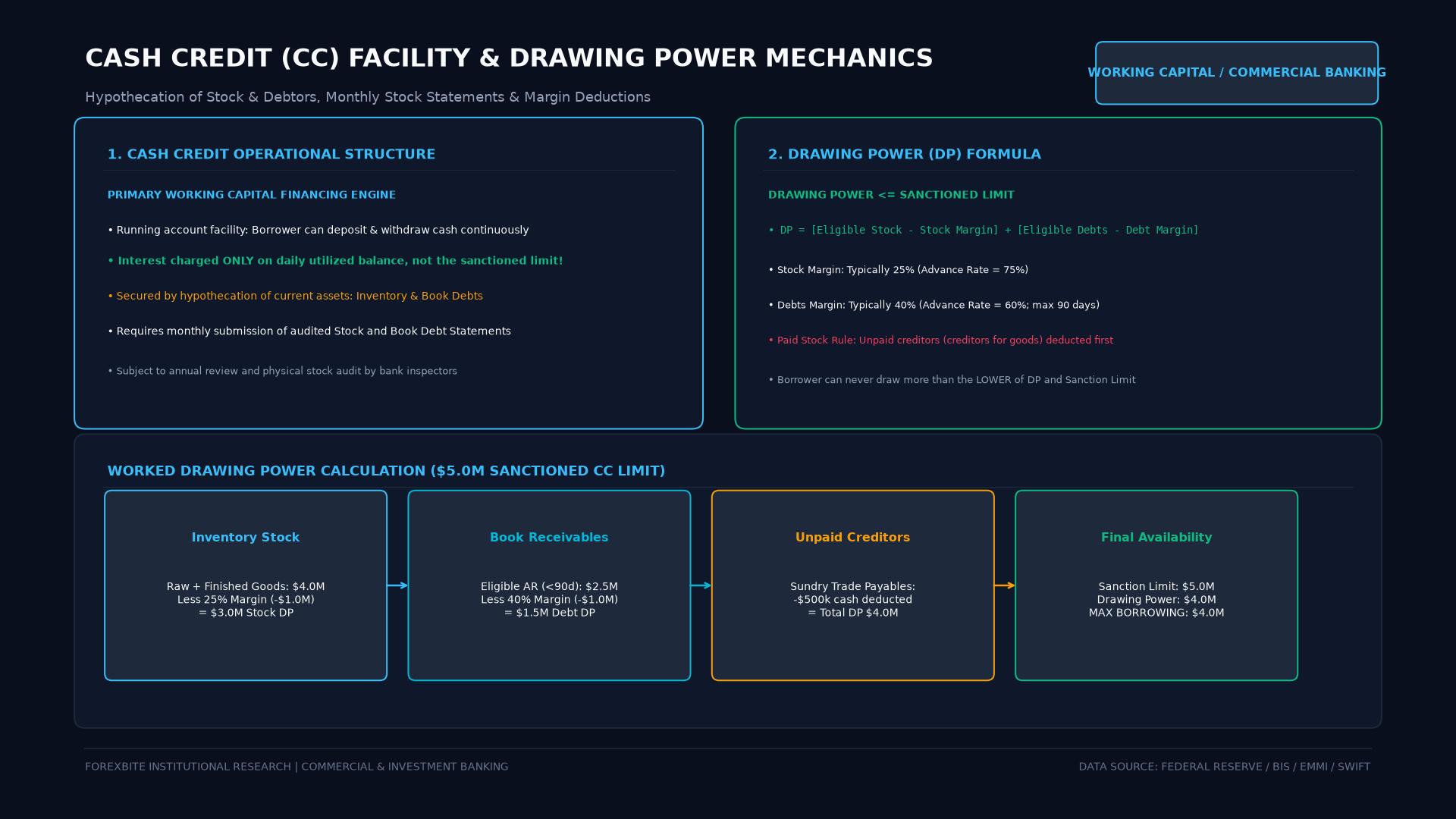 Figure: Revolving hypothecated working capital facility: continuous borrowing and deposit cycles based on audited monthly debtor and inventory stock statements.
The Drawing Power (DP) Formulation
Unlike an unsecured revolving credit card or fixed term loan, the effective borrowing capacity in a Cash Credit facility changes every month. The borrower submits a certified Stock and Book Debt Statement to the lending bank, typically within 7 to 15 days following the close of each calendar month.
The bank credit officer calculates Drawing Power by applying mandatory margin hair-cuts:
$$\text{DP} = [\text{Eligible Paid Stock} \times (1 - M_s)] + [\text{Eligible Book Debts} \times (1 - M_d)]$$
Where:
- Eligible Paid Stock: Total inventory valuation minus unpaid trade creditors (sundry creditors for goods). Banks refuse to finance inventory that has not yet been paid for, preventing double-financing.
- $M_s$ is the Stock Margin: Typically 25% to 30%, requiring the borrower to fund a portion of the inventory with their own equity.
- Eligible Book Debts: Outstanding customer accounts receivable that fall strictly within approved aging limits (typically invoices outstanding for less than 90 days). Older or disputed invoices are completely excluded.
- $M_d$ is the Debtors Margin: Typically 30% to 40%.
$$\text{Effective Borrowing Limit} = \min(\text{Sanctioned Credit Limit}, \text{Calculated Drawing Power})$$
If an enterprise possesses a sanctioned limit of $2,000,000, but a drop in eligible inventory results in a calculated Drawing Power of only $1,400,000, the firm cannot draw a single dollar past $1,400,000. If the debit balance exceeds Drawing Power, the account enters an irregular state, triggering penalty interest rates until the borrower deposits cash or pledges additional collateral.
Cash Credit (CC) vs. Bank Overdraft (OD)
Corporate treasurers frequently confuse Cash Credit with Bank Overdraft facilities. While both are revolving credit mechanisms charging interest solely on utilized debit balances, their collateral structures and operational purposes differ fundamentally:
+------------------------------------+------------------------------------+
| Feature: Cash Credit (CC)          | Feature: Bank Overdraft (OD)       |
+------------------------------------+------------------------------------+
| Purpose: Exclusively used to fund  | Purpose: Broad operational uses,   |
| operating cycle / working capital. | cash flow timing mismatches.       |
|                                    |                                    |
| Primary Security: Hypothecation of | Primary Security: Pledging fixed   |
| current assets (stock & debtors).  | deposits, real estate, securities. |
|                                    |                                    |
| Drawing Limit: Fluctuate monthly   | Drawing Limit: Static limit fixed  |
| based on audited Drawing Power.    | against value of pledged asset.    |
|                                    |                                    |
| Ongoing Compliance: Monthly stock  | Ongoing Compliance: Minimal stock  |
| statements, annual stock audits.   | reporting; annual review only.     |
+------------------------------------+------------------------------------+
Regulatory Guidelines and the WCDL Bifurcation
Historically, corporate borrowers treated Cash Credit facilities as permanent, semi-equity capital, rolling over massive debit balances indefinitely without ever clearing their bank lines. This practice created significant liquidity risks for the banking sector.
To instill credit discipline, banking regulators introduced structural reforms:
Historical Working Capital Committees
In South Asia, the Reserve Bank of India implemented the recommendations of the Tandon Committee (1975) and the Chore Committee (1979), which mandated maximum permissible bank finance (MPBF) formulas. These rules required corporations to fund at least 25% of their current assets out of long-term funds (net working capital).
Working Capital Demand Loan (WCDL) Mandate
Under modern loan delivery guidelines, commercial banks are prohibited from extending 100% of large working capital limits as pure Cash Credit. For borrowers with aggregate working capital limits exceeding specified thresholds, the facility must be bifurcated:
- Loan Component (Minimum 60%): Disbursed as a fixed-term Working Capital Demand Loan (WCDL) with a defined maturity (e.g., 7 days to 1 year). The borrower must pay interest on the full principal sum of this tranche, encouraging tighter balance sheet management.
- Cash Credit Component (Maximum 40%): Maintained as a flexible revolving Cash Credit line to absorb unpredictable daily cash flow variances.
Bank Monitoring, Stock Audits, and Risk Controls
Lending institutions maintain continuous oversight over Cash Credit facilities to prevent inventory fraud and credit diversion:
- Physical Stock Audits: Banks mandate periodic inspections conducted by independent chartered accountants or engineering surveyors. Auditors visit warehouses and factory yards to verify the physical existence, quality, and marketability of the hypothecated inventory.
- Bank Hypothecation Boards: Borrowers must affix prominent display notices at all warehouse entrances and factories stating that all stocks, raw materials, and goods-in-process are hypothecated to the lending bank.
- Comprehensive Insurance Endorsement: Hypothecated inventories must be insured against fire, flood, burglary, and transit damage under policies containing a formal Bank Clause, ensuring insurance claim proceeds are paid directly to the bank.
Financial Analysis of Cash Credit Utilization
Credit rating agencies, equity analysts, and debt investors examine Cash Credit utilization rates to assess corporate liquidity:
- Chronic 95%–100% Utilization: Indicates acute working capital distress. If a company constantly maxes out its Drawing Power, any temporary delay in customer collections or modest supplier dispute can trigger payment defaults on term debt or commercial paper.
- Healthy 40%–70% Utilization: Demonstrates adequate liquidity buffers, indicating the enterprise maintains seasonal flexibility and operates with positive cash flow from operations.
- Sudden Spikes in Drawing Power vs. Stagnant Revenue: A forensic red flag indicating inventory buildup due to unsold, obsolete products, or aggressive booking of uncollectible receivables to inflate borrowing capacity.
Frequently Asked Questions
How is interest calculated on a Cash Credit account?
Interest is calculated on a daily product basis using the day-end closing debit balance in the account:
$$\text{Daily Interest} = \frac{\text{Day-End Debit Balance} \times \text{Annual Interest Rate}}{365}$$
At the end of the monthly billing cycle, the accumulated daily interest charges are debited directly to the Cash Credit account, increasing the outstanding principal balance.
What happens if the debit balance in a Cash Credit account exceeds the Drawing Power?
When an outstanding debit balance exceeds either the sanctioned limit or the calculated Drawing Power, the excess portion is classified as an irregularity or over-advance. The lending bank assesses a penal interest rate (typically 2.0% to 3.0% per annum above the contractual rate) on the excess balance and issues an urgent margin call requiring immediate cash deposits to eliminate the deficit.
Can an enterprise hold Cash Credit facilities with multiple banks?
Yes. Large corporations whose working capital requirements exceed the single-borrower exposure limits of an individual bank arrange a Consortium Lending or Multiple Banking Arrangement (MBA). A lead bank assesses the working capital need, determines the overall sanction limit, and allocates specific shares of the Cash Credit facility across consortium member banks under an agreed inter-creditor pact.
Ready to trade forex?
Open a free demo account with a regulated broker. Practice with virtual funds before risking real money.