Overdraft
An overdraft is a short-term credit facility extended by a depository institution that allows an account holder to draw funds or honor debits exceeding the available account balance, creating a negative balance up to an authorized credit limit.
An overdraft occurs when a bank or depository institution honors a withdrawal, check, electronic fund transfer, or debit card payment despite the account lacking sufficient available ledger balances, causing the account balance to fall below zero. In institutional banking and corporate treasury, an overdraft represents an essential revolving credit facility that provides intraday and short-term working capital float. In retail consumer banking, overdrafts operate as high-cost liquidity backstops that have been the focus of intense regulatory scrutiny regarding consumer disclosures and junk fee enforcement.
Depending on contractual authorization, overdrafts are divided into two distinct legal and operational classifications:
- Arranged (Authorized) Overdraft: A formal credit line negotiated in advance between the borrower and the financial institution, establishing a designated borrowing ceiling, a contractually agreed interest rate, and specific repayment terms.
- Unarranged (Unauthorized) Overdraft: An informal credit extension occurring when an account holder incurs debits exceeding their available balance without prior bank authorization, or breaches an established arranged overdraft ceiling. This typically triggers punitive administrative fees, daily default interest charges, and potential negative reporting to credit registries.
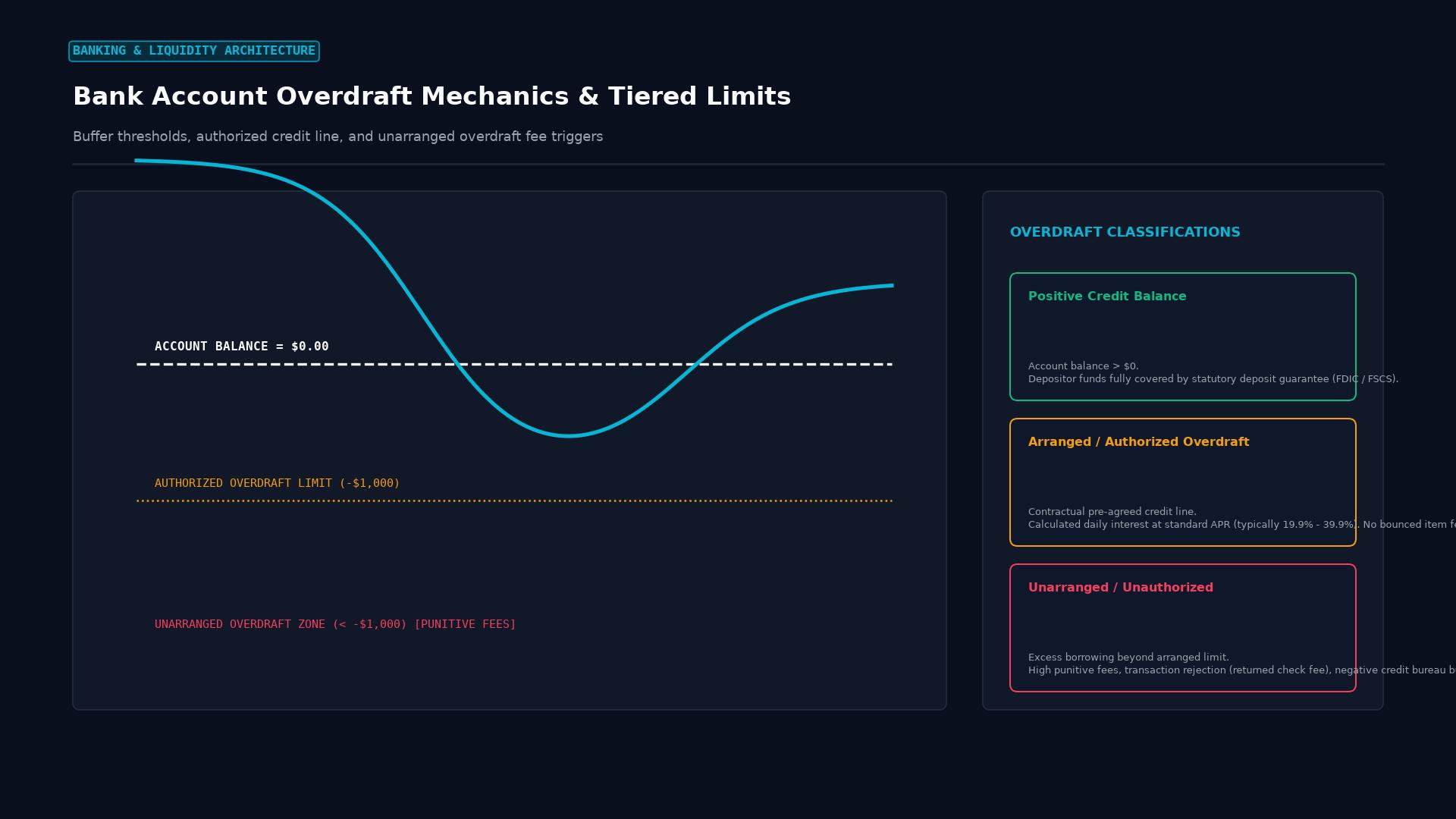 Figure: Bank account balance dynamics: positive credit buffers, pre-arranged overdraft limits with standard interest, and unauthorized overdraft punitive fee zones.
Institutional and Corporate Overdraft Facilities
In corporate finance, commercial treasury management, and global payments, overdraft lines represent flexible liquidity pipelines:
1. Corporate Operating Line of Credit vs. Bank Overdraft
While term loans provide a lump-sum cash disbursement amortized over a multi-year schedule, a corporate overdraft facility operates as a continuous revolving liquidity valve tied directly to the enterprise’s operating checking account:
- Intraday Working Capital: Corporations utilize overdraft lines to bridge the timing mismatch between trade receivables collections and immediate disbursements (such as vendor accounts payable and bi-weekly employee payroll).
- Daily Netting and Interest Accrual: Interest is charged strictly on the net negative ledger balance at the close of each business day, calculated using simple interest accrual formulas: $$\text{Daily Overdraft Interest} = \frac{|\text{Negative Closing Ledger Balance}| \times \text{Overdraft Annual Rate}}{360 \text{ (or 365)}}$$ This feature minimizes borrowing expenses, as incoming customer wire transfers instantly reduce the outstanding overdraft balance, preventing the enterprise from paying interest on idle cash.
2. Daylight Overdrafts in Wholesale Payment Clearing
In central banking and wholesale interbank funds settlement (such as the Federal Reserve’s Fedwire Funds Service and the private sector CHIPS network), commercial banks generate multi-billion-dollar daylight overdrafts:
- Mechanism: A primary dealer bank transfers billions of dollars in sovereign debt securities before receiving the corresponding payment from buyers. To prevent systemic liquidity paralysis, the Federal Reserve provides intraday credit, allowing the bank’s Federal Reserve account to run a temporary negative balance during the operating day.
- Federal Reserve Policy on Payment System Risk (PSR): The Federal Reserve charges commercial banks an annualized fee on uncollateralized daylight overdrafts (historically 50 basis points) while permitting fee-free daylight overdrafts to institutions that pledge eligible collateral (such as US Treasuries or Agency MBS) up to their statutory Net Debit Cap.
                   DAYLIGHT OVERDRAFT CLEARING MECHANISM

  09:00 EST (Market Open)            12:00 EST (Midday Peak)        17:00 EST (Market Close)
  +-----------------------+          +-----------------------+     +-----------------------+
  | Bank A Fed Balance:   |          | Bank A Fed Balance:   |     | Bank A Fed Balance:   |
  | $500 Million (Clean)  | =======> | -$1.2 Billion         | ==> | $150 Million (Clean)  |
  +-----------------------+          | (Daylight Overdraft)  |     +-----------------------+
                                     +-----------------------+
                                                 |
                                     Fed permits negative intraday
                                     balance to prevent gridlock;
                                     fully extinguished by close.
The Economics of Consumer Retail Overdrafts
In retail banking, overdraft structures function differently. Rather than operating as negotiated credit lines, consumer overdraft programs are historically structured as discretionary courtesy services accompanied by fixed fees.
1. Overdraft Fees vs. Non-Sufficient Funds (NSF) Fees
- Overdraft Fee: Assessed when the bank elects to honor the transaction, absorbing the negative balance and charging the account holder a fixed fee (historically $30 to $35 in the United States).
- NSF (Non-Sufficient Funds) Fee: Assessed when the bank rejects the payment (such as returning a bounced physical check or unpaid ACH direct debit). The transaction fails, the merchant is unpaid, and the bank levies an NSF fee for processing the rejected item.
2. Effective APR Derivation on Retail Overdrafts
Consumer advocacy watchdogs and the Consumer Financial Protection Bureau (CFPB) have criticized retail overdraft programs as short-term predatory credit. Because overdraft fees are charged as flat dollar penalties rather than percentage interest rates, the annualized percentage rate (APR) on small consumer overdrafts is exceptionally high:
Assume a consumer purchases a $20 cup of coffee and meal with a debit card, overdrawing their checking account. The bank honors the payment and charges a $35 overdraft fee. The consumer deposits funds five days later to restore a zero balance: $$\text{Principal Borrowed} = $20.00$$ $$\text{Finance Charge} = $35.00$$ $$\text{Loan Duration} = 5 \text{ Days}$$
$$\text{APR} = \left( \frac{\text{Finance Charge}}{\text{Principal}} \right) \times \left( \frac{365}{\text{Duration in Days}} \right) \times 100%$$ $$\text{APR} = \left( \frac{35}{20} \right) \times \left( \frac{365}{5} \right) \times 100% = 1.75 \times 73 \times 100% = 12,775%$$
This mathematical reality highlights why retail overdrafts represent one of the most lucrative revenue streams for commercial depository institutions, historically generating over $12 billion annually in non-interest fee income for US banks.
Regulatory Frameworks and Consumer Protection
Global regulatory agencies have enacted sweeping reforms to restrict predatory consumer overdraft practices:
+------------------------+--------------------------------------------------+
| Regulatory Directive   | Legal Mandate and Market Transformation          |
+------------------------+--------------------------------------------------+
| US Regulation E        | Prohibits financial institutions from assessing  |
| (12 CFR § 1005.17)     | overdraft fees on ATM and one-time debit card    |
|                        | transactions unless the consumer affirmatively   |
|                        | opts in to the overdraft service.                |
+------------------------+--------------------------------------------------+
| CFPB Junk Fee Guidance | Prohibits "surprise overdraft fees," including   |
| (2022–2024)            | Authorize Positive, Settle Negative (APSN) fees  |
|                        | and multi-generation NSF fees on the same item.  |
+------------------------+--------------------------------------------------+
| UK FCA High-Cost Credit| Banned fixed daily/monthly overdraft fees in     |
| Reform (2020)          | 2020, mandating that UK banks charge overdrafts  |
|                        | strictly as a transparent annual percentage APR. |
+------------------------+--------------------------------------------------+
| Dodd-Frank Section 1036| Prohibits Unfair, Deceptive, or Abusive Acts or  |
| (UDAAP Authority)      | Practices (UDAAP) regarding transaction posting  |
|                        | order manipulations (reordering high-to-low).    |
+------------------------+--------------------------------------------------+
1. The High-to-Low Posting Reordering Controversy
In the early 2000s, major commercial banks utilized automated batch processing algorithms that systematically reordered customer transactions from highest dollar amount to lowest dollar amount at the close of each business day, rather than clearing them chronologically:
- If a depositor with $100 in their account made four consecutive $10 purchases followed by one $110 car insurance payment, chronological processing would result in four cleared transactions and a single overdraft on the final payment (one $35 fee).
- By reordering transactions from high to low, the bank cleared the $110 charge first, immediately draining the $100 balance. The subsequent four $10 purchases each triggered separate overdraft fees, transforming a single fee into four distinct overdraft charges ($140 total).
- Federal class-action litigation and CFPB supervisory enforcement successfully penalized this practice, forcing major banks to adopt chronological or low-to-high posting orders.
2. Authorize Positive, Settle Negative (APSN)
A complex operational friction targeted by modern regulators is APSN:
- At the moment a consumer swipes their debit card at a merchant, their available balance is sufficient, and the bank approves the transaction hold.
- Over the two to three business days before the merchant formally submits the settlement batch, intervening checks or recurring bills post to the account, reducing the balance.
- When the original debit card transaction settles, the account enters negative territory, and the bank assesses an overdraft fee.
- The CFPB issued formal guidance declaring APSN fees an unfair practice under consumer financial protection statutes because consumers cannot reasonably anticipate the posting sequence of delayed settlement batches.
Bank Credit Risk Management and Delinquency Recovery
When an account holder fails to eliminate an unarranged overdraft balance within statutory windows (typically 30 to 60 days), the bank initiates formal credit recovery procedures:
                  CHRONOLOGY OF OVERDRAFT DEFAULT RECOVERY

  Day 1: Account Overdrawn (Negative Balance & Overdraft Fee Assessed)
                                   |
                                   v
  Day 15-30: Soft Collections (Automated Warnings, Account Restricted)
                                   |
                                   v
  Day 45-60: Bank Exercises Right of Set-Off (Seizes Linked Deposits)
                                   |
                                   v
  Day 60-90: Formal Charge-Off (Account Closed, Sent to Third-Party Debt Collector)
                                   |
                                   v
  Reporting to Specialty Consumer Reporting Agencies (ChexSystems / Early Warning Services)
1. The Common Law Right of Set-Off
Under established commercial banking law (compensatio or banker’s lien), a bank maintains the legal right of set-off:
- If an individual holds an overdrawn checking account with a negative balance of -$500, but maintains a separate savings account containing $2,000 within the same financial institution, the bank has the statutory authority to seize $500 from the savings account without a court order to extinguish the overdraft liability.
- This right cannot be exercised against designated government trust funds, such as Social Security benefit accounts protected under federal anti-attachment provisions.
2. Specialty Consumer Reporting Agencies (ChexSystems and EWS)
Unlike standard consumer credit bureaus (Equifax, Experian, TransUnion) that track traditional installment loans and credit cards, commercial banks report unpaid overdraft charge-offs to Specialty Consumer Reporting Agencies, predominantly ChexSystems and Early Warning Services (EWS):
- An unpaid overdraft charge-off remains recorded on an individual’s ChexSystems file for five years.
- Having an active negative record on ChexSystems prevents the consumer from opening new checking or savings accounts across virtually all major commercial banks, effectively excluding them from the formal financial system.
- To serve this demographic, financial institutions offer “Second Chance Checking” accounts with strict zero-overdraft debit card parameters.
Comparative Matrix: Overdraft vs. Competing Credit Products
+------------------------+-----------------------------+-----------------------------+-----------------------------+
| Feature                | Bank Overdraft Facility     | Personal Credit Card        | Payday / Short-Term Loan    |
+------------------------+-----------------------------+-----------------------------+-----------------------------+
| Formal Approval        | Arranged: Yes;              | Yes; rigorous credit check  | Minimal credit check;       |
| Requirement            | Unarranged: Discretionary   | and underwriting score      | requires proof of income    |
+------------------------+-----------------------------+-----------------------------+-----------------------------+
| Pricing Structure      | Arranged: Spread over base; | Revolving APR               | Flat fee per $100 borrowed  |
|                        | Unarranged: Flat fixed fees | (typically 18% to 29%)      | (translates to 300%+ APR)   |
+------------------------+-----------------------------+-----------------------------+-----------------------------+
| Repayment Horizon      | Immediate; extinguished     | Monthly minimum payment;    | Lump sum due on subsequent  |
|                        | upon next deposit inflow    | 21-to-25 day grace period   | regular payroll date        |
+------------------------+-----------------------------+-----------------------------+-----------------------------+
| Impact on Credit Score | Arranged: None (if current);| Direct monthly reporting    | Reported only upon formal   |
|                        | Unarranged: Severe if sent  | to Equifax/Experian/Trans.  | default and collection      |
+------------------------+-----------------------------+-----------------------------+-----------------------------+
Best Practices for Managing Overdraft Facilities
- Establish Formal Overdraft Protection Links: Consumers should link their primary checking account directly to a secondary savings account or a dedicated personal line of credit. If an unexpected debit exceeds checking cash, the bank automatically transfers exact funds from the backup account, bypassing flat $35 overdraft penalties.
- Opt Out of Discretionary Overdraft Services for Debit Cards: Under Regulation E, consumer account holders retain the statutory right to decline overdraft coverage for ATM withdrawals and debit card purchases. If funds are insufficient, the card is declined at the point of sale with zero fees charged.
- Negotiate Formal Arranged Caps for Corporate Accounts: Corporate treasurers must negotiate arranged overdraft agreements with clear interest spreads linked to standard overnight money market benchmarks (such as SOFR or Euribor) rather than relying on discretionary bank clearing.
Frequently Asked Questions (FAQ)
What is the difference between an overdraft fee and a non-sufficient funds (NSF) fee?
An overdraft fee is charged by a bank when it elects to honor an incoming payment or withdrawal that exceeds the customer’s available balance, allowing the transaction to go through and creating a temporary negative balance on the account. In contrast, an NSF (Non-Sufficient Funds) fee is charged when the bank rejects and returns the payment unpaid (such as a bounced check), meaning the merchant does not receive their money.
Can an overdraft negatively affect my personal credit score?
An ordinary arranged overdraft or a brief unarranged overdraft that is repaid within a few days is not reported to the three major consumer credit bureaus (Equifax, Experian, and TransUnion) and will not affect your FICO score. However, if an account remains negative for an extended period (typically 60 to 90 days), the bank will close the account, report the unpaid balance as a delinquent charge-off to specialized banking registries like ChexSystems, and transfer the debt to a third-party collection agency, which will cause severe damage to your standard credit score.
What is the purpose of a daylight overdraft in corporate banking?
A daylight overdraft is an intraday negative balance permitted by central banks (such as the Federal Reserve) on the clearing accounts of major commercial banks. Because massive global wire transfers and sovereign debt transactions occur continuously throughout the trading day, daylight overdrafts prevent liquidity gridlocks by allowing banks to clear payments before incoming client wire transfers settle. These negative balances must be completely extinguished by the close of the business day.
Ready to trade forex?
Open a free demo account with a regulated broker. Practice with virtual funds before risking real money.