Collateral
Collateral refers to cash, securities, or physical assets pledged by a borrower or trader to a broker, lender, or clearing house to guarantee performance and secure credit. In leveraged foreign exchange, a trader's account equity acts as collateral to absorb potential market losses.
What Is Collateral?
In commercial finance and investment banking, collateral is an asset of verifiable value pledged by a debtor to a creditor as a security guarantee for a loan or financial obligation. If the debtor fulfills their contractual commitments, the collateral remains unencumbered. If the debtor defaults, breaches agreed risk thresholds, or fails to meet financial obligations, the creditor holds the legal right to seize, repossess, or liquidate the pledged collateral to recoup outstanding losses.
While traditional banking collateral typically takes the form of physical real estate (a residential mortgage) or commercial equipment, collateral in modern derivative and foreign exchange markets consists predominantly of liquid cash balances, sovereign treasury bills, and high-grade government bonds.
In leveraged financial trading, collateral serves as the essential bedrock that permits brokers and interbank clearing houses to extend multi-million-dollar purchasing power to participants while maintaining systemic solvency.
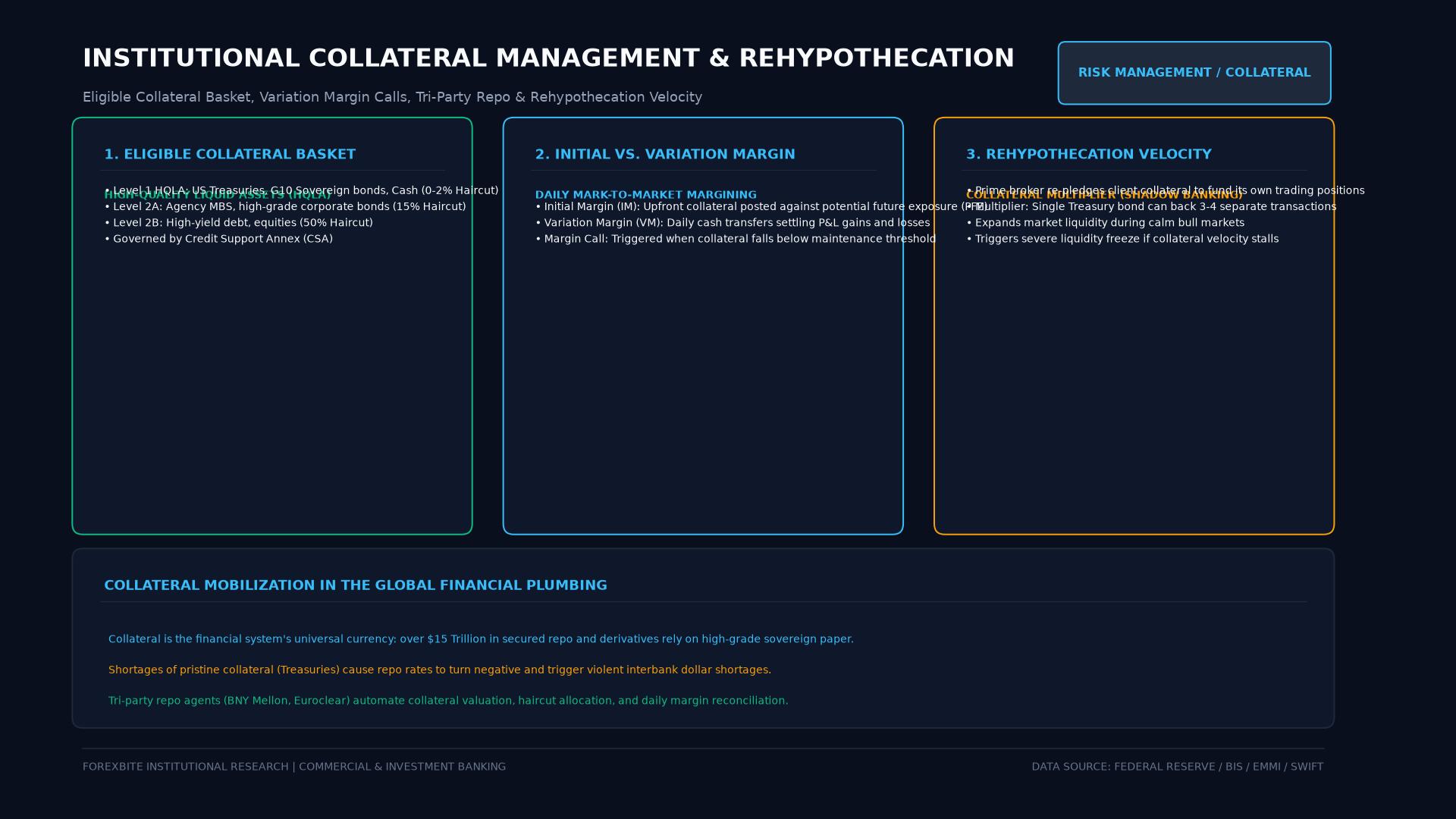 Figure: Collateral risk hierarchy under Basel III: sovereign HQLA securities, corporate debt, real estate, and receivable haircuts in secured lending.
Collateral vs. Margin in Retail Forex
The terms “collateral” and “margin” are frequently used interchangeably on retail trading platforms, but an important structural distinction exists:
- Account Equity (The Collateral Pool): Your total account equity—calculated as your cash balance plus floating unrealized profits, minus floating unrealized losses—represents the total collateral value available to back your positions.
- Used Margin (The Performance Bond): The specific dollar portion of your collateral pool that the broker locks up to maintain open leveraged trades.
- Free Margin (Usable Collateral): The remaining collateral that is not committed to existing trades. It represents your buffer against adverse market swings: $$ \text{Free Margin} = \text{Equity (Collateral)} - \text{Used Margin} $$
When you trade with 1:100 leverage, you are borrowing $100,000 of currency while pledging only $1,000 of your own capital. That $1,000 is not a payment or fee; it is collateral held in trust by the broker to guarantee that any market losses you incur can be settled immediately in cash.
Initial Margin vs. Variation Margin
In institutional finance, interbank foreign exchange, and futures exchanges (such as the CME Group), collateral management is formalized through two distinct operational mechanisms, governed by International Swaps and Derivatives Association (ISDA) agreements:
1. Initial Margin (IM)
Initial margin is the upfront collateral required to initiate a derivative contract. It is calibrated using statistical models (such as Value at Risk, or VaR) to cover potential future losses during the time it would take to liquidate the position in an orderly market if the counterparty were to default tomorrow.
2. Variation Margin (VM)
Variation margin represents the continuous, daily (or intraday) cash transfers exchanged between counterparties to reflect live mark-to-market fluctuations.
- If a hedge fund’s long EUR/USD position gains $500,000 today, the clearing broker credits that variation margin in cash to the fund’s account.
- If the position loses $500,000, the fund must transfer $500,000 in cash variation margin to the clearing broker before the next trading session opens.
- By settling gains and losses daily, variation margin prevents uncollateralized credit risk from compounding over time.
Collateral Haircuts in Institutional Trading
Institutional market participants do not always post pure cash as collateral; they frequently pledge high-quality liquid assets, such as US Treasury bills, German Bunds, or blue-chip equities.
Because non-cash assets can fluctuate in market price or suffer liquidity discounts during crises, lenders and prime brokers apply a collateral haircut—a percentage reduction deducted from the asset’s nominal market value:
- US Treasury Bills (under 1 year): Typically carry a tiny haircut of 0.5% to 1.0% due to virtually zero default and duration risk ($1,000,000 in T-bills yields $990,000 in borrowing collateral).
- Long-Term Sovereign Bonds (10 to 30 years): Subject to haircuts of 3.0% to 6.0% to account for interest rate sensitivity.
- Corporate Equities: Subject to steep haircuts of 15% to 30% due to higher price volatility.
The Collateral Depletion Process: Margin Calls and Stop-Outs
When adverse price movements strike an open leveraged trade, the trader’s collateral pool deteriorates in real time. Brokers monitor the Margin Level Percentage:
$$ \text{Margin Level} = \left( \frac{\text{Equity}}{\text{Used Margin}} \right) \times 100 $$
As long as the Margin Level remains well above 100%, the collateral pool is healthy. However, if losses mount:
- The Margin Call Level (Typically 100%): When equity drops to equal used margin, the broker issues a formal warning. The trader cannot open new positions and is urged to deposit additional collateral immediately.
- The Stop-Out Level (Typically 50% or 20%): If the market continues moving adversely and collateral drops to the broker’s minimum safety threshold, the broker’s automated risk engine intervenes. The broker unilaterally liquidates open positions at prevailing market prices to preserve remaining capital and prevent the account from plunging into a negative balance.
Practical Trading Example: Collateral Mechanics in Action
Suppose a trader deposits $10,000 into a forex trading account offering 1:100 leverage.
- Position Entry: The trader buys 2 Standard Lots of GBP/USD at 1.3000 (total notional value = £200,000 = $260,000).
- Used Margin (Locked Collateral): With 1:100 leverage (1% margin), the broker locks: $$ \text{Used Margin} = $260,000 \times 1% = $2,600.00 $$
- Account State at Entry:
- Balance: $10,000
- Equity: $10,000
- Used Margin: $2,600
- Free Margin (Collateral Buffer): $$10,000 - $2,600 = $7,400$
- Margin Level: $($10,000 / $2,600) \times 100 = 384.6%$
- Market Collapse: High-impact UK geopolitical news triggers a violent sell-off. GBP/USD plunges 300 pips ($3,000 loss per standard lot, total floating loss = -$6,000).
- New Account State:
- Equity: $$10,000 - $6,000 = $4,000$
- Used Margin: $2,600
- Free Margin: $$4,000 - $2,600 = $1,400$
- Margin Level: $($4,000 / $2,600) \times 100 = 153.8%$
The trader’s collateral buffer has contracted from $7,400 down to just $1,400. Another 70-pip decline would breach the 100% Margin Call threshold, forcing the trader to either close part of the position, inject new collateral, or face automated liquidation.
Key Takeaways
- Collateral is capital or assets pledged to secure borrowing and guarantee contractual performance.
- In retail forex, account equity functions as the collateral pool supporting open leveraged positions.
- Free margin represents unencumbered collateral available to absorb market drawdowns or open new trades.
- In institutional markets, initial margin covers future liquidation risk, while variation margin settles daily mark-to-market changes.
- Non-cash collateral is subject to percentage haircuts based on volatility, liquidity, and credit quality.
FAQ
What is the difference between collateral and a deposit? A deposit is cash transferred into a brokerage account. Collateral is the legal status assigned to those deposited funds once they are pledged to back leveraged trading positions and absorb potential market losses.
What are segregated client collateral accounts? Under strict regulations in jurisdictions like the UK (FCA), Australia (ASIC), and the US (CFTC), brokers must hold client collateral in segregated trust accounts at top-tier banks, strictly separated from the broker’s operational funds to protect clients if the brokerage goes bankrupt.
Can my losses exceed my deposited collateral? In unregulated or offshore jurisdictions, extreme market gap events can cause losses to exceed deposited collateral, leaving the trader with a legal debt to the broker. However, regulated jurisdictions mandate Negative Balance Protection, legally requiring brokers to absorb any losses that exceed the client’s deposited collateral.
Ready to trade forex?
Open a free demo account with a regulated broker. Practice with virtual funds before risking real money.