CDF
The ISO 4217 currency code for the Congolese Franc, the official national currency of the Democratic Republic of the Congo, managed by the Banque Centrale du Congo.
What is the CDF (Congolese Franc)?
CDF is the three-letter currency code designated under ISO 4217 for the Congolese Franc, the official legal tender of the Democratic Republic of the Congo (DRC). Represented domestically by the currency symbol FC and nominally subdivided into 100 centimes (though inflation has rendered centimes obsolete), the currency is issued, circulated, and regulated by the Banque Centrale du Congo (BCC), headquartered in Kinshasa.
In the landscape of emerging and frontier market foreign exchange, the Congolese Franc is defined by two interlocking structural characteristics: extreme financial dollarization and deep economic dependence on strategic mineral exports. Operating in a mineral-rich economy that accounts for over 70% of the world mined cobalt and ranks as a top global producer of copper, the CDF functions in an environment where the United States Dollar serves as the dominant unit of account for commercial contracts, corporate payrolls, and bank savings.
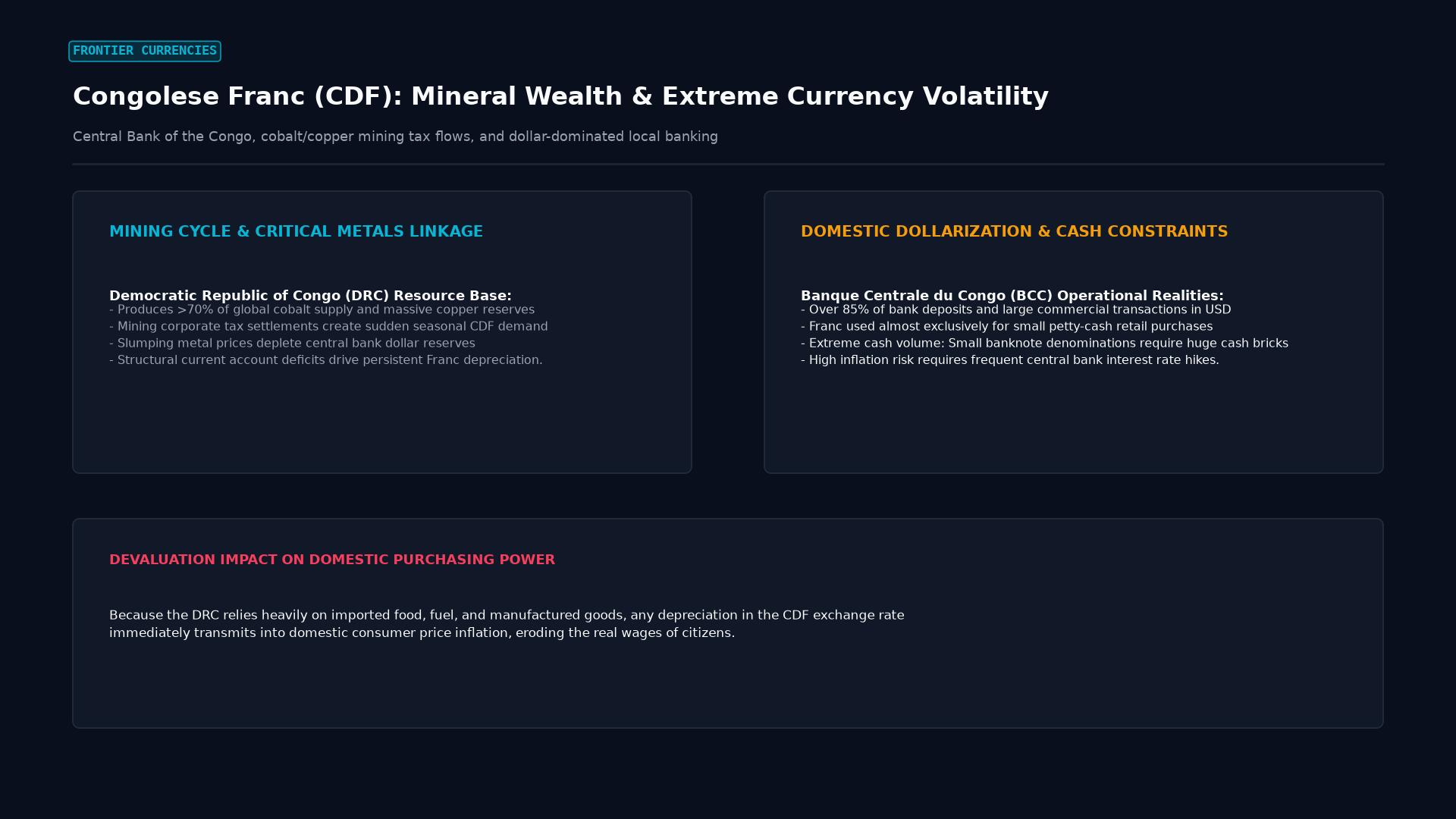 Figure: Resource extraction linkages: cobalt and copper tax revenue inflows versus high domestic dollarization and food import inflation in the DRC.
Monetary History: From the Zaïre to the Modern Franc
The history of the modern Congolese Franc is rooted in decades of political upheaval and macroeconomic instability:
- The First Franc Period (1960–1967): Following independence from Belgium, the country maintained the original Congolese Franc until monetary breakdown forced a currency reform.
- The Zaïre and Hyperinflation (1967–1997): President Mobutu Sese Seko introduced the Zaïre (ZR), followed by the New Zaïre (ZRN) in 1993. Excessive deficit monetization by the central bank triggered catastrophic hyperinflation, exceeding 23,000% annually in the mid-1990s. The currency collapsed, destroying the domestic banking sector.
- The 1998 Monetary Restoration: Following the overthrow of Mobutu, President Laurent-Désiré Kabila reinstated the Congolese Franc on June 30, 1998, exchanging 1 new Congolese Franc for 100,000 New Zaïres.
However, recurring regional conflicts in the eastern provinces, fiscal monetization, and reliance on imported food products have driven steady nominal depreciation of the CDF against the US Dollar across successive decades.
De Facto Dollarization and Currency Substitution
A prominent feature of the Congolese economy is its high level of financial dollarization. Economists classify the DRC as an economy with high financial and transaction dollarization:
+------------------------------------+------------------------------------+
| Transaction Segment                | Dominant Circulating Currency      |
+------------------------------------+------------------------------------+
| Commercial Banking Deposits:       | United States Dollar (USD)         |
| Over 85% to 90% of total bank      | accounts for the vast majority of  |
| deposits are denominated in USD.   | liquid financial wealth.           |
|                                    |                                    |
| Real Estate & Wholesale Trade:     | Invoiced exclusively in USD. Rent, |
| Commercial leases, auto sales, and | capital equipment, and imports are |
| large supplier invoices.           | quoted in dollars.                 |
|                                    |                                    |
| Retail Consumer Purchases:         | Congolese Franc (CDF) serves as    |
| Food markets, public transit fares,| small-change transaction currency  |
| and daily household staples.       | alongside one-dollar USD bills.    |
+------------------------------------+------------------------------------+
Because ordinary citizens and corporate enterprises remember past hyperinflation cycles that erased domestic savings, economic agents immediately convert surplus CDF into US Dollars to preserve real purchasing power. This persistent flight to hard currency creates continuous structural downward pressure on the CDF exchange rate.
Commodity Export Drivers: The 2018 Mining Code
The DRC is a geopolitical linchpin of the global green energy transition. The mineral-rich Katanga Copperbelt contains extraordinary reserves of cobalt, high-grade copper, lithium, and tantalum. Because mineral contracts are invoiced globally in US Dollars, national balance of payments dynamics depend on international commodity prices:
$$\text{Trade Balance} = (\text{Cobalt Output} \times P_{\text{Cobalt}}) + (\text{Copper Output} \times P_{\text{Copper}}) - \text{Total Import Invoices}$$
The 2018 Mining Code Foreign Exchange Rules
In 2018, the DRC government enacted a revised Mining Code containing strict foreign exchange repatriation clauses:
- Mining concessionaires must repatriate at least 60% of gross export receipts through local commercial banks during the project amortization phase.
- Following full recovery of initial capital investments, the mandatory repatriation threshold rises to 100%.
- Mining companies must pay domestic corporate taxes and specialized mineral royalties directly into the national treasury, providing the central bank with regular dollar liquidity.
When global cobalt or copper prices tumble, tax receipts collapse, drying up domestic dollar inflows and prompting steep depreciations in the CDF/USD exchange rate.
Banque Centrale du Congo: Monetary Operations and FX Auctions
The Banque Centrale du Congo operates a managed floating exchange rate regime. The central bank manages domestic monetary policy and currency stabilization using several core mechanisms:
  Monetary Tool            Operational Mechanism                     Policy Target
  -----------------------------------------------------------------------------------
  BCC Key Policy Rate      Adjusts refinancing rates to banks        Controls CDF liquidity
  Reserve Requirements     Mandates higher reserve ratios on USD     Incentivizes dedollarization
                           deposits compared to CDF deposits
  Foreign Exchange Sales   Injects USD reserves into commercial      Smooths erratic currency
                           banks via competitive FX auctions         depreciation spikes
  BCC Bills (Bons BCC)     Issues short-term central bank debt       Absorbs excess commercial bank
                           securities to commercial banks            Congolese Franc liquidity
In times of acute exchange rate pressure, the BCC intervenes directly by selling US Dollar reserves to licensed commercial banks in bi-weekly foreign exchange auctions, establishing an interbank clearing reference rate.
Trading Conventions and Interbank Structure
In international foreign exchange markets, trading the CDF involves unique market frictions:
- Non-Deliverable Offshore Nature: The Congolese Franc is not cleared through international automated clearing houses. Offshore institutional investors hedging sovereign or corporate risks utilize bilateral Non-Deliverable Forward (NDF) contracts denominated in USD.
- Two-Tiered Exchange Rate Spread: A persistent spread exists between the official interbank rate published by the BCC and the informal street cash rate (le marché noir / cambistes de rue) operating in central Kinshasa and Lubumbashi. During periods of hard currency rationing, the informal premium expands significantly.
- Cash Logistics Costs: Because highest-denomination banknotes (e.g., 10,000 and 20,000 Francs) have low dollar values during inflationary cycles, large commercial transactions settled in cash require transporting literal sacks or bricks of paper currency, creating substantial handling costs and security risks.
Frequently Asked Questions
Can an international traveler or investor spend US Dollars directly in the DRC?
Yes. Clean, un-torn US Dollar banknotes (particularly denominations issued after 2013) are accepted universally across commercial hotels, supermarkets, restaurants, and retail stores in Kinshasa and Lubumbashi. Change for purchases under $5 or $10 is frequently returned in Congolese Francs calculated at the prevailing local exchange rate.
What is the primary cause of sudden depreciations in the Congolese Franc?
Sudden depreciations in the CDF typically stem from three triggers: a sharp decline in world copper and cobalt prices reducing mining tax receipts, central bank monetization of government fiscal budget deficits to fund emergency state expenditures, or localized political instability that sparks corporate dollar hoarding.
Why doesn’t the DRC fully eliminate the Congolese Franc and adopt the US Dollar officially?
While the economy is de facto dollarized, retaining the Congolese Franc preserves national monetary sovereignty. Issuing its own currency allows the central bank to earn seigniorage profits, provide emergency liquidity to domestic financial institutions, and maintain a symbol of national independence.
Ready to trade forex?
Open a free demo account with a regulated broker. Practice with virtual funds before risking real money.