CDFA
A professional credential denoting a Certified Divorce Financial Analyst, an expert trained in the quantitative, tax, and asset-division complexities of matrimonial litigation and divorce settlements.
What Does CDFA Stand For in Finance?
In wealth management, matrimonial law, and forensic accounting, the acronym CDFA stands for Certified Divorce Financial Analyst. Administered and conferred by the Institute for Divorce Financial Analysts (IDFA), this specialized professional designation identifies financial practitioners who possess expert training in the quantitative, tax, and long-term economic aspects of marital dissolution.
While divorce attorneys guide clients through statutory family court procedures and litigate contested legal issues, they frequently lack the specialized forensic training necessary to evaluate complex financial assets. A CDFA steps into matrimonial proceedings to model long-term after-tax cash flows, assess retirement plan divisions, calculate the real value of equity compensation packages, and ensure that proposed property distribution agreements do not result in post-divorce financial insolvency for either spouse.
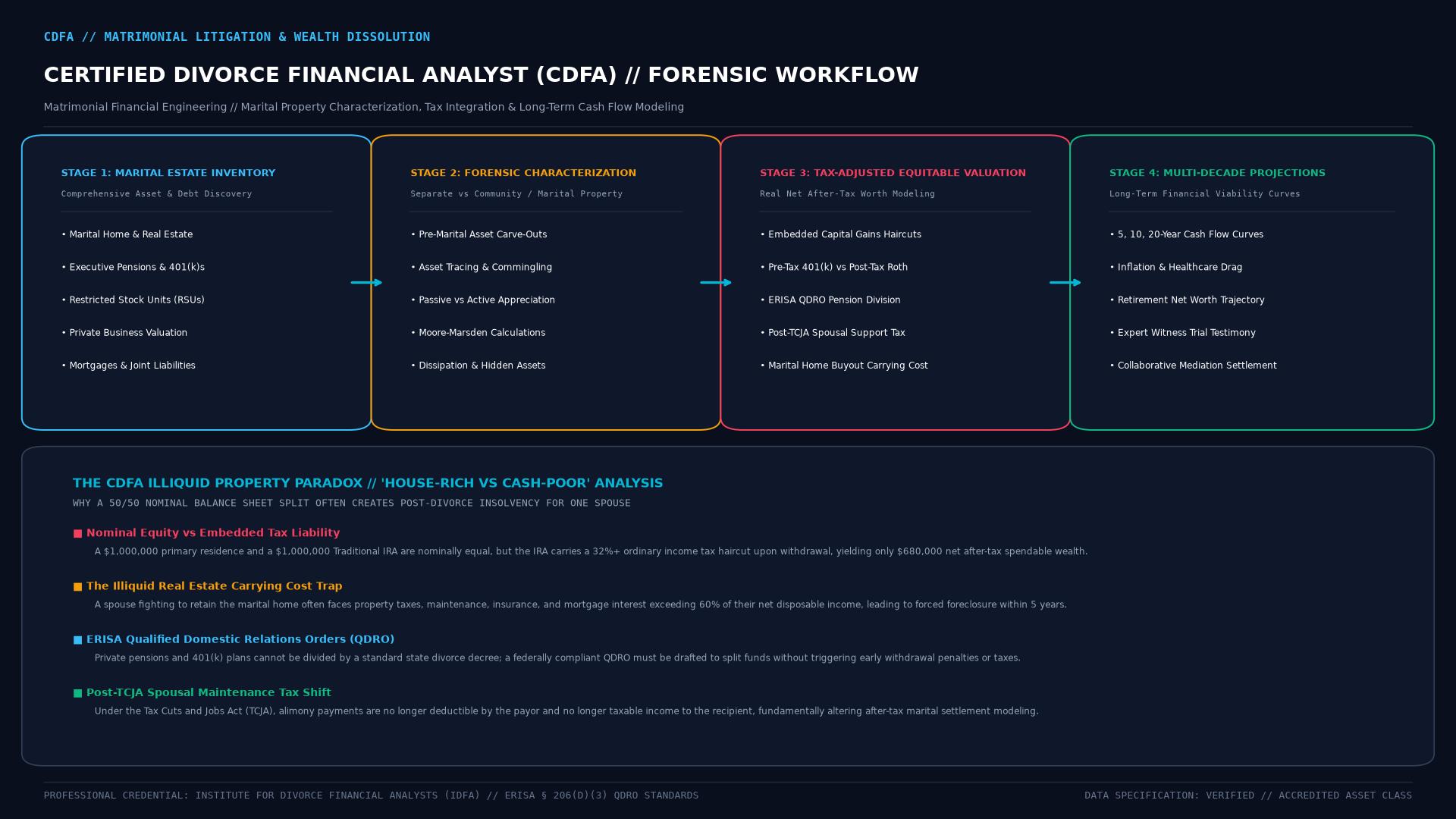 Figure: The Certified Divorce Financial Analyst (CDFA) matrimonial workflow detailing forensic marital property characterization, after-tax equitable division, and long-term liquidity modeling.
Core Competencies and Curriculum
To earn and maintain the CDFA credential from the IDFA, candidates (who typically hold prerequisite certifications such as CFP, CPA, or CFA) must complete a comprehensive curriculum covering four core examination modules:
+------------------------------------+------------------------------------+
| Curriculum Focus Area              | Practical Matrimonial Application  |
+------------------------------------+------------------------------------+
| Financial Overview of Divorce:     | Distinguishing equitable           |
| Legal procedures, discovery,       | distribution states from community |
| mediation, and collaborative law.  | property jurisdictions.            |
|                                    |                                    |
| Marital Property Valuation:        | Appraising residential homes,      |
| Real estate, privately held stock, | defined benefit pensions, stock    |
| deferred comp, executive perks.    | options, and partnership equity.   |
|                                    |                                    |
| Tax Implications of Divorce:       | IRC § 1041 property transfers,     |
| TCJA alimony rules, filing status, | capital gains basis pass-through,  |
| dependency exemption allocations.  | and early withdrawal tax penalties.|
|                                    |                                    |
| Financial Analysis & Projections:  | Generating multi-decade cash flow  |
| Actuarial life expectancy models,  | models demonstrating long-term     |
| inflation impact, lifestyle costs. | solvency under proposed splits.    |
+------------------------------------+------------------------------------+
Critical Financial Pitfalls Addressed by a CDFA
Matrimonial asset distribution agreements frequently appear equitable on the surface while masking deep structural financial imbalances:
1. The Embedded Capital Gains Tax Trap
A common mistake in divorce negotiations is treating assets with equal nominal face values as economically equivalent.
- Spouse A receives the marital home valued at $1,000,000 with a cost basis of $300,000.
- Spouse B receives a cash bank account and short-term Treasuries valued at $1,000,000.
Under Internal Revenue Code (IRC) Section 1041, transfers of property between spouses incident to a divorce are tax-free at transfer, but the recipient spouse retains the carryover cost basis. If Spouse A sells the home post-divorce, they utilize only an individual $250,000 capital gains exclusion under IRC § 121, leaving $450,000 of taxable gain subject to federal and state capital gains taxes. Spouse B faces zero tax on their liquid cash. A CDFA tax-adjusts asset values before property division to ensure genuine parity.
2. Qualified Domestic Relations Orders (QDROs)
Dividing corporate retirement accounts governed by the Employee Retirement Income Security Act of 1974 (ERISA), such as 401(k) plans or defined benefit pensions, requires a court-issued Qualified Domestic Relations Order (QDRO).
Under IRC § 414(p), a properly executed QDRO recognizes the right of an alternate payee (the non-employee spouse) to receive all or a portion of the retirement benefits. A CDFA ensures that the QDRO language accurately addresses survivorship benefits, cost-of-living adjustments (COLAs), and market appreciation between the date of separation and the date of distribution, preventing early withdrawal penalties under IRC § 72(t).
3. The Tax Cuts and Jobs Act of 2017 (TCJA) Alimony Shift
Prior to the TCJA, alimony was governed by historical tax integration rules: deductible by the payor spouse under IRC § 215 and taxable to the recipient spouse under IRC § 71.
For divorce decrees executed or modified after December 31, 2018:
- Spousal maintenance is no longer deductible by the paying spouse.
- Spousal maintenance is no longer treated as gross income to the recipient spouse.
This statutory reversal eliminated the divorce tax deduction, which previously allowed couples to shift income from a higher tax bracket to a lower tax bracket. A CDFA recalibrates maintenance proposals using net after-tax income to prevent the payor spouse from suffering severe cash flow shortfalls.
Professional Modes of Engagement
A CDFA operates across three primary dispute resolution formats:
- Individual Client Advocate: Retained by one spouse to review settlement offers, analyze tax returns, prepare financial affidavits, and coach the client through financial negotiations.
- Neutral Financial Specialist (Collaborative Divorce / Mediation): Retained jointly by both spouses in a non-adversarial collaborative divorce or mediation. The CDFA compiles the unified marital asset inventory, educates both parties on their financial realities, and models mutually acceptable property division scenarios.
- Expert Witness in Contested Litigation: Retained by litigation counsel to provide forensic accounting analysis, author formal valuation reports, and testify in court regarding asset dissipation, business valuations, or true executive cash compensation.
Comparative Value: CDFA vs. Traditional Financial Planner
  Metric                Certified Divorce Financial Analyst (CDFA)    General Financial Planner (CFP)
  ---------------------------------------------------------------------------------------------------
  Core Specialization   Matrimonial asset splitting & divorce law     Wealth accumulation & retirement
  Tax Focus             IRC § 1041, § 414(p) QDRO, post-TCJA alimony  General income tax & estate planning
  Time Horizon          Pre-decree forensic valuation & settlement    Post-decree long-term asset management
  Legal Integration     Collaborates directly with divorce counsel   Coordinates with general estate attorneys
  Dispute Resolution    Trained in mediation & expert testimony       Standard client advisory interactions
Frequently Asked Questions
Can a CDFA give legal advice during a divorce proceeding?
No. A CDFA is a specialized financial professional, not a licensed attorney. A CDFA cannot draft legal divorce petitions, represent clients in legal motions, or interpret legal statutes in court pleadings. Their role is strictly restricted to quantitative financial analysis, tax modeling, and litigation consulting in collaboration with legal counsel.
At what point in a divorce should a CDFA be engaged?
Engaging a CDFA as early as possible in the discovery phase provides the highest strategic value. Early involvement ensures that hidden assets are uncovered, marital lifestyles are forensically documented, and settlement proposals are evaluated for long-term tax consequences before either spouse signs a binding separation agreement.
How does a CDFA value a defined benefit pension plan?
Unlike a 401(k) account that has an exact daily cash balance, a defined benefit pension promises a future monthly annuity based on years of service and final average salary. A CDFA calculates the present actuarial lump-sum value of the pension using specialized software, applying mortality tables, retirement age assumptions, and appropriate discount interest rates (such as PBGC rates or GATT rates).
Ready to trade forex?
Open a free demo account with a regulated broker. Practice with virtual funds before risking real money.