CDS
The dominant financial acronym for Credit Default Swap, a bilateral over-the-counter credit derivative instrument transferring credit risk of a debt issuer between counterparties, and secondarily for the Canadian Depository for Securities.
What Does CDS Stand For in Finance?
In global capital markets, derivatives trading, and risk management, the acronym CDS primarily stands for Credit Default Swap. A Credit Default Swap is a bilateral over-the-counter (OTC) financial derivative contract that allows an investor to transfer or hedge the credit risk of an underlying reference entity (such as a corporation or sovereign government) to a counterparty.
In institutional market plumbing, CDS also serves as an established acronym for the Canadian Depository for Securities (formally CDS Clearing and Depository Services Inc.), Canada national securities depository, clearing house, and settlement hub owned by TMX Group.
However, in mainstream trading and macroeconomic parlance, CDS almost universally refers to the multitrillion-dollar credit derivative contract that revolutionized institutional debt pricing and sovereign risk analysis.
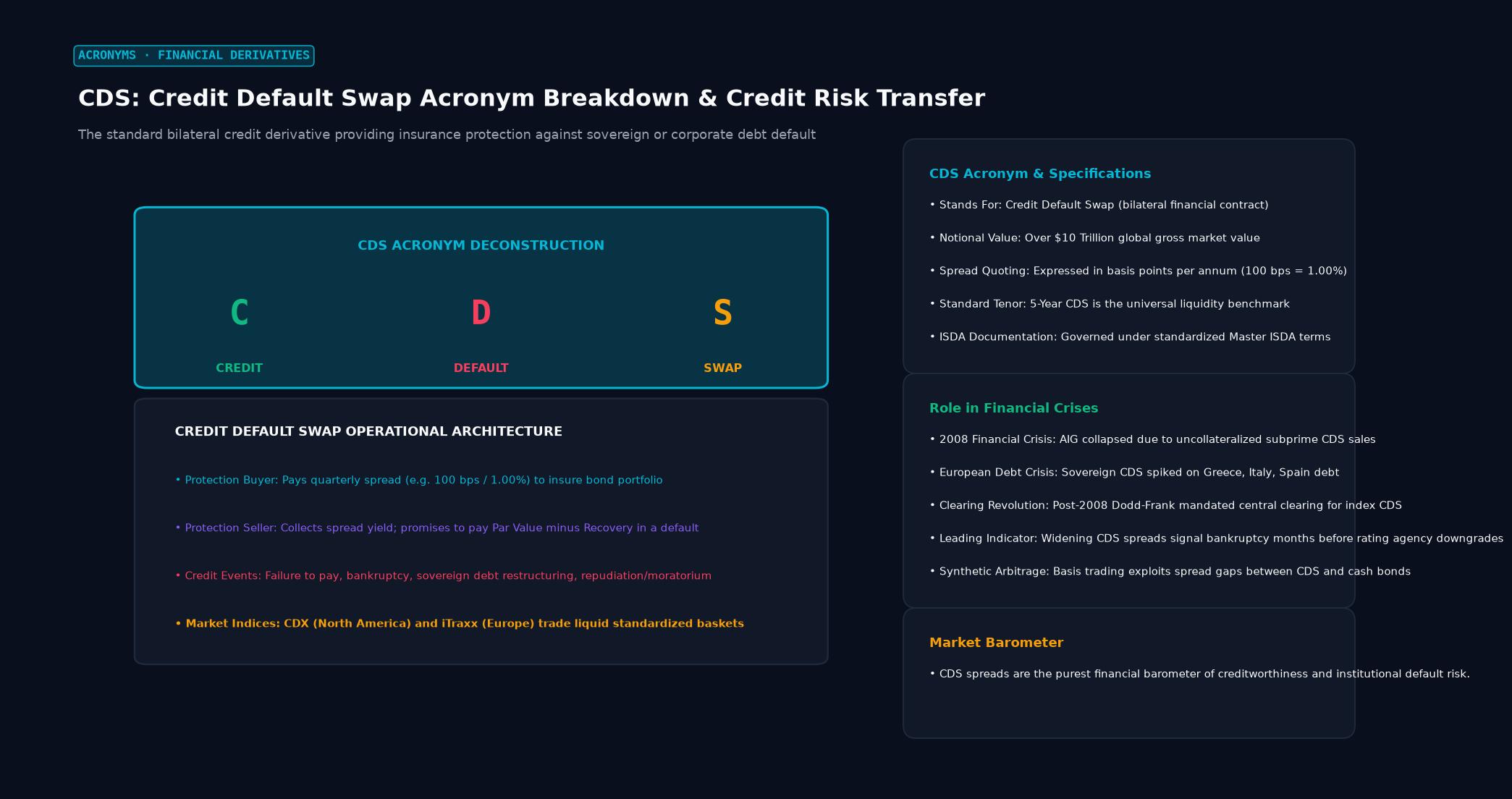 Figure: The standard bilateral credit derivative providing insurance protection against sovereign or corporate debt default

1. Credit Default Swap (CDS) Architecture
Standardized under the legal documentation framework established by the International Swaps and Derivatives Association (ISDA), a Credit Default Swap functions economically like an insurance policy on corporate or sovereign bonds, although it is legally classified as a derivative rather than insurance.
Key Contractual Variables
- Reference Entity: The corporate entity or sovereign state whose debt is being hedged (e.g., Apple Inc., Deutsche Bank AG, or the Federative Republic of Brazil).
- Reference Obligation: A specific underlying bond issue (typically senior unsecured debt) that defines the priority ranking of the debt.
- Notional Amount: The face dollar value of credit protection purchased (e.g., $10,000,000).
- CDS Spread (Running Premium): The annualized price of protection quoted in basis points (bps). A CDS spread of 200 bps on a $10 million notional requires the protection buyer to pay:
$$\text{Annual Premium} = $10,000,000 \times 0.0200 = $200,000 \text{ per year}$$
Payments are traditionally settled on standardized quarterly maturity dates (March 20, June 20, September 20, December 20) under ISDA Big Bang and Small Bang protocol reforms.
ISDA Credit Events and Determination Committees
The protection seller is required to pay out if and only if a formal Credit Event occurs. Under ISDA master definitions, Credit Events are adjudicated by independent regional ISDA Determinations Committees (DCs) composed of buy-side and sell-side institutional market participants:
+------------------------------------+------------------------------------+
| ISDA Credit Event Category         | Legal Trigger Condition            |
+------------------------------------+------------------------------------+
| Bankruptcy:                        | The reference entity files for     |
| Corporate insolvency proceedings.  | formal Chapter 11, administration, |
|                                    | or judicial liquidation.           |
|                                    |                                    |
| Failure to Pay:                    | Default on principal or interest   |
| Missing contractual debt service.  | exceeding statutory minimums after |
|                                    | the expiration of grace periods.   |
|                                    |                                    |
| Restructuring:                     | Mandatory reductions or deferrals  |
| Distressed debt exchange terms.    | of interest/principal that bind   |
|                                    | all debt holders involuntarily.    |
|                                    |                                    |
| Governmental Intervention:         | Mandatory bail-in or conversion    |
| Bank regulatory resolution actions.| of subordinated debt under central |
|                                    | bank emergency powers.             |
|                                    |                                    |
| Repudiation / Moratorium:          | Sovereign declaration declaring    |
| Sovereign debt disavowals.         | external foreign debt invalid.     |
+------------------------------------+------------------------------------+
Settlement Mechanisms: Physical vs. Auction Settlement
Historically, when a default occurred, contracts required physical settlement: the protection buyer delivered defaulted physical bonds to the protection seller in exchange for 100% of the par notional value in cash.
However, because the outstanding notional value of CDS contracts frequently exceeded the total physical volume of underlying bonds in existence by 10 to 1, physical settlement created massive short squeezes for defaulted paper.
Following the 2009 ISDA Big Bang Protocol, standard CDS settlement transitioned to Auction Settlement:
- Administrators (Creditex and S&P Global / Markit) execute a two-stage credit fix auction to establish the market-clearing post-default recovery price of the reference debt.
- If the auction establishes a final recovery value of 35% ($0.35 on the dollar): $$\text{Cash Settlement Payout} = \text{Notional} \times (1.0 - \text{Recovery Rate})$$ $$\text{Payout} = $10,000,000 \times (1.0 - 0.35) = $6,500,000$$ The protection seller transfers $6,500,000 in cash to the protection buyer, and the contract terminates with zero physical bond delivery required.
Standardized Indices: CDX and iTraxx
While single-name CDS contracts hedge individual corporations, institutional asset managers and hedge funds trade standardized liquid baskets known as CDS indices:
- CDX (Credit Derivative Product): Covers corporate debt across North America and Emerging Markets. Flagship indices include the CDX North American Investment Grade (CDX NA IG) index (125 liquid investment-grade firms) and the CDX High Yield (CDX NA HY) index.
- iTraxx: Covers corporate debt across Europe, Asia, and Australia. Key indices include the iTraxx Europe (125 investment-grade names) and the iTraxx Crossover (sub-investment-grade corporate entities).
CDS index contracts roll over every six months (in March and September) with updated series composition, providing traders with deep liquidity to take directional bets on systemic credit market health.
  Index Series               Constituent Count    Primary Risk Focus
  -----------------------------------------------------------------------------------
  CDX NA Investment Grade    125 Entities         North American blue-chip credit
  CDX NA High Yield          100 Entities         North American sub-investment grade
  iTraxx Europe Main         125 Entities         European investment-grade corporate
  iTraxx Europe Crossover    75 Entities          European high-yield / crossover names
  CDX Emerging Markets       Liquid Sovereign     Developing nation sovereign debt
2. Canadian Depository for Securities (CDS Canada)
In Canadian institutional market structure, CDS refers to the Canadian Depository for Securities Limited. CDS is the national central securities depository, clearing house, and settlement service for equities, corporate debt, and sovereign government bonds in Canada.
+------------------------------------+------------------------------------+
| Institutional Profile: CDS Canada  | Operational Function               |
+------------------------------------+------------------------------------+
| Operating Engine: CDSX             | Real-time electronic trade netting |
|                                    | and book-entry settlement system.  |
|                                    |                                    |
| Corporate Ownership: TMX Group     | Wholly owned subsidiary of TMX     |
|                                    | Group (operator of TSX and TSXV).  |
|                                    |                                    |
| Cross-Border Depository Linkage    | Maintains direct clearing conduits |
|                                    | with the US Depository Trust and   |
|                                    | Clearing Corporation (DTCC).       |
+------------------------------------+------------------------------------+
Through the CDSX platform, trillions of Canadian Dollars in securities trades clear annually with complete Delivery Versus Payment (DvP), eliminating settlement failure risk across Canadian capital markets.
Frequently Asked Questions
Can an investor buy a Credit Default Swap without owning the underlying bonds?
Yes. This transaction is known as a Naked CDS. Investors purchase credit protection purely as a speculative position to bet that a corporation or sovereign will suffer credit deterioration or bankruptcy. However, following the European sovereign debt crisis, the European Union implemented EU Regulation No 236/2012, which strictly bans naked CDS positions on sovereign debt within member states.
What caused the collapse of AIG in 2008 regarding Credit Default Swaps?
AIG Financial Products (AIGFP) acted as a massive protection seller, writing hundreds of billions of dollars in CDS protection on multi-sector Collateralized Debt Obligations (CDOs) containing subprime mortgages. Because AIG possessed a AAA credit rating, it was not initially required to post cash collateral against paper mark-to-market losses. When subprime defaults escalated and rating agencies downgraded AIG, contractual covenants triggered tens of billions of dollars in immediate cash margin calls, forcing an emergency federal government bailout.
What does it mean when a country’s sovereign CDS spread widens?
When a sovereign CDS spread widens (for example, surging from 80 bps to 450 bps), it signals that global financial markets are pricing in an increased probability of sovereign debt default, currency devaluation, or debt restructuring. Widening spreads increase foreign borrowing costs for both the sovereign government and domestic corporate borrowers seeking international credit.
Ready to trade forex?
Open a free demo account with a regulated broker. Practice with virtual funds before risking real money.