CDSC
A mutual fund and investment acronym for Contingent Deferred Sales Charge, a tiered redemption fee assessed on fund investors who liquidate shares prior to an agreed holding period.
What Does CDSC Stand For in Finance?
In wealth management, retail asset management, and mutual fund distribution, the acronym CDSC stands for Contingent Deferred Sales Charge. Frequently referred to in retail investment sales as a back-end load, a CDSC is a specialized fee assessed by an open-end mutual fund management company when an investor redeems (sells) fund shares before completing a specified multi-year holding period.
Unlike traditional front-end sales loads (which deduct broker sales commissions immediately upon investment), a CDSC allows 100% of an investor initial capital to be invested into portfolio securities on day one. The sales charge is contingent because it is triggered only if the investor exits the fund prematurely, and it is deferred because the fee schedule declines in annual steps until reaching zero, incentivizing long-term investor retention and allowing the fund distributor to recoup upfront broker commissions over time.
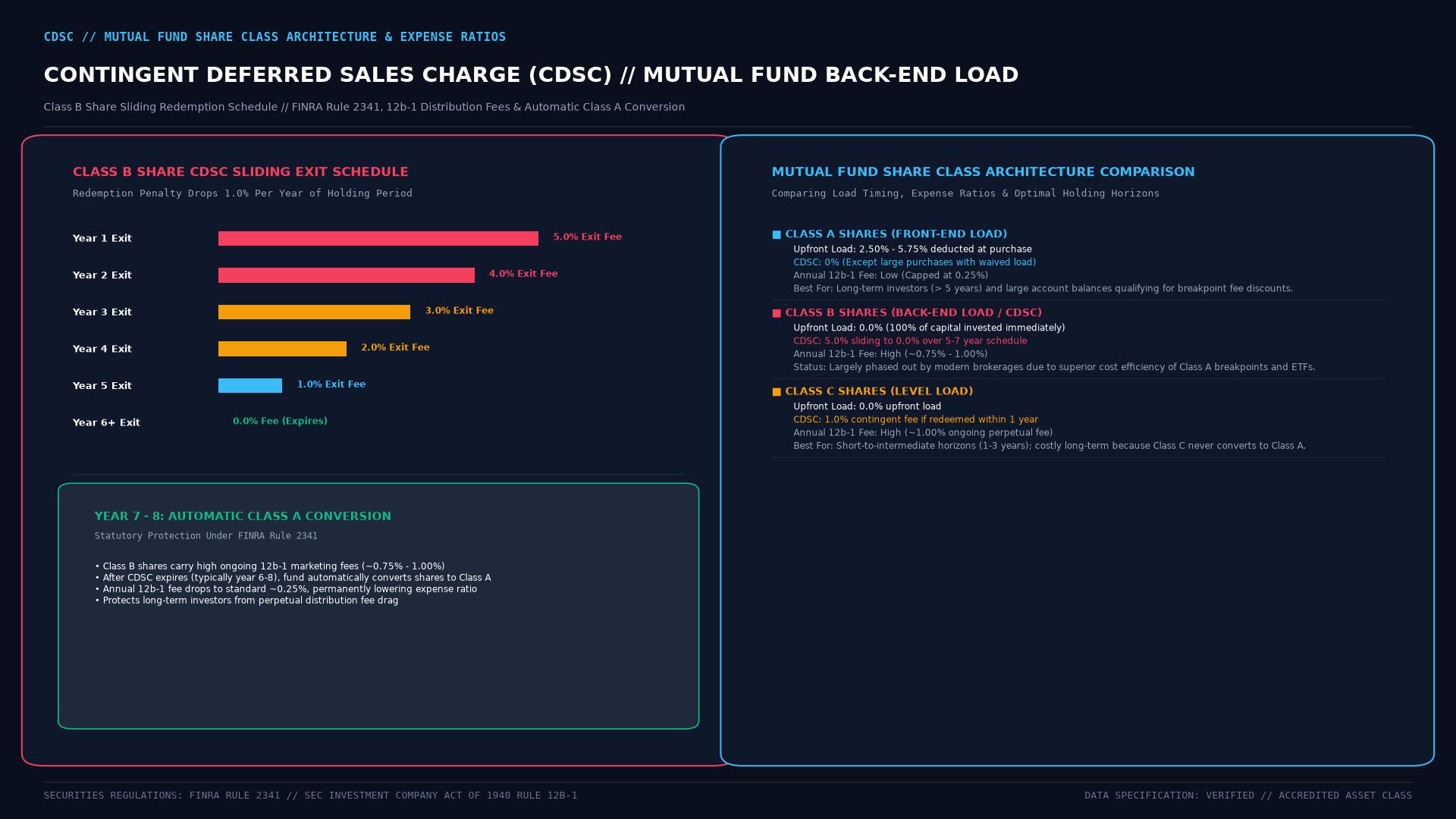 Figure: Class B mutual fund Contingent Deferred Sales Charge (CDSC) sliding back-end redemption schedule, FINRA Rule 2341 automatic Class A conversion, and share class expense comparison.
Share Class Architecture: Class A, Class B, and Class C
The application of a CDSC is tied to mutual fund share class categorization:
+------------------------------------+------------------------------------+
| Mutual Fund Share Class            | Fee Structure & CDSC Profile       |
+------------------------------------+------------------------------------+
| Class A Shares:                    | Upfront Sales Load: Typically      |
| Front-end loaded shares.           | 2.50% to 5.75% deducted at purchase|
|                                    | Zero CDSC (except for large        |
|                                    | purchases qualifying for load      |
|                                    | waivers held under 12-18 months).  |
|                                    |                                    |
| Class B Shares:                    | Zero Upfront Load: 100% invested.  |
| The classic CDSC vehicle.          | Declining CDSC schedule starting   |
|                                    | at 5.0% and phasing out over 6 yrs.|
|                                    | High 12b-1 fees (~1.00% annually); |
|                                    | converts to Class A after lockup.  |
|                                    |                                    |
| Class C Shares:                    | Level Load Shares: Zero upfront    |
| Short-term retail trading vehicle. | commission. Modest 1.0% CDSC if    |
|                                    | redeemed within first 12 months.   |
|                                    | Ongoing 1.0% 12b-1 fee forever;    |
|                                    | generally never converts to Class A|
+------------------------------------+------------------------------------+
Mathematical Computation of the CDSC
Securities and Exchange Commission (SEC) regulations and prospectus guidelines require mutual funds to calculate the CDSC using a favorable consumer formula designed to prevent penalizing market gains.
The charge is calculated by applying the prevailing schedule percentage to the lesser of the original purchase cost basis or the current Net Asset Value (NAV) of the redeemed shares:
$$\text{CDSC Dollar Charge} = \text{Applicable CDSC } % \times \min(\text{Original Purchase Cost Basis}, \text{Redemption NAV})$$
First-In, First-Out (FIFO) Liquidation Rules
Mutual fund accounting rules dictate that when an investor executes a partial redemption, shares are liquidated in a specific order designed to minimize fee penalties:
- Reinvested Dividend and Capital Gain Shares: Redeemed first. Because these shares were acquired through automatic distributions rather than original cash purchases, they are completely exempt from CDSC fees.
- Market Appreciation: Value gains above original cost basis are exempt from charges.
- Oldest Purchase Lots First: Shares held the longest (which qualify for lower CDSC percentage tiers) are liquidated before newly acquired shares.
Practical Mathematical Example
An investor purchased 1,000 Class B shares at an initial NAV of $20.00 ($20,000 cost basis).
- In Year 2 (subject to a 4.0% CDSC), the fund NAV appreciates to $25.00 ($25,000 total market value).
- The investor redeems the entire position.
- Calculation: $\min($20,000, $25,000) = $20,000$.
- CDSC Fee Owed: $$20,000 \times 0.04 = $800$.
- Net Proceeds Delivered to Investor: $$25,000 - $800 = $24,200$.
If the NAV had instead collapsed to $15.00 ($15,000 market value due to a market downturn), the fee is calculated against the depressed market value:
- Calculation: $\min($20,000, $15,000) = $15,000$.
- CDSC Fee Owed: $$15,000 \times 0.04 = $600$.
Regulatory Framework: FINRA Rule 2830
In the United States, the Financial Industry Regulatory Authority (FINRA) regulates mutual fund sales compensation under FINRA Rule 2830:
- Maximum Aggregate Sales Charge Caps: The rule imposes an absolute ceiling on total combined sales charges (front-end plus back-end CDSC), capping aggregate charges at 8.5% of the offering price for funds that do not assess ongoing service fees, or 7.25% for funds with ongoing service fees.
- Annual 12b-1 Distribution Caps: Funds assessing a CDSC utilize Rule 12b-1 fees to finance the upfront broker commissions paid to selling brokers. FINRA caps asset-based distribution fees at 0.75% per annum, with an additional 0.25% permitted as a shareholder servicing fee (total cap: 1.00% annually).
- Disclosure Mandates: The fund prospectus and Statement of Additional Information (SAI) must explicitly disclose the CDSC declining schedule, redemption order rules, and share class conversion timelines.
Standard Statutory Waivers and Exceptions
Mutual fund sponsors provide contractual waivers where the CDSC is eliminated, even if shares are redeemed within the fee window:
  Waiver Category                      Statutory / Contractual Eligibility Condition
  -----------------------------------------------------------------------------------
  Death or Permanent Disability        Redemptions executed by surviving beneficiaries
                                       or upon verified permanent disability of owner
  Required Minimum Distributions (RMD) Mandatory IRA withdrawals under IRC § 401(a)(9)
  Systematic Withdrawal Plans (SWP)    Pre-scheduled monthly distributions typically
                                       capped at 10% to 12% of account value annually
  Fund Liquidation / Merger            Involuntary liquidations mandated by fund board
Industry Evolution: The Decline of Class B Shares
Over the past two decades, Class B shares and long-term CDSC schedules have largely vanished from the modern wealth management landscape:
- Fiduciary Standard Scrutiny: Regulatory enforcement by the SEC and FINRA highlighted that Class B shares were frequently more expensive over multi-year horizons than Class A shares (due to compounding 1.00% annual 12b-1 fees over six years compared to a one-time front-end load with lower ongoing 0.25% 12b-1 fees).
- Growth of Fee-Based Advisory: Broker-dealers shifted from commission-based brokerage accounts to Registered Investment Advisor (RIA) fee-based models charging an annualized asset-under-management (AUM) fee (e.g., 1.0%). These accounts utilize Institutional No-Load share classes (Class I) or Clean Shares that carry zero front-end loads, zero CDSCs, and zero 12b-1 fees.
Frequently Asked Questions
Does the CDSC fee go directly to the financial advisor who sold the fund?
No. The CDSC fee collected upon early redemption is paid directly to the mutual fund sponsor or principal underwriter. The fund underwriter retains the CDSC to recoup the upfront commission (typically 4% to 5%) that it advanced out of its own capital to the selling financial advisor on the day the investor originally purchased the shares.
How does an investor know when their CDSC holding period has expired?
Mutual fund account statements provide share lot accounting reports indicating the acquisition date of each share block. Once a lot reaches the final anniversary milestone specified in the prospectus (such as year 6 for Class B shares, or month 12 for Class C shares), the CDSC percentage drops to zero, and the shares can be liquidated with zero exit fees.
Can an investor exchange CDSC shares into another fund without triggering the charge?
Yes. Mutual fund families permit intra-family fund exchanges. An investor can exchange Class B shares of an equity fund into Class B shares of a money market or bond fund within the same fund family without triggering the CDSC. The original purchase date carries over to the new fund lot, preserving the aging timeline toward the zero-fee milestone.
Ready to trade forex?
Open a free demo account with a regulated broker. Practice with virtual funds before risking real money.