Mutual Fund
A mutual fund is a regulated collective investment vehicle that pools capital from retail and institutional investors to purchase a diversified portfolio of equities, bonds, or money market securities, priced daily at Net Asset Value (NAV).
What Is a Mutual Fund?
A mutual fund is a regulated pooled investment vehicle managed by an institutional asset management company (such as Vanguard, Fidelity, BlackRock, or T. Rowe Price). By pooling the capital of thousands or millions of individual and corporate investors, a mutual fund creates a massive, diversified portfolio of securities—encompassing common equities, corporate bonds, government treasuries, money market instruments, or commodities—that would be cost-prohibitive for an individual investor to replicate independently.
Regulated primarily under the Investment Company Act of 1940 in the United States and the UCITS (Undertakings for Collective Investment in Transferable Securities) framework in Europe, standard mutual funds operate as open-ended investment funds. Investors buy and redeem shares directly with the fund sponsor rather than trading with other investors on a secondary exchange. Critically, mutual fund transactions execute only once per business day after the financial market close, priced at the fund’s official Net Asset Value (NAV).
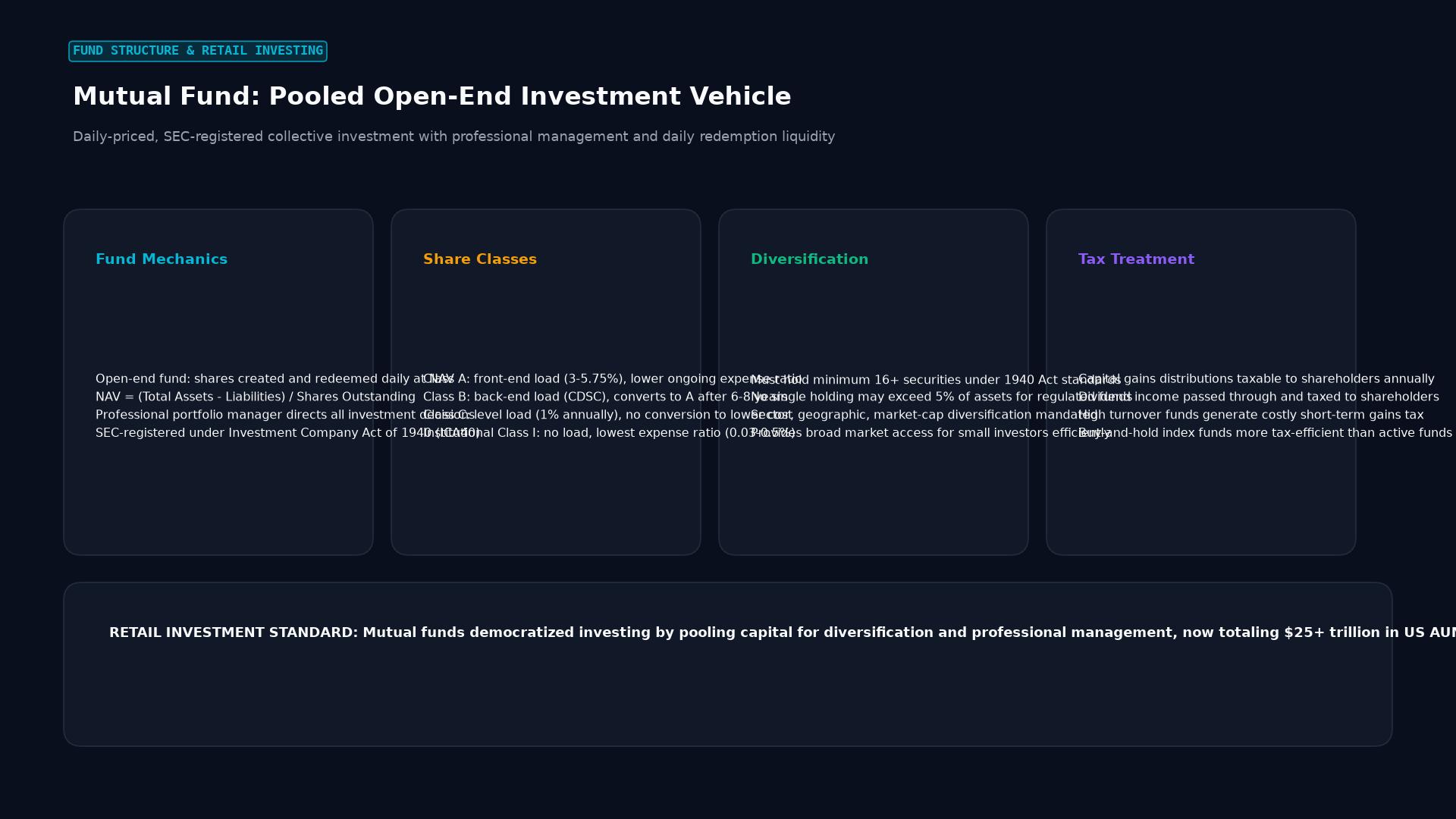 Figure: Daily-priced, SEC-registered collective investment with professional management and daily redemption liquidity
Key Takeaways
- Instant Diversification: Purchasing a single share of a mutual fund grants immediate fractional exposure to dozens, hundreds, or thousands of underlying individual securities, eliminating single-stock default risk.
- Daily Net Asset Value (NAV) Pricing: Unlike stocks or ETFs that trade continuously with fluctuating bids and asks throughout the day, mutual funds trade exclusively once per day at the official 4:00 PM EST NAV cut.
- Active vs. Passive Management: Active mutual funds employ portfolio managers attempting to beat a market benchmark (generating “alpha”), while passive index funds track established market benchmarks (like the S&P 500) with minimal expense ratios.
- Continuous Share Creation and Redemption: Open-end mutual funds continuously create new shares when investors deposit capital and redeem (retire) shares when investors liquidate, keeping the share price strictly pegged to the fair value of underlying assets.
- Currency Hedged Share Classes: International mutual funds that invest in overseas markets routinely offer “currency-hedged” share classes, using foreign exchange forward contracts to insulate investors from foreign exchange rate volatility.
Comparative Taxonomy: Mutual Funds vs. ETFs vs. Hedge Funds
| Structural Dimension | Open-End Mutual Fund | Exchange-Traded Fund (ETF) | Hedge Fund |
|---|---|---|---|
| Trading Execution | Once daily at 4:00 PM EST NAV | Continuous real-time intraday exchange trading | Monthly or quarterly redemption windows |
| Intraday Leverage / Shorting | Strictly prohibited | Supported (via margin or inverse ETFs) | Fundamental component of strategy |
| Regulatory Framework | Investment Company Act of 1940 / UCITS | 1940 Act / SEC Rule 6c-11 | Exempt / Reg D (Accredited investors only) |
| Minimum Investment | $500 – $3,000 (often $0 for 401k) | Price of 1 single share (fractional shares) | $250,000 to $5,000,000+ |
| Expense Ratios | 0.05% (Passive) to 1.50% (Active) | 0.03% to 0.75% | “2 and 20” (2% AUM + 20% Performance) |
| Portfolio Transparency | Disclosed quarterly with 60-day lag | Disclosed daily | Strictly confidential / proprietary |
The Mathematics of Net Asset Value (NAV)
The price per share of a mutual fund is mathematically defined as its Net Asset Value (NAV):
$$\text{NAV} = \frac{\text{Total Market Value of Assets} - \text{Total Fund Liabilities}}{\text{Total Number of Outstanding Shares}}$$
Where:
- Total Assets: The closing market value of all stocks, bonds, cash equivalents, and accrued dividends.
- Total Liabilities: Accrued management fees, custodian charges, administrative expenses, and pending trades.
Numerical Calculation:
A global multi-asset mutual fund records the following figures at the 4:00 PM EST close:
- Equity Holdings: $$850,000,000$
- Bond Holdings: $$320,000,000$
- Cash & Currency Reserves: $$30,000,000$
- Total Assets: $$1,200,000,000$
- Total Accrued Operational Liabilities: $$50,000,000$
- Total Outstanding Shares: $25,000,000$
$$\text{Fund Net Equity} = $1,200,000,000 - $50,000,000 = $1,150,000,000$$
$$\text{NAV per Share} = \frac{$1,150,000,000}{25,000,000} = \mathbf{$46.00}$$
Every investor who submitted a buy or sell order during the trading day—whether at 9:35 AM or 3:55 PM—transacts at exactly $46.00 per share.
Real-World Case Study: John Bogle and the Vanguard Index Revolution
Prior to 1976, the mutual fund industry was dominated by expensive active managers charging front-end sales loads of 8.5% and high annual management fees, claiming they could consistently outperform the market.
- The Innovation: John C. Bogle, founder of Vanguard, established the First Index Investment Trust (tracking the S&P 500) on December 31, 1975.
- Wall Street Ridicule: Competitors dismissed the fund as “Bogle’s Folly” and “un-American,” arguing that settling for average index returns guaranteed mediocrity.
- The Mathematical Reality: Bogle proved that over long investment horizons, the overwhelming majority of active mutual fund managers underperform the broad market index due to high trading turnover, management fees, and transaction drag.
- The Legacy: Vanguard expanded the fund into the Vanguard 500 Index Fund, lowering expense ratios to under 0.04%. The index fund transformed global retail investing, redirecting trillions of dollars from high-fee active funds into low-cost passive index mutual funds and ETFs.
Critical Fee Traps in Traditional Mutual Funds
- Sales Loads: Certain broker-sold mutual funds charge Front-End Loads (deducting 3% to 5.75% of your deposit immediately before investing) or Back-End Loads / Deferred Sales Charges (penalizing you for redeeming shares within 5 years).
- 12b-1 Distribution Fees: Annual marketing and distribution fees (often 0.25% to 0.75%) deducted directly from fund assets to compensate financial intermediaries for selling the fund.
- Tax Inefficiency (Capital Gain Distributions): When an active mutual fund manager sells winning positions to meet redemptions from other investors, the fund must distribute taxable capital gains to all remaining shareholders at year-end, even if the individual investor did not sell a single share.
Frequently Asked Questions (FAQ)
What is the difference between a mutual fund and an ETF?
An Exchange-Traded Fund (ETF) trades continuously like a stock on open stock exchanges throughout the trading day with real-time fluctuating prices. A mutual fund trades only once per day after the market close at the calculated Net Asset Value (NAV).
How do mutual funds protect against foreign currency volatility?
International mutual funds often offer “hedged” share classes that deploy foreign exchange forward contracts and currency swaps. When foreign currencies depreciate against the investor’s home currency, gains on the forward derivative hedges offset the currency translation losses of the underlying foreign assets.
What is a target-date mutual fund?
A target-date mutual fund is a specialized retirement fund that automatically rebalances its asset allocation over time based on an investor’s expected retirement year (e.g., Target 2050 Fund). It holds a high allocation of aggressive equities during early working years and gradually shifts into conservative bonds as the target date approaches.
Ready to trade forex?
Open a free demo account with a regulated broker. Practice with virtual funds before risking real money.