CHE
The ISO 4217 currency code for the WIR Euro, an electronic complementary trade currency operated alongside the WIR Franc (CHW) by Switzerland's WIR Bank to facilitate inter-enterprise barter credit.
What is the CHE (WIR Euro)?
CHE is the official three-letter international currency code assigned under ISO 4217 to the WIR Euro, an electronic complementary trade currency administered in Switzerland by WIR Bank (Banque WIR). Circulating alongside its domestic counterpart, the WIR Franc (ISO 4217 code: CHW), the WIR Euro was launched in December 2004 to enable Swiss small and medium-sized enterprises (SMEs) to conduct cross-border and multinational commercial trade transactions with trading partners inside the European single market.
In the global monetary architecture, the WIR system is recognized by central banks and macroeconomists as the world oldest, most resilient, and most successful institutional complementary currency. Regulated under Swiss banking law by the Swiss Financial Market Supervisory Authority (FINMA), the WIR currency network functions as a private mutual credit clearing ring, enabling thousands of independent businesses to finance commercial transactions, trade goods, and settle invoices without relying exclusively on traditional commercial bank debt.
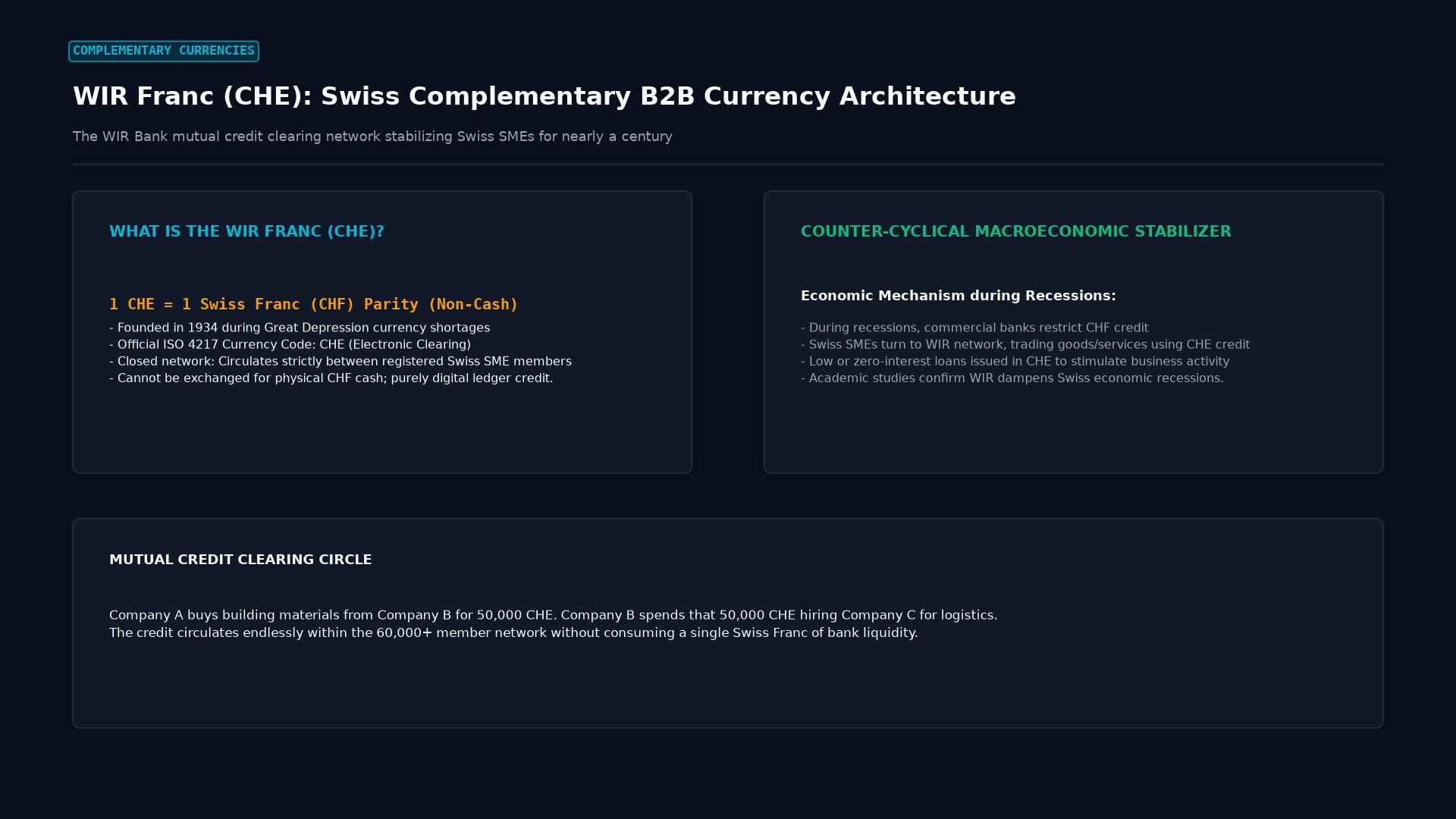 Figure: Mutual credit clearing: WIR Bank electronic currency pegged 1:1 to CHF, providing counter-cyclical liquidity to over 60,000 Swiss SMEs since 1934.
Historical Origins and Economic Philosophy
The WIR economic mechanism was born out of the deflationary collapse of the Great Depression. In 1934, Swiss economic reformers Werner Zimmermann and Paul Enz observed that while Swiss factories had unused capacity and skilled workers faced unemployment, businesses could not trade because traditional Swiss Franc (CHF) money was hoarded, and commercial banks had frozen business credit.
Influenced by the economic concepts of Silvio Gesell and his theory of “Freigeld” (free, non-hoarded money), the founders formed the Wirtschaftsring-Genossenschaft (Economic Circle Cooperative), choosing the abbreviation WIR, which is both an abbreviation of the German word for “Economic Ring” and the German word for “We”.
+------------------------------------+------------------------------------+
| Traditional Commercial Currency    | The Swiss WIR Complementary Model  |
+------------------------------------+------------------------------------+
| Supply dictated by central bank    | Credit generated endogenously by   |
| interest rate policy & bank loans. | businesses entering trade pacts.   |
|                                    |                                    |
| Hoarded during economic downturns, | Cannot be hoarded for interest;    |
| starving the real economy of cash. | designed to maintain velocity.     |
|                                    |                                    |
| High interest rates on working     | Low-interest mutual credit lines   |
| capital credit lines from banks.   | backed by collateralized liens.    |
|                                    |                                    |
| Procyclical: Expands in booms,     | Countercyclical: Expands during    |
| contracts sharply in recessions.   | commercial banking credit crunches.|
+------------------------------------+------------------------------------+
In 1936, the Swiss government required the cooperative to obtain a formal banking charter. Today, WIR Bank operates as a regulated cooperative bank headquartered in Basel, maintaining both conventional Swiss Franc deposit operations and the proprietary WIR clearing circle.
Monetary Mechanics of CHE and CHW
Under ISO 4217 specifications, Switzerland possesses three designated currency codes:
- CHF: The official sovereign legal tender (Swiss Franc), issued by the Swiss National Bank (SNB).
- CHW: The WIR Franc, an electronic unit of account pegged by bank statute at an exact 1:1 parity with the Swiss Franc ($1.00 \text{ CHW} = 1.00 \text{ CHF}$).
- CHE: The WIR Euro, an electronic unit of account pegged at an exact 1:1 parity with the European Union Euro ($1.00 \text{ CHE} = 1.00 \text{ EUR}$).
Non-Convertibility into Cash
A fundamental architectural rule of the WIR system is non-convertibility:
- No Physical Banknotes: There are no paper CHE or CHW banknotes. All balances exist exclusively as electronic book-entry ledgers inside WIR Bank accounts.
- No Direct Outbound Foreign Exchange: A company holding a positive balance of 100,000 CHE cannot walk into WIR Bank and demand 100,000 physical Euro cash, nor can it transfer those funds to a standard account at Deutsche Bank.
To utilize CHE balances, the enterprise must purchase goods, industrial materials, office furniture, vehicle fleets, software development, or hospitality services from another participating merchant within the WIR network. This non-convertibility creates a closed, self-reinforcing economic loop that traps purchasing power inside the domestic SME community.
Mixed-Currency Invoicing and Commercial Operations
In daily Swiss business commerce, transactions are rarely billed 100% in WIR. Instead, businesses negotiate split-currency pricing (partially settled in conventional currency and partially in WIR):
$$\text{Total Invoice Amount} = \text{Cash Component (EUR / CHF)} + \text{WIR Component (CHE / CHW)}$$
Consider a commercial construction contractor purchasing €200,000 of architectural glass:
- The supplier invoices with a 40% WIR acceptance rate.
- The contractor pays €120,000 via standard bank transfer (covering the supplier out-of-pocket raw material and energy costs).
- The remaining €80,000 is settled by an electronic book-entry transfer of 80,000 CHE.
  Merchant WIR Acceptance Rate    Commercial Motivation
  ──────────────────────────────────────────────────────────────────────────
  High Acceptance (50% to 100%):  Service firms with low marginal costs
                                  (hotels, architects, legal consultants, print
                                  shops) seeking to attract new commercial clients.

  Moderate Acceptance (20% to 40%):Manufacturing & construction firms requiring
                                  hard cash to pay imported components while using
                                  WIR to finance local subcontractor labor.

  Low Acceptance (10% to 15%):    High-volume wholesale distributors operating on
                                  narrow gross profit margins.
Macroeconomic Countercyclicality
Academic studies, including research published by the Swiss National Bank and international macroeconomists, highlight the unique countercyclical property of the WIR system.
During periods of macroeconomic expansion:
- Traditional bank credit is readily available.
- Businesses rely more heavily on standard Swiss Francs and Euros.
- Transaction velocity in the WIR network moderates.
During periods of macroeconomic recession or banking crises:
- Commercial banks restrict credit lines, raise risk margins, and reduce SME lending.
- Facing cash liquidity crunches, Swiss businesses turn to WIR Bank to activate collateralized WIR credit lines.
- Inter-enterprise trading volume in CHE and CHW expands rapidly, preserving employment and corporate cash flow while shielding the Swiss economy from the full severity of global credit contractions.
Frequently Asked Questions
Is the WIR Euro (CHE) legal tender in Switzerland?
No. The sole official legal tender in Switzerland is the Swiss Franc (CHF), issued by the Swiss National Bank. The WIR Euro (CHE) is a private, contractual complementary currency. Businesses are not legally obligated to accept it; participation in the WIR clearing network is voluntary and governed by private civil and banking contracts.
How does WIR Bank ensure that participating businesses do not default on their CHE credit lines?
WIR Bank underwrites loans and credit lines using prudent banking standards. When an enterprise applies for a WIR credit line, it must provide verified collateral, such as commercial real estate mortgages, pledges of corporate inventory, or personal guarantees. If a borrower defaults, WIR Bank forecloses on the pledged collateral.
Can individuals use CHE for everyday retail shopping?
While individual employees can hold private WIR accounts and spend balances at participating local retail shops, restaurants, and hotels, the vast majority of CHE and CHW transaction volume is concentrated in business-to-business (B2B) trade between corporate enterprises, construction contractors, and professional service firms.
Ready to trade forex?
Open a free demo account with a regulated broker. Practice with virtual funds before risking real money.