CME Group
CME Group is the world's largest financial derivatives exchange marketplace, encompassing the CME, CBOT, NYMEX, and COMEX. It facilitates institutional trading across FX futures, equity indexes, energy, agricultural commodities, and interest rate products.
What Is CME Group?
CME Group Inc. (Chicago Mercantile Exchange & Chicago Board of Trade) is the preeminent global derivatives marketplace, processing billions of contracts annually across every major investable asset class. Headquartered in Chicago, CME Group operates global electronic venues—anchored by the CME Globex platform—and central counterparty clearing services that enable institutional asset managers, commercial hedgers, liquidity providers, and active retail traders to manage risk, speculate, and establish forward valuations.
The modern exchange conglomerate was formed through pivotal consolidations:
- Chicago Mercantile Exchange (CME): Founded in 1898 as the Chicago Butter and Egg Board, CME pioneered financial futures in 1972 under Leo Melamed by launching currency futures alongside the International Monetary Market (IMM).
- Chicago Board of Trade (CBOT): Founded in 1848, the premier grain and agricultural exchange merged with CME in 2007.
- New York Mercantile Exchange (NYMEX): Acquired in 2008, bringing global benchmark energy contracts (WTI crude oil, natural gas).
- Commodity Exchange (COMEX): Acquired with NYMEX, housing benchmark precious metals futures (gold, silver, copper).
- NEX Group (formerly ICAP/EBS): Acquired in 2018, integrating the world’s primary electronic spot FX interdealer matching broker (EBS) directly into CME’s footprint.
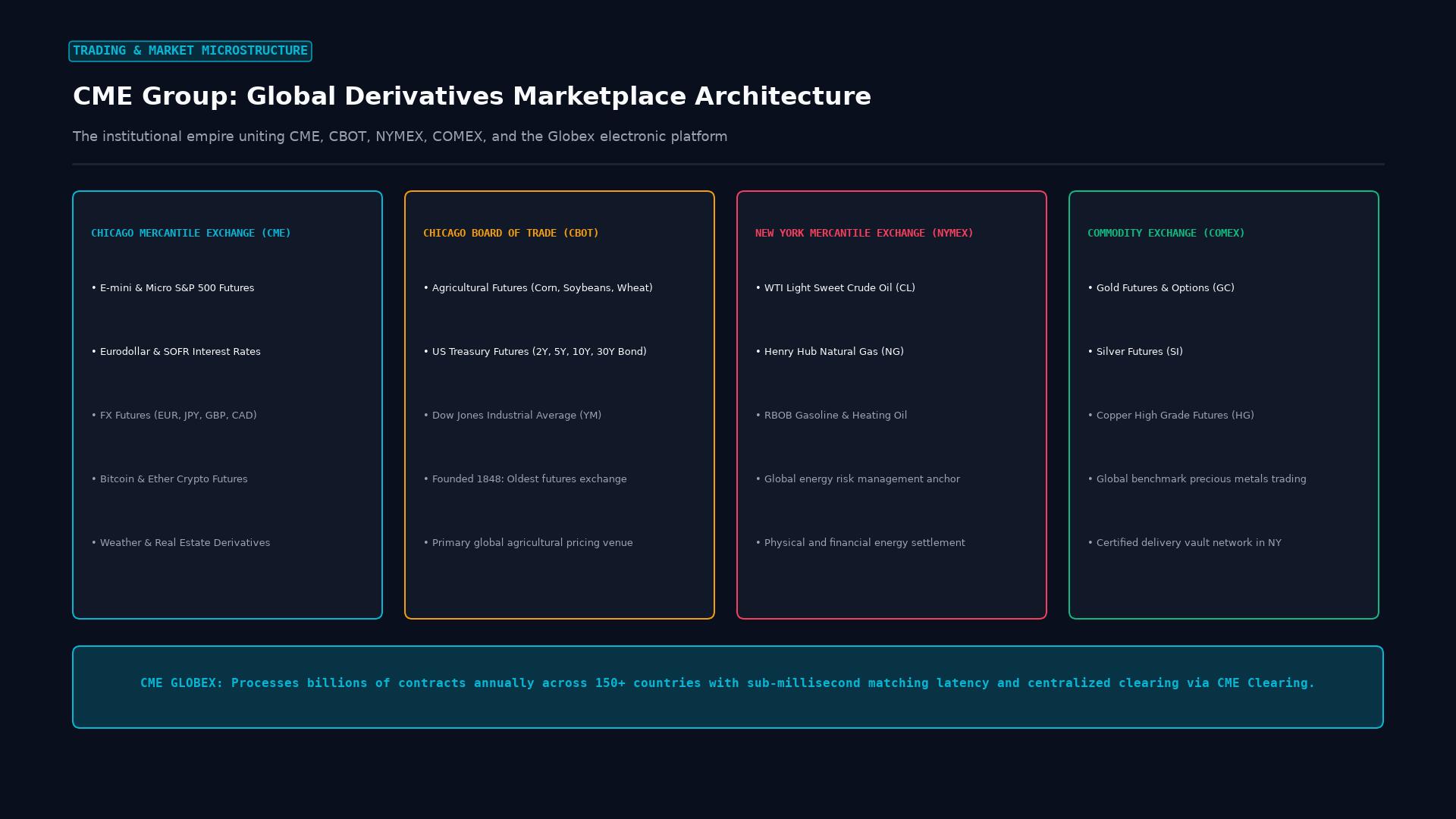 Figure: The multi-exchange CME Group ecosystem uniting Chicago Mercantile Exchange, CBOT, NYMEX, and COMEX with the sub-millisecond Globex electronic matching engine.
Key Takeaways
- Global Benchmark Price Discovery: CME Group sets the world’s daily benchmark prices for interest rates (SOFR futures), FX (Euro, Yen, Pound futures), commodities (WTI Crude Oil, Gold, Corn), and equities (E-mini S&P 500, Nasdaq 100).
- Exchange-Traded vs. OTC FX: Unlike the decentralized Over-the-Counter (OTC) spot currency market, CME FX futures are standardized, centrally cleared, and traded on a public limit order book with total volume transparency.
- Counterparty Guarantee: Every trade executed on CME venues is novated into CME Clearing, acting as buyer to every seller and seller to every buyer, virtually eliminating bilateral default risk.
- Commitments of Traders (COT): Because CME contracts fall under the jurisdiction of the Commodity Futures Trading Commission (CFTC), CME market participants provide the data underlying the weekly COT report, a critical sentiment tool for currency traders.
Market Architecture: Spot FX vs. CME Currency Futures
For foreign exchange market participants, CME Group represents the standardized alternative to OTC interbank markets. While retail spot forex operates via broker-dealer market makers or ECN aggregators without centralized trade repositories, CME operates a transparent central limit order book (CLOB).
| Operational Dimension | OTC Spot Forex Market | CME Group Currency Futures |
|---|---|---|
| Market Structure | Decentralized, bilateral, fragmented across ECNs | Centralized Exchange Order Book (CME Globex) |
| Counterparty Risk | Bilateral bank/broker default risk | Zero bilateral risk; guaranteed by CME Clearing |
| Volume Transparency | Fragmented tick volume; no universal tape | 100% transparent trade volume and Open Interest |
| Regulation | Varies by jurisdiction (NFA/FCA/ASIC/offshore) | Strict CFTC and National Futures Association (NFA) oversight |
| Contract Specifications | Custom lot sizes (e.g., micro, standard units) | Standardized contract sizes (e.g., €125,000 per 6E lot) |
| Settlement Mechanism | Rolling spot T+2 with overnight rollover swaps | Physical delivery or cash settlement on quarterly IMM dates |
The Role of CME Clearing and Capital Efficiency
At the center of CME Group’s institutional dominance is CME Clearing, one of the world’s largest Central Counterparties (CCPs). CME Clearing employs the Standard Portfolio Analysis of Risk (SPAN) margin system (and modern SPAN 2 framework) to calculate portfolio risk dynamically.
Institutional participants benefit from cross-margining efficiencies:
- Margin Offsets: A fund holding long CME Euro FX futures ($6E$) alongside short OTC EUR/USD spot positions or interest rate swaps can cross-margin their collateral, reducing total initial margin requirements by 40% to 75%.
- Mark-to-Market Settlement: Accounts are marked to market twice daily. Profits and losses are paid and collected in cash each trading session, preventing the buildup of uncollateralized systemic debt.
- Default Waterfall: In the catastrophic event of a clearing member bankruptcy, CME relies on a multi-tiered safety net: member collateral, default funds, exchange surplus capital, and mutualized assessment pools.
Real-World Case Study: Hedging Currency Exposure via CME Euro Futures
Consider a multinational European export firm anticipating the receipt of $25,000,000 USD from an American distributor in September. The corporate treasurer seeks to lock in the euro conversion rate in March, when the EUR/USD exchange rate is 1.0850.
Contract Parameters
- Contract: CME Euro FX Futures (Ticker:
6E) - Underlying Value: €125,000 per contract
- Tick Value: $0.00005 per euro ($6.25 per tick per contract)
- Target Notional: $25,000,000 USD $\approx$ €23,041,475
- Contracts Required: $$\text{Contracts} = \frac{€23,041,475}{€125,000} \approx 184 \text{ contracts}$$
Hedging Execution
- The company enters a long position in 184 September CME Euro FX contracts at 1.0850.
- By September maturity, unforeseen European central bank easing pushes the spot EUR/USD exchange rate down to 1.0250 (a 600-pip depreciation of the euro against the dollar).
- In the cash market, the firm’s $25,000,000 conversion yields: $$\frac{$25,000,000}{1.0250} = €24,390,244$$ (Yielding a raw paper gain in euros, but demonstrating severe dollar purchasing power disparity).
- In an inverse scenario where the dollar weakens to 1.1500, the firm’s cash dollars would convert to only €21,739,130 (a €1,302,345 shortfall).
- The CME futures position offsets this variance penny-for-penny against the IMM settlement price, insulating corporate financial earnings from FX volatility.
Frequently Asked Questions
Can retail traders access CME Group contracts?
Yes. Retail traders can trade CME contracts through registered Futures Commission Merchants (FCMs) and retail brokers. To accommodate smaller accounts, CME introduced Micro E-mini equity futures and Micro FX Futures (such as M6E, which is €12,500 in notional size—one-tenth the size of standard futures).
How does CME trading affect spot forex pricing?
High-frequency market makers and statistical arbitrage desks run algorithmic models linking CME Globex futures order books with interbank OTC liquidity pools (such as EBS, Refinitiv Matching, and Currenex). Because futures reflect deep institutional order flow, significant spikes in CME volume or price breaks immediately transmit to retail spot broker feeds within milliseconds.
What is the difference between CME Globex and CME ClearPort?
CME Globex is the electronic central limit order book where participants submit bids and offers for automated matching. CME ClearPort is an institutional post-execution clearing service that allows off-exchange, privately negotiated Over-the-Counter (OTC) transactions (block trades and exchange-for-related-positions) to be entered into CME Clearing for central clearing and counterparty protection.
Ready to trade forex?
Open a free demo account with a regulated broker. Practice with virtual funds before risking real money.