Clearing
The post-trade, pre-settlement operational process in financial markets where transactions are reconciled, authenticated, netted, and matched, frequently involving novation by a Central Counterparty (CCP) to guarantee contract fulfillment.
What is Financial Clearing?
In capital and currency markets, clearing encompasses all activities and legal processes that occur between the moment a trade is executed on an exchange or dealing desk and the moment funds and securities are permanently transferred (settlement).
Clearing transforms a raw verbal or electronic trade agreement into a legally binding, standardized, and risk-managed transaction. The clearing process verifies that both parties agree on the trade terms (price, volume, currency pair, settlement date), calculates net obligations across all market participants, and collects performance collateral (margin) to guarantee that neither party defaults before final delivery.
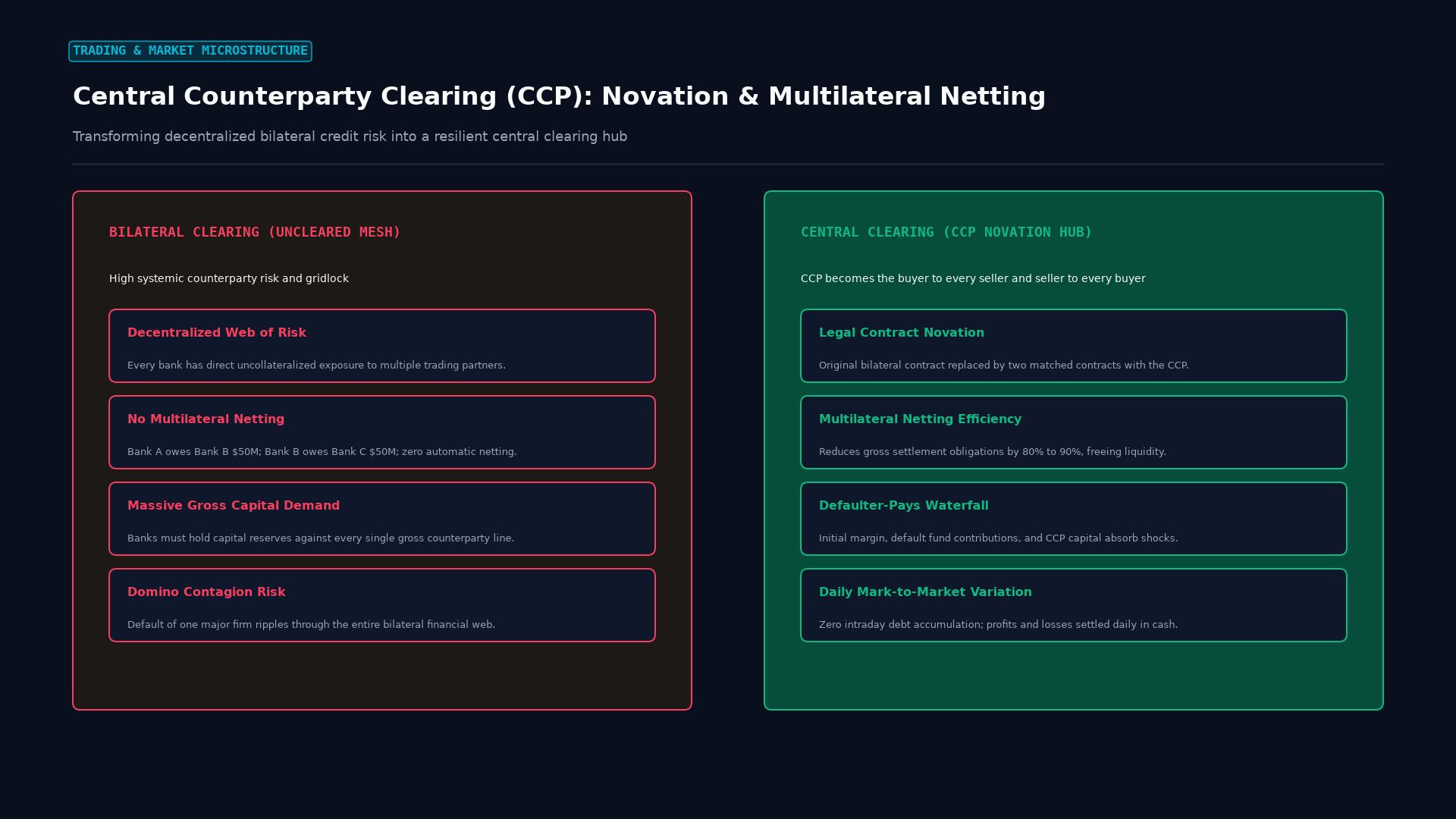 Figure: Systemic risk mitigation through CCP novation: transforming decentralized bilateral counterparty mesh exposure into a centralized multilateral netting hub.
Central Counterparty (CCP) Clearing and Novation
The bedrock of modern financial stability is the Central Counterparty Clearinghouse (CCP) (such as CME Clearing, LCH.Clearnet, and Eurex Clearing). Following the 2008 global financial crisis, G20 regulatory reforms mandated central clearing for standardized over-the-counter (OTC) derivatives through a legal mechanism known as novation:
The Novation Process
- Initial Agreement: Party A agrees to sell €100 million to Party B at 1.0850.
- Novation Event: The CCP legally extinguishes the original bilateral contract between Party A and Party B.
- Twin Contracts Created:
- Contract 1: Party A sells €100 million to the CCP (the CCP acts as buyer to every seller).
- Contract 2: The CCP sells €100 million to Party B (the CCP acts as seller to every buyer).
- Credit Risk Neutralization: Neither Party A nor Party B carries credit risk against each other. If Party B goes bankrupt, the CCP absorbs the loss and ensures Party A receives their funds, preventing systemic domino defaults.
Bilateral vs. Multilateral Clearing
Financial architecture organizes clearing into two operating models:
1. Bilateral Clearing
- Structure: Common in traditional over-the-counter (OTC) foreign exchange forwards, swaps, and exotic options.
- Workflow: The two original counterparties deal directly with one another under private legal frameworks (such as an ISDA Master Agreement).
- Collateral: Margin is exchanged bilaterally under a Credit Support Annex (CSA). Each institution holds direct counterparty default risk against the other.
2. Multilateral Clearing (Clearinghouse Model)
- Structure: Standard for exchange-traded futures (CME, ICE) and cleared interest rate swaps.
- Workflow: All member transactions flow into a centralized clearinghouse hub.
- Multilateral Netting: The clearinghouse aggregates all trades across all members, netting offsetting positions down to a single net daily payment, reducing global liquidity demands by up to 90%.
The Clearinghouse Default Waterfall
To ensure a CCP remains solvent even during catastrophic market collapses, clearinghouses maintain a structured multi-tiered defense system known as the default waterfall:
- Defaulter’s Initial Margin: The collateral deposited by the bankrupt member is liquidated first to cover losses.
- Defaulter’s Default Fund Contribution: Additional reserve capital posted by the defaulting member is consumed.
- CCP Capital (“Skin in the Game”): The clearinghouse’s own designated corporate equity capital is deployed.
- Surviving Members’ Default Fund: Mutualized capital contributions from non-defaulting clearing members are drawn upon.
- Emergency Powers: Cash calls, recovery assessments, or variation margin haircutting applied across all exchange members.
Comparative Matrix: Clearing Frameworks Across Asset Classes
| Feature | Exchange-Traded Futures Clearing | Centrally Cleared OTC FX | Bilateral Over-the-Counter FX | Retail Brokerage Clearing |
|---|---|---|---|---|
| Clearing Body | CME Clearing / ICE Clear | LCH ForexClear | None (Direct bank-to-bank) | Broker Internal / Prime Broker |
| Legal Novation | Mandatory | Mandatory | None | Internal matching / STP |
| Margin Calls | Twice Daily / Real-Time | Daily Mark-to-Market | Daily via CSA thresholds | Automated platform liquidation |
| Counterparty Risk | Mutualized through CCP | Mutualized through CCP | Direct bilateral credit risk | Retail client takes broker risk |
| Netting Efficiency | Maximum (Multilateral) | High (Multilateral) | Moderate (Bilateral only) | Internal netting (B-Book) |
Strategic Significance for Currency Traders
- Elimination of Counterparty Anxiety: Traders executing currency futures on the CME Group do not need to investigate the balance sheet health of their counterparty; the clearinghouse fully guarantees trade settlement.
- Dynamic Intraday Margin Adjustments: When currency volatility spikes (e.g., during unexpected geopolitical escalations), clearinghouses issue intraday variation margin calls, requiring brokers to collect more capital from traders to maintain open market positions.
Key Takeaways
- Clearing is the post-trade reconciliation, risk management, and netting process that prepares trades for final settlement.
- Central Counterparties (CCPs) utilize legal novation to step in between buyers and sellers, eliminating bilateral counterparty risk.
- Multilateral netting consolidates offsetting trades into a single net cash obligation, dramatically conserving interbank liquidity.
- Clearinghouses enforce strict initial and variation margin requirements, backed by a structured default waterfall.
- Following G20 post-2008 reforms, the majority of standardized global financial derivatives are legally required to undergo central clearing.
Frequently Asked Questions
What is the difference between “clearing” and “settlement”?
Clearing is the calculation and verification process that establishes who owes what to whom, manages margin collateral, and nets obligations. Settlement is the physical execution of that agreement, where money and securities are irrevocably transferred between bank accounts at the central bank.
What is a “clearing member”?
A clearing member (or General Clearing Member - GCM) is an elite financial institution (such as Goldman Sachs or JPMorgan) that meets rigorous capital requirements to connect directly to a clearinghouse. Non-clearing brokers and hedge funds must clear their transactions through an authorized clearing member.
What is “variation margin” in clearing?
Variation margin is the daily or intraday cash transferred between market participants and the clearinghouse to reflect mark-to-market price movements, ensuring that accumulated profits are credited and losses are funded daily.
What happens if a clearinghouse fails?
A clearinghouse collapse would represent an existential systemic financial catastrophe. Because CCPs are designated as Systemically Important Financial Market Utilities (SIFMUs), global central banks maintain strict resolution plans and sovereign liquidity backstops to ensure clearing continuity during extreme crises.
Ready to trade forex?
Open a free demo account with a regulated broker. Practice with virtual funds before risking real money.