Commitments
Commitments represent the aggregate contractual obligations held by market participants in derivatives contracts, quantified through Open Interest and detailed in regulatory filings like the CFTC Commitments of Traders (COT) report.
What Are Commitments in Financial Markets?
In financial market terminology, commitments refer to the total outstanding contractual obligations assumed by market participants in exchange-traded derivatives, such as futures and options. Broadly, commitments quantify the volume of capital that participants have actively committed to open positions that have not yet been liquidated by an offsetting trade, delivered, or cash-settled.
The term encompasses two primary institutional applications:
- Open Interest Commitments: The total number of open contracts held across long and short positions within a specific derivative instrument.
- The Commitments of Traders (COT) Report: A weekly regulatory publication released by the U.S. Commodity Futures Trading Commission (CFTC) detailing the exact composition of aggregate market commitments broken down by participant classification (Commercial Hedgers, Non-Commercial Speculators, and Small Retail Traders).
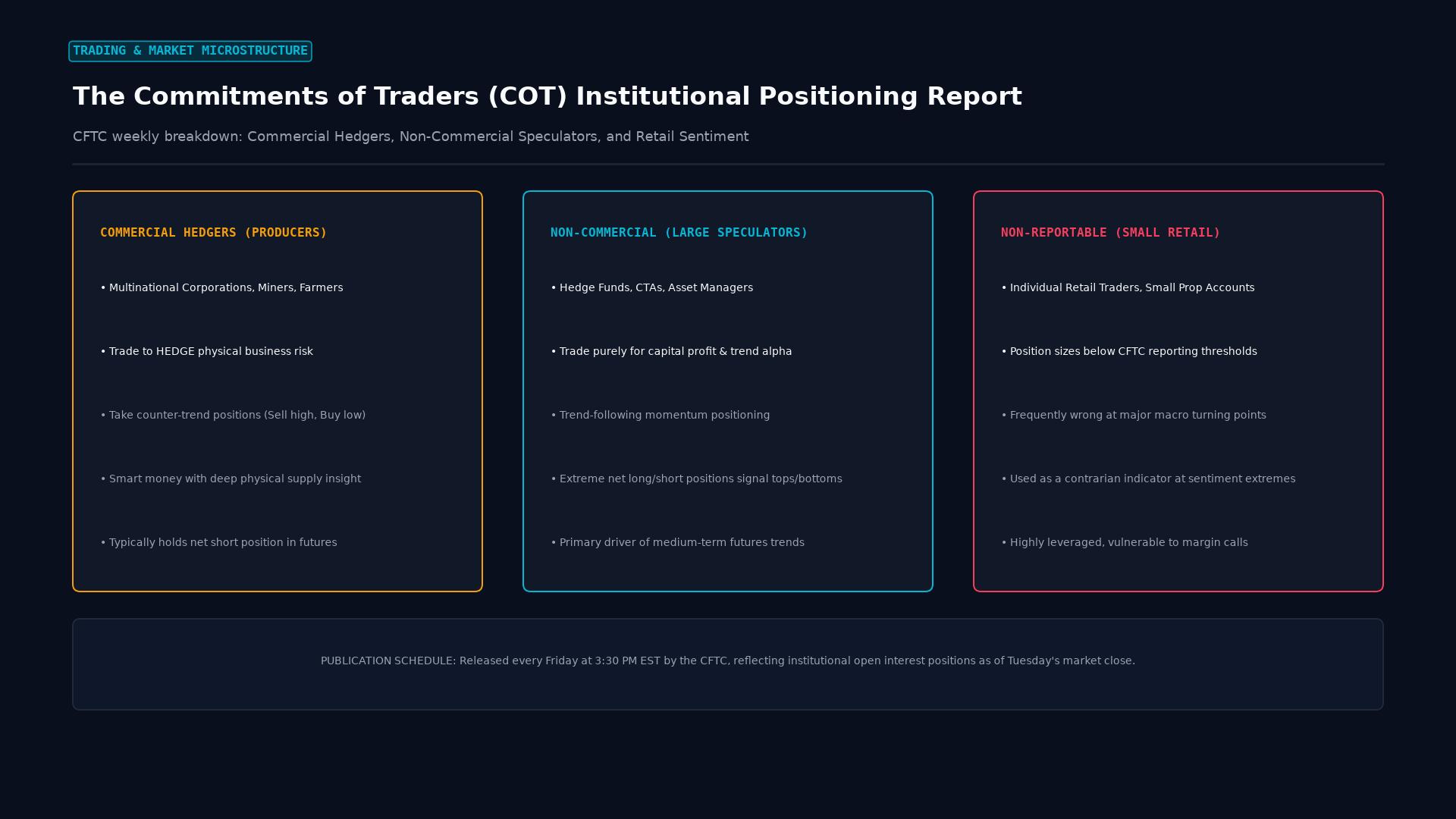 Figure: CFTC weekly COT report breakdown: commercial hedger smart-money positions, non-commercial large speculative momentum trends, and retail trader sentiment extremes.
Key Takeaways
- Open Contract Measurement: Unlike daily trading volume (which counts every buy and sell turnover), commitments reflect sticky, held capital that dictates structural market exposure.
- The CFTC COT Report: Published every Friday at 3:30 PM Eastern Time reflecting Tuesday’s positioning data, the COT report serves as the currency trader’s single best window into institutional smart-money vs. speculative leverage.
- Sentiment Extremes: Extreme net-long or net-short commitments among non-commercial speculators frequently precede significant macroeconomic trend reversals due to exhausted buying or selling liquidity.
- Hedgers vs. Speculators: Commercial hedgers trade in opposition to dominant trends to lock in production costs or export revenues, whereas non-commercial speculative funds trade with momentum.
Participant Categories in the Commitments of Traders (COT)
Under CFTC regulatory standards, any market participant holding a position exceeding reportable thresholds (e.g., 400 contracts in Euro FX futures) must register their trades. The CFTC classifies these commitments into distinct operational tiers:
| Participant Category | Operational Nature | Motivation & Philosophy | Forex Market Profile |
|---|---|---|---|
| Commercial Hedgers | Multinational corporations, bullion dealers, commercial banks | Insulate operations against adverse currency fluctuations; not profit-seeking on directional price | Frequently build heavy net-short commitments into multi-year market rallies |
| Non-Commercial Traders (Large Speculators) | Commodity Trading Advisors (CTAs), hedge funds, asset managers | Capture directional capital gains using leverage | Aggressively build net-long or net-short positions aligning with macro interest rate trends |
| Non-Reportable Traders (Small Speculators) | Active retail traders, proprietary prop desks below reporting limits | Short-term speculative trading | Historically prone to holding maximum exposure near cycle tops and bottoms |
Analyzing Net Commitments: The Speculative Sentiment Indicator
Currency strategists calculate the Net Speculative Position to evaluate underlying buying or selling pressure across currency futures:
$$\text{Net Speculative Position} = \text{Non-Commercial Long Contracts} - \text{Non-Commercial Short Contracts}$$
To normalize this figure across multi-year cycles and account for expanding overall open interest, analysts calculate the COT Index:
$$\text{COT Index} = \frac{\text{Current Net Position} - \text{Minimum Net Position}{N}}{\text{Maximum Net Position}{N} - \text{Minimum Net Position}_{N}} \times 100$$
Where $N$ typically spans a lookback period of 26 to 52 weeks.
Interpretation of the COT Index:
- COT Index > 80%: Speculators are heavily long (Overbought extreme; vulnerability to long squeeze).
- COT Index < 20%: Speculators are heavily short (Oversold extreme; vulnerability to short squeeze).
Real-World Case Study: Spotting a Japanese Yen Trend Reversal via Commitments
During early 2024, the Bank of Japan maintained negative interest rates while the Federal Reserve kept rates above 5.25%, incentivizing global funds to execute the classic USD/JPY carry trade.
The Buildup in Commitments:
- CFTC Data Tracking: By July 2024, Non-Commercial traders had accumulated an all-time record net-short commitment in Japanese Yen futures (
6J), holding over 184,000 net-short contracts. - Sentiment Saturation: The COT Index for the Yen hit 0% across a 3-year lookback window. Virtually every global CTA and macro fund was already short the Yen.
- The Catalyst: On July 31, 2024, the Bank of Japan unexpectedly raised its policy rate to 0.25%, while the Fed signaled an impending rate-cutting cycle.
- The Unwind Cascade: Because speculative commitments were completely lopsided, short sellers lacked buyers to absorb their emergency covering orders.
- Market Impact: USD/JPY collapsed from 161.90 down toward 141.70 over the next several weeks—a massive 2,000-pip drop fueled entirely by the forced liquidation of institutional speculative commitments.
Trading Implications for Forex and Futures Traders
Integrating commitment metrics into a trading framework provides critical structural advantages over standalone technical indicators:
1. Divergence Analysis
When spot prices break out to a new 52-week high, but speculative commitments fail to make a corresponding new peak, market participation is waning. This classic divergence indicates that institutional capital is taking profits, warning retail traders against chasing breakouts.
2. Smart Money Accumulation
Commercial hedgers operate with deep balance sheets and long horizons. When commercial hedgers consistently absorb contracts on price declines—transitioning from net-short to net-long—it signals that the underlying currency is trading below its long-term fundamental replacement cost.
Frequently Asked Questions
Is the COT commitments report too delayed to use for day trading?
Yes. Because the CFTC gathers data on Tuesday and publishes it on Friday afternoon, there is a 3-day reporting lag. As a result, commitment data is unsuitable for scalping or day trading. However, for swing traders and position traders with holding periods of weeks to months, commitments provide an irreplaceable macro compass.
What does it mean if Open Interest rises while commitments shift short?
When Open Interest increases simultaneously with a surge in non-commercial short positions, it confirms aggressive new capital entering the market to short the asset. This indicates strong, conviction-driven downward momentum rather than mere profit-taking by longs.
How do option commitments differ from futures commitments?
The CFTC publishes both a “Futures Only” report and a “Futures and Options Combined” report. In the combined report, options commitments are converted into delta-equivalent futures contracts to reflect the true directional market exposure of option positions.
Ready to trade forex?
Open a free demo account with a regulated broker. Practice with virtual funds before risking real money.