Open Interest
Open interest is the total number of active, unsettled derivative contracts—such as currency futures and options—held by market participants at the end of each trading day, serving as a primary gauge of institutional capital flow.
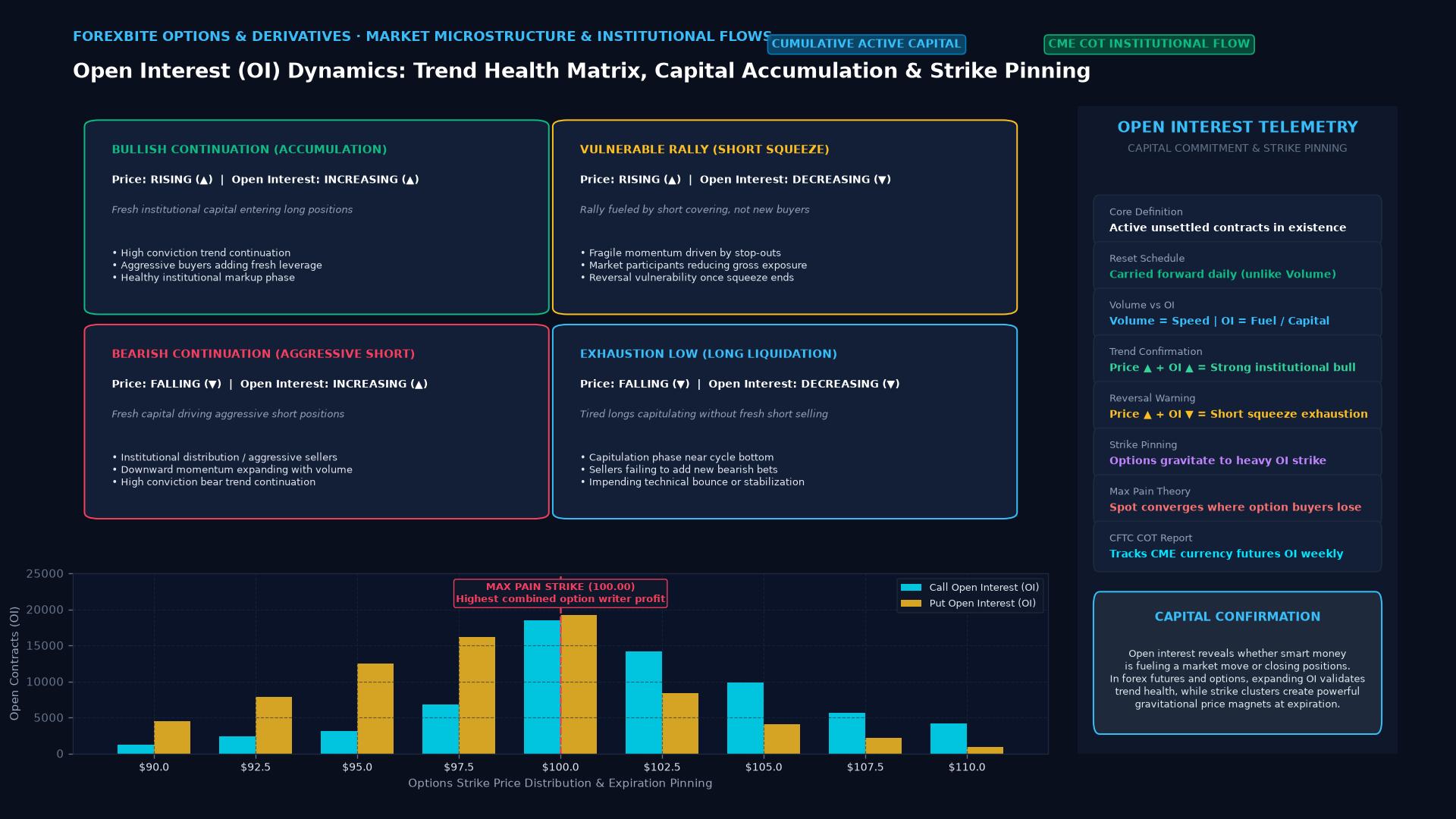
Open interest represents the total number of open or outstanding derivative contracts—predominantly futures and options—that have not been settled by delivery, exercised, or offset by an opposite transaction. Unlike trading volume, which tallies the total turnover of contracts changing hands over a specific timeframe, open interest reflects the net pool of active capital committed to the market.
In foreign exchange analysis, traders monitor open interest on centralized exchanges such as the Chicago Mercantile Exchange (CME) to verify the conviction behind spot currency trends and interpret the weekly Commitments of Traders (COT) report.
Open Interest vs. Trading Volume
While trading volume resets to zero at the beginning of every session, open interest is a continuous cumulative metric that changes only when a contract is created or eliminated:
| Metric | Trading Volume | Open Interest |
|---|---|---|
| What It Measures | Total number of contracts traded during a session | Total active, unclosed contracts in existence |
| Reset Cycle | Resets to zero every trading day | Carries over daily; updates once after market close |
| Market Meaning | Market activity, liquidity, and immediate turnover | Capital commitment, institutional positioning, and trend liquidity |
| Spot Forex Availability | Tick volume only (decentralized broker data) | Centralized, official data (CME currency futures/options) |
How Open Interest Expands and Contracts
Open interest fluctuates based on whether the buyer and seller are entering fresh positions or liquidating existing ones:
- Both Parties Open a New Position (+1 OI): A new buyer goes long 10 EUR/USD futures contracts from a new seller who goes short 10 contracts. Open interest increases by 10.
- Both Parties Close an Existing Position (-1 OI): A trader holding 10 long contracts sells them to a trader covering 10 short contracts. Open interest decreases by 10.
- One Opens, One Closes (0 Change): A new buyer enters the market, purchasing 10 contracts from a trader liquidating an existing long position. The contracts simply transfer ownership; total open interest remains unchanged.
The Price Action and Open Interest Matrix
Institutional technical analysts combine open interest with price action to evaluate the underlying health and sustainability of a trend:
| Price Action | Open Interest | Market Interpretation | Underlying Mechanics |
|---|---|---|---|
| Rising | Increasing | Bullish Continuation | Fresh aggressive long positions are entering the market; trend is healthy. |
| Rising | Decreasing | Vulnerable Rally (Short Squeeze) | Rally is driven by short sellers covering losses, not new buyers; reversal risk is high. |
| Falling | Increasing | Bearish Continuation | Fresh aggressive short capital is entering the market; downtrend is robust. |
| Falling | Decreasing | Weakening Downtrend (Liquidation) | Long traders are capitulating, but new sellers are absent; selling exhaustion near. |
Open Interest in Forex Trading: The COT Report
Because the spot forex market is decentralized and over-the-counter (OTC), it lacks a central clearinghouse to report official aggregate volume or open interest. To overcome this limitation, currency traders turn to the Commitments of Traders (COT) report published weekly by the U.S. Commodity Futures Trading Commission (CFTC).
The COT report tracks open interest across CME currency futures (such as the 6E Euro futures or 6J Japanese Yen futures), breaking down open interest into distinct institutional categories:
- Commercial Traders: Multinational corporations and banks hedging physical trade exposure.
- Non-Commercial Traders: Large hedge funds, CTAs, and asset managers trading speculatively.
- Non-Reportable Traders: Small retail speculators.
When non-commercial net-long open interest reaches multi-year statistical extremes (such as +150,000 net contracts), it indicates crowded positioning. Even a minor macroeconomic surprise can trigger a cascade of profit-taking, leading to a violent trend reversal.
Practical Example: Identifying Trend Exhaustion on CME Euro Futures (6E)
Consider a scenario where spot EUR/USD has rallied 400 pips over six weeks from 1.0500 to 1.0900:
- Initial Phase (Healthy Bull Trend): Between 1.0500 and 1.0800, daily price increases were matched by a steady climb in CME Euro futures open interest, growing from 420,000 to 510,000 contracts. This confirmed that institutional capital was actively initiating new long positions.
- Exhaustion Phase (The Divergence): Over the subsequent two weeks, EUR/USD inches higher from 1.0800 to 1.0950. However, open interest drops sharply from 510,000 down to 465,000 contracts.
- Analytical Deduction: The final 150-pip advance was not fueled by fresh institutional buyers. Instead, it was propelled by remaining short sellers buying back contracts to stop out their losses, while early longs began taking profits off the table.
- Trade Execution: A macro swing trader interprets this drop in open interest as a warning of buyer exhaustion. As EUR/USD prints a bearish rejection candle at 1.0940, the trader opens a short position:
- Stop-Loss: Placed above the swing high at 1.0975 (35 pips).
- Take-Profit: Targeted at the 1.0780 consolidation base (160 pips).
- Outcome: Without fresh capital entering to absorb liquidity, the rally collapses, and the pair retraces back to 1.0780 over the next two weeks.
Key Takeaways
- Unsettled Contracts: Open interest measures the total number of outstanding derivatives contracts that remain open and unsettled in the market.
- Institutional Conviction: Increasing open interest during a price trend confirms fresh money entering, whereas falling open interest signals position liquidation.
- Centralized Data: While spot forex does not record universal open interest, CME currency futures and weekly CFTC COT reports provide an accurate institutional proxy.
- Volume vs. Open Interest: Volume tracks trade frequency per day, while open interest tracks the net size of total capital exposure committed to the market.
- Exhaustion Warnings: A rising price accompanied by declining open interest indicates a short-covering rally that is structurally fragile and prone to sharp reversals.
Frequently Asked Questions
Can open interest be calculated for the spot forex market?
No. Because spot forex is an over-the-counter (OTC) market without a central clearinghouse, universal open interest cannot be computed. Traders rely on centralized CME currency futures open interest and the CFTC COT reports as institutional barometers.
Does high open interest mean a market is bullish?
No. High open interest simply means a large number of contracts are active. For every buyer in an open contract, there is an exact matching seller. Directional bias is determined by observing whether open interest expands as price rises (bullish) or as price falls (bearish).
What causes open interest to drop?
Open interest decreases whenever an existing buyer sells their contract to an existing short seller who is buying to cover. Both parties close out their positions simultaneously, reducing the total contract count in the market by one.
Ready to trade forex?
Open a free demo account with a regulated broker. Practice with virtual funds before risking real money.