Covered Call
A covered call is an options strategy where an investor holds a long position in an underlying asset and simultaneously writes (sells) call options against that position to generate income from the option premium.
What Is a Covered Call?
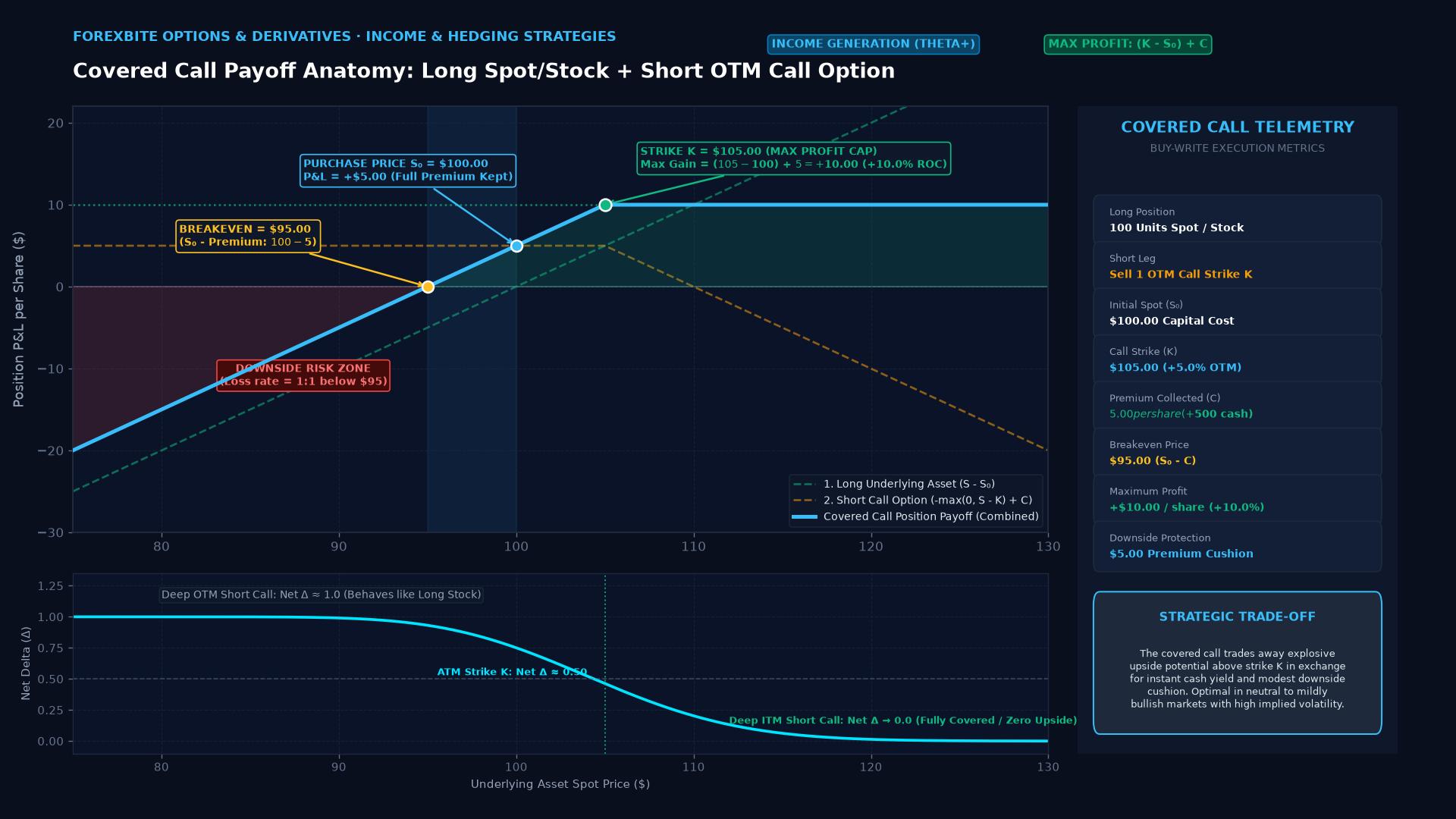
A covered call (also known as a buy-write strategy) is one of the most widely deployed conservative options strategies in equity, commodity, and foreign exchange derivatives markets. Under this structure, an investor who owns a long position in an underlying asset simultaneously writes (sells) a call option contract on that exact same asset on a share-for-share (or notional-for-notional) basis.
The strategy is termed “covered” because the seller’s obligation to deliver the underlying asset if the option is exercised is completely secured by the long physical position already resting in their portfolio. This eliminates the catastrophic unbounded risk associated with writing an uncollateralized naked call. In exchange for assuming the obligation to sell their asset at the predetermined strike price ($K$), the investor immediately collects and retains the cash option premium.
Covered Call Strategy Architecture:
┌────────────────────────────────────────────────────────┐
│                 COVERED CALL POSITION                  │
└──────────────────────────┬─────────────────────────────┘
                           │
      ┌────────────────────┴────────────────────┐
      ▼                                         ▼
┌──────────────────────────┐      ┌──────────────────────────┐
│   LONG UNDERLYING ASSET  │  +   │   SHORT CALL OPTION      │
│  Own 100 Shares / Spot   │      │ Sell 1 Call Strike K     │
│   (Provides the Cover)   │      │ (Collect Upfront Premium)│
└──────────────────────────┘      └──────────────────────────┘
Key Takeaways
- Income Generation: The primary objective of a covered call is to produce steady, recurring cash flow (synthetic dividend yield) from a held asset in neutral, flat, or mildly bullish market conditions.
- Capped Upside Potential: If the underlying asset explodes into a massive parabolic rally above the strike price, the investor’s profit is strictly capped at the strike; all subsequent gains belong to the call buyer.
- Downside Cushion: The cash premium collected acts as a limited buffer against falling prices, reducing the effective purchase price of the underlying asset by the exact amount of the premium.
- Positive Theta Decay: Time decay ($\Theta$) works entirely in favor of the covered call seller: as expiration approaches, the extrinsic value of the sold call erodes toward zero, allowing the seller to retain the premium.
Payoff Mechanics and Formulas
The financial performance of a covered call position is governed by three critical equations:
1. Maximum Profit
Occurs when the underlying price closes at or above the call strike price ($S_T \ge K$) at expiration: $$\text{Max Profit} = (K - S_0) + C$$
Where:
- $K$ = Strike price of the written call
- $S_0$ = Original purchase price of the underlying asset
- $C$ = Call premium received per share or unit
2. Breakeven Point
The price to which the underlying asset can fall before the position experiences an aggregate net loss: $$\text{Breakeven Price} = S_0 - C$$
3. Maximum Loss
Occurs if the underlying asset collapses to zero ($S_T = 0$): $$\text{Max Loss} = S_0 - C \quad \text{(Substantial, but cushioned by the premium)}$$
The Greek Profile of a Covered Call
Understanding how options Greeks interact within a covered call helps portfolio managers calibrate position risk:
| Greek Parameter | Net Covered Call Profile | Practical Trading Impact |
|---|---|---|
| Delta ($\Delta$) | Moderately Positive ($\Delta_{\text{stock}} + \Delta_{\text{short call}} \approx 1.0 - 0.50 = +0.50$) | The position behaves like holding half a position; gains on rallies, but at a slower pace |
| Theta ($\Theta$) | Positive ($+\Theta$) | The position earns money every day that passes purely through time decay |
| Vega ($\nu$) | Negative ($-\nu$) | Rising implied volatility expands the short call’s value, creating a temporary headwind |
| Gamma ($\Gamma$) | Negative ($-\Gamma$) | Price acceleration near the strike reduces the position’s directional sensitivity |
Real-World Case Study: Generating Income on an Equity Holding
An investor holds 100 shares of a multinational company currently trading at $100.00 per share ($10,000 total capital). The investor expects the stock to trade sideways over the next month.
Trade Setup:
- Long Asset: 100 shares at $100.00.
- Action: Sell 1 Out-of-the-Money (OTM) 30-day Call Option with Strike $K = $105.00$.
- Premium Received: $3.00 per share ($300 total cash credited immediately).
Expiration Outcome Scenarios:
| Market Scenario | Stock Price at Expiration | Stock P&L | Call Option Status | Total Net Profit / Loss | Return on Capital |
|---|---|---|---|---|---|
| Bullish Flat | $104.00 | +$400 | Expires Worthless (Keep $300) | +$700.00 | +7.0% (Shares kept) |
| Strong Rally | $115.00 | +$1,500 | Assigned at $105 (-$1,000) | +$800.00 (Max Profit) | +8.0% (Shares sold at $105) |
| Neutral Flat | $100.00 | $0 | Expires Worthless (Keep $300) | +$300.00 | +3.0% (Pure yield) |
| Mild Dip | $97.00 | -$300 | Expires Worthless (Keep $300) | $0.00 (Breakeven) | 0.0% (Insulated) |
| Severe Drop | $85.00 | -$1,500 | Expires Worthless (Keep $300) | -$1,200.00 | -12.0% (Versus -15% buy & hold) |
Strategic Applications in Forex Derivatives
While covered calls are predominantly executed on equities and ETFs, currency option desks apply the identical synthetic logic to spot foreign exchange holdings:
- A fund holding a long spot position in EUR/USD at
1.0800writes a 30-day1.0950OTC Call Option against an investment bank. - If EUR/USD remains below 1.0950, the fund pockets the forward volatility premium, enhancing the yield of its sovereign cash reserves.
- If EUR/USD exceeds 1.0950, the fund delivers its Euros at 1.0950, effectively fulfilling a limit take-profit order while earning free option premium.
Frequently Asked Questions
What happens if the stock price drops significantly?
A covered call does not protect against a catastrophic market crash. While the collected premium provides a small cushion (e.g., absorbing the first $3.00 of decline), the investor retains 100% of the remaining downside risk on their underlying shares. Investors fearing a severe crash should buy a put option (Protective Put) or establish a Collar.
Can the investor buy back the short call before expiration?
Yes. If the underlying asset drops or time decays rapidly, the short call’s market price might fall from $3.00 down to $0.20. The investor can execute a “Buy to Close” order to lock in 90%+ of the maximum profit early and free the underlying shares from delivery obligations.
What is the difference between a covered call and a naked call?
In a covered call, the seller owns the underlying asset, capping risk. In a naked call, the seller owns no underlying shares; if the asset spikes parabolic, the seller faces infinite theoretical loss because they must buy the shares in the open market at any price to fulfill the contract.
Ready to trade forex?
Open a free demo account with a regulated broker. Practice with virtual funds before risking real money.