Calendar Spread
An options or futures strategy involving the simultaneous purchase and sale of contracts on the identical underlying asset and strike price, but with different expiration dates, designed to exploit differential rates of time decay (theta) or term structure shifts.
What is a Calendar Spread?
A calendar spread (frequently designated as a time spread or horizontal spread) is an advanced derivatives strategy engineered to profit from the passage of time and shifts in implied volatility rather than sharp directional price swings.
Unlike vertical spreads (which combine different strike prices sharing the same expiration date), a calendar spread combines identical strike prices with different expiration dates:
- Front-Month Leg: The trader sells (shorts) a near-term option contract.
- Back-Month Leg: The trader buys (longs) a longer-dated option contract of the same type (both calls or both puts) at the exact same strike price.
Because longer-dated options carry greater extrinsic time value than shorter-dated options, initiating a standard long calendar spread results in an upfront net debit. The trader’s objective is for the near-term sold option to decay rapidly toward zero, while the long-term purchased option retains substantial value.
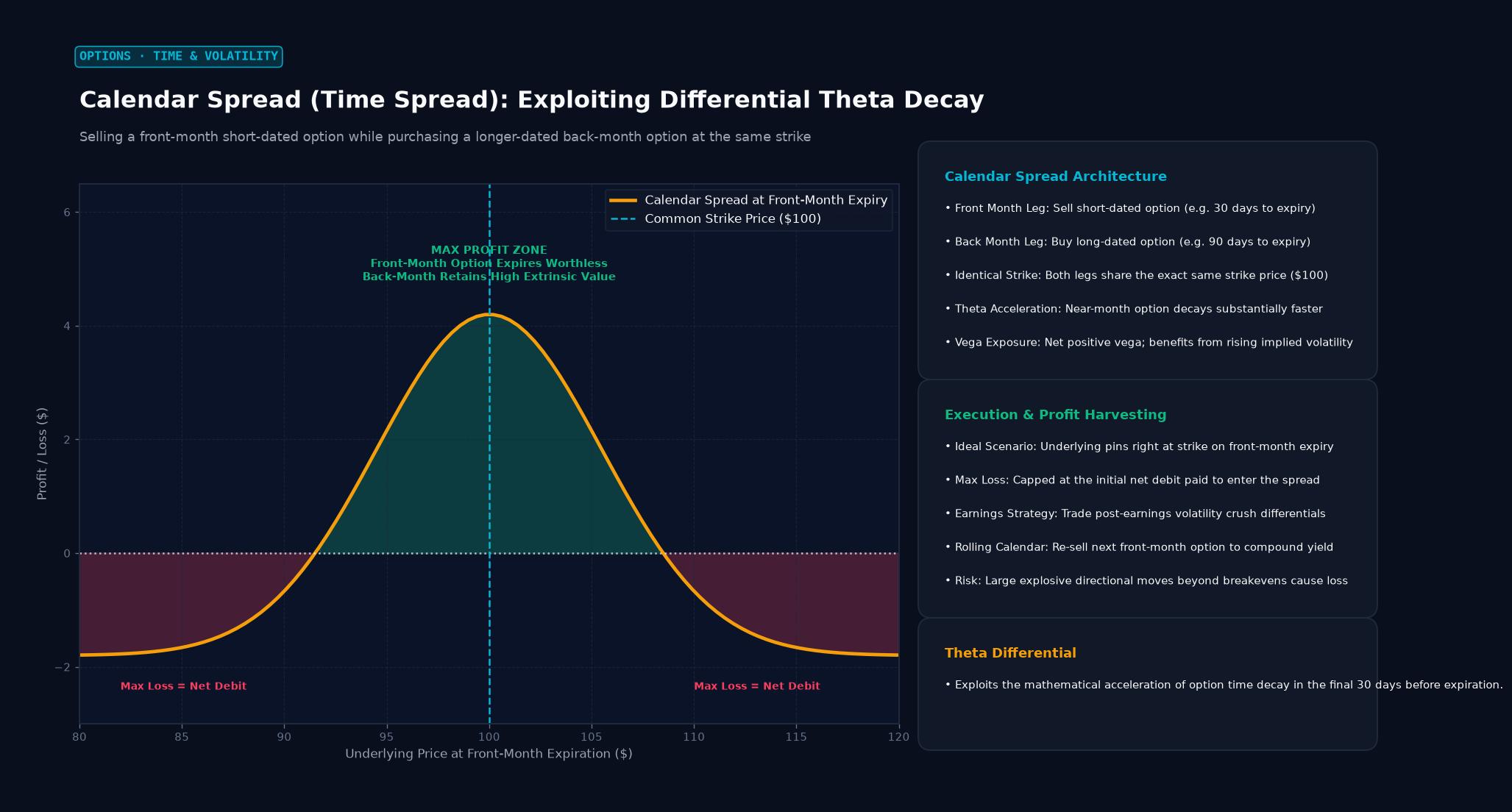 Figure: Selling a front-month short-dated option while purchasing a longer-dated back-month option at the same strike
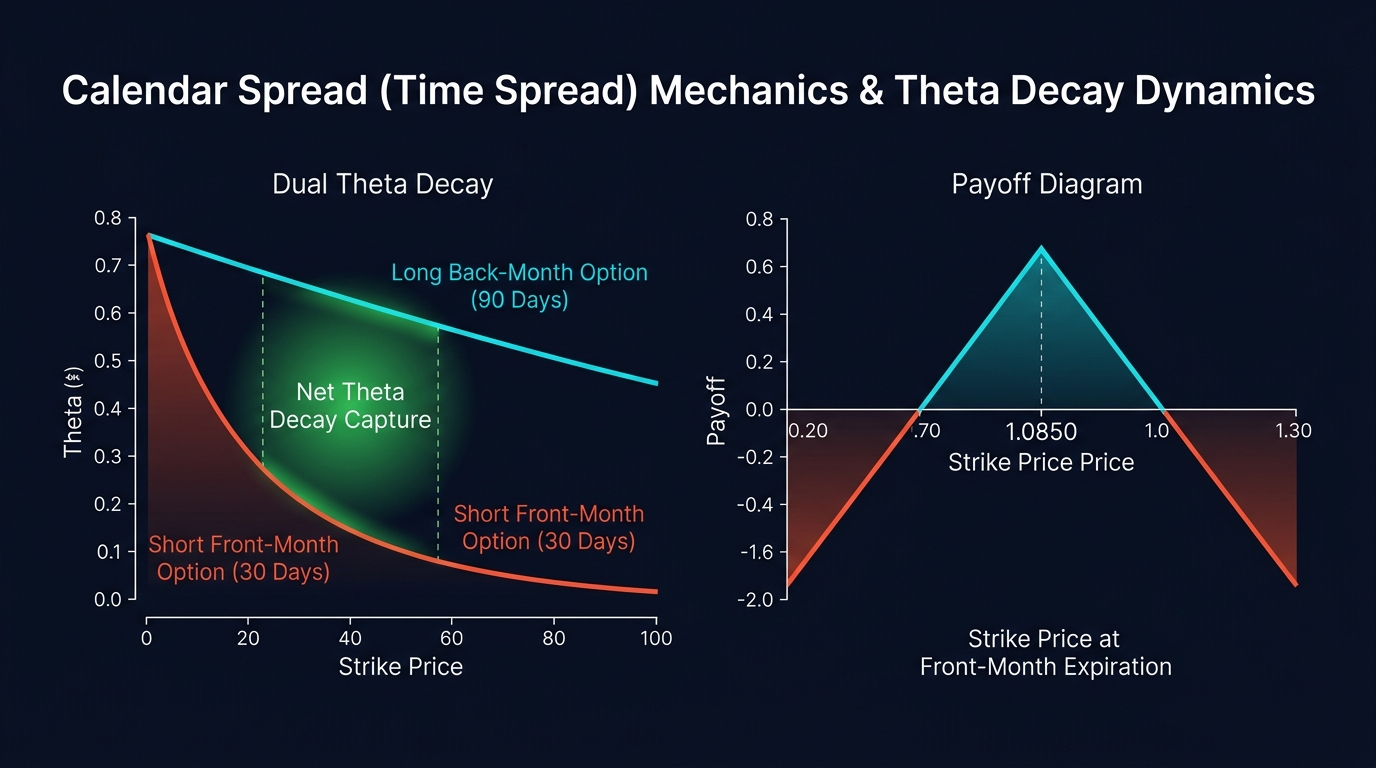
The Mathematical Engine: Non-Linear Theta Decay
The mathematical advantage of a calendar spread stems from the fact that option time decay (theta) does not proceed along a straight linear line. Under the Black-Scholes-Merton model, an option’s extrinsic time value decays in proportion to the square root of time remaining:
$$\text{Extrinsic Value} \propto \sigma S \sqrt{T}$$
Consequently, as an option approaches its final 30 days before expiration, its daily theta decay accelerates sharply:
- A 30-day option might lose $4.00 per day in extrinsic value.
- A 90-day option at the same strike might lose only $1.80 per day.
By being short the 30-day option and long the 90-day option, the calendar spread trader captures a net positive time decay of +$2.20 per day, provided the underlying asset stays close to the strike price.
Step-by-Step Currency Example: EUR/USD At-the-Money Calendar Spread
Consider an options trader analyzing EUR/USD, currently trading at 1.0850. The trader anticipates that the currency pair will trade in a tight range over the coming month ahead of European elections, but expects macroeconomic volatility to expand later in the year.
The trader establishes an At-the-Money (ATM) Long Call Calendar Spread:
- Sell 1 contract of EUR/USD 1.0850 Call expiring in 30 Days (Front Month) for 80 pips.
- Buy 1 contract of EUR/USD 1.0850 Call expiring in 90 Days (Back Month) for 150 pips.
Trade Financials
- Net Debit Paid: $150 - 80 = 70\text{ pips}$ ($700 per standard 100,000 contract).
- Maximum Risk: Strictly capped at the net debit of 70 pips ($700).
- Maximum Potential Profit: Occurs if spot EUR/USD closes at exactly 1.0850 on Day 30.
Performance at Front-Month Expiration (Day 30)
| Spot EUR/USD on Day 30 | Front-Month 30D Call (Short) | Back-Month 60D Remaining Call (Long) | Net Spread Value | Net P&L ($ per Lot) |
|---|---|---|---|---|
| 1.0500 (Severe Drop) | Expires Worthless ($0) | Worth ~15 pips | 15 pips | $150 - $700 = -$550 (Loss) |
| 1.0750 (Moderate Drop) | Expires Worthless ($0) | Worth ~55 pips | 55 pips | $550 - $700 = -$150 |
| 1.0850 (Exact Pin) | Expires Worthless ($0) | Worth ~115 pips (60 Days Left) | 115 pips | $1,150 - $700 = +$450 (+64%) |
| 1.0950 (Moderate Rally) | Worth -100 pips (Loss) | Worth ~160 pips | 60 pips | $600 - $700 = -$100 |
| 1.1200 (Explosive Surge) | Worth -350 pips (Loss) | Worth ~370 pips | 20 pips | $200 - $700 = -$500 (Loss) |
At Day 30, the short front-month call expires completely worthless, allowing the trader to keep 100% of the premium sold. The trader now owns a free or heavily discounted 60-day call option on EUR/USD, which they can either sell to lock in +$450 in profit or hold as a cheap directional position.
Implied Volatility and the Term Structure (Vega Impact)
Calendar spreads exhibit unique sensitivity to shifts in the volatility term structure:
- Net Long Vega: Longer-dated options have substantially higher vega (sensitivity to implied volatility) than shorter-dated options. Therefore, a rise in overall implied volatility increases the value of the back-month option faster than the front-month option, boosting the position’s value.
- Volatility Skew Optimization: Traders achieve optimal results by initiating calendar spreads when front-month implied volatility is abnormally high relative to back-month volatility (an inverted volatility curve), anticipating that front-month premium will collapse.
Comparative Matrix: Spread Architecture Across Dimensions
| Strategy Structure | Strike Prices Used | Expiration Dates Used | Primary Profit Driver | Capital Exposure |
|---|---|---|---|---|
| Calendar Spread | Same Strike | Different Dates | Theta differential & rising vega | Capped at net debit |
| Vertical Spread | Different Strikes | Same Date | Directional price movement | Capped at debit or credit |
| Diagonal Spread | Different Strikes | Different Dates | Directional bias + time decay | Capped at net debit |
| Butterfly Spread | Three Different Strikes | Same Date | Volatility collapse & strike pin | Capped at net debit |
Strategic Management: The “Rolling” Technique
One of the premier advantages of a calendar spread is its operational flexibility. When the front-month option expires worthless on Day 30, the trader does not have to exit:
- Selling the Next Month: The trader can sell another 30-day option against their existing long contract (a practice known as rolling the short leg).
- By sequentially selling monthly options against a single 6-month or 1-year long option, sophisticated traders transform calendar spreads into continuous cash-flow generation engines.
Key Takeaways
- A calendar spread involves simultaneously buying and selling options of the same type and strike price with different expiration dates.
- The strategy profits from the mathematical reality that near-term options experience accelerated time decay (theta) compared to longer-term options.
- Maximum profit is achieved when the underlying asset pins the shared strike price on the expiration date of the front-month contract.
- Maximum financial risk is strictly limited to the net debit paid to establish the spread.
- Because the long-dated leg dominates the position’s vega, calendar spreads benefit from an expansion in longer-term implied volatility.
Frequently Asked Questions
Can calendar spreads be executed with put options instead of calls?
Yes. A Put Calendar Spread utilizes identical put strikes across two expiration months. It behaves nearly identically to a call calendar spread when centered at-the-money, but can be tailored with out-of-the-money puts to capture downside consolidation.
What is the difference between a calendar spread and a diagonal spread?
In a calendar spread, both options share the exact same strike price. In a diagonal spread, the trader changes both the expiration dates and the strike prices (for example, selling an OTM 30-day call while buying an ITM 90-day call).
What happens if the market rallies aggressively through the strike price?
If the underlying asset surges violently beyond the strike price, both options move deep into the money. Because deep-in-the-money options lose their extrinsic time value and trade almost purely on intrinsic value, the difference between the two contracts narrows, resulting in a loss capped at the initial net debit.
What is a “reverse calendar spread”?
A reverse calendar spread involves buying the near-term option and selling the longer-dated option for a net credit. It is an aggressive volatility strategy designed to profit from an immediate, explosive breakout in either direction accompanied by a collapse in back-month implied volatility.
Ready to trade forex?
Open a free demo account with a regulated broker. Practice with virtual funds before risking real money.