Bull Spread
A vertical options strategy deployed when an investor expects a moderate increase in the price of the underlying asset. Constructed by simultaneously purchasing an option at a lower strike price and selling an equivalent option at a higher strike price with identical expiration dates, capping both maximum profit and maximum risk.
What is a Bull Spread?
A bull spread is a directional options strategy designed to capture profits from a moderate upward movement in the price of an underlying asset while strictly defining and limiting downside risk. Rather than buying a standalone call option—which can be costly and suffer heavily from time decay—an options trader constructs a bull spread by combining two options of the same asset class and expiration date at different strike prices.
The defining characteristic of a bull spread is its bounded payoff structure. By selling a higher-strike option against a long lower-strike option, the trader offsets a significant portion of the upfront purchase premium. In exchange for this reduced capital outlay and lower breakeven threshold, the trader accepts a hard ceiling on potential gains. Bull spreads can be constructed using either call options (bull call spread) or put options (bull put spread).
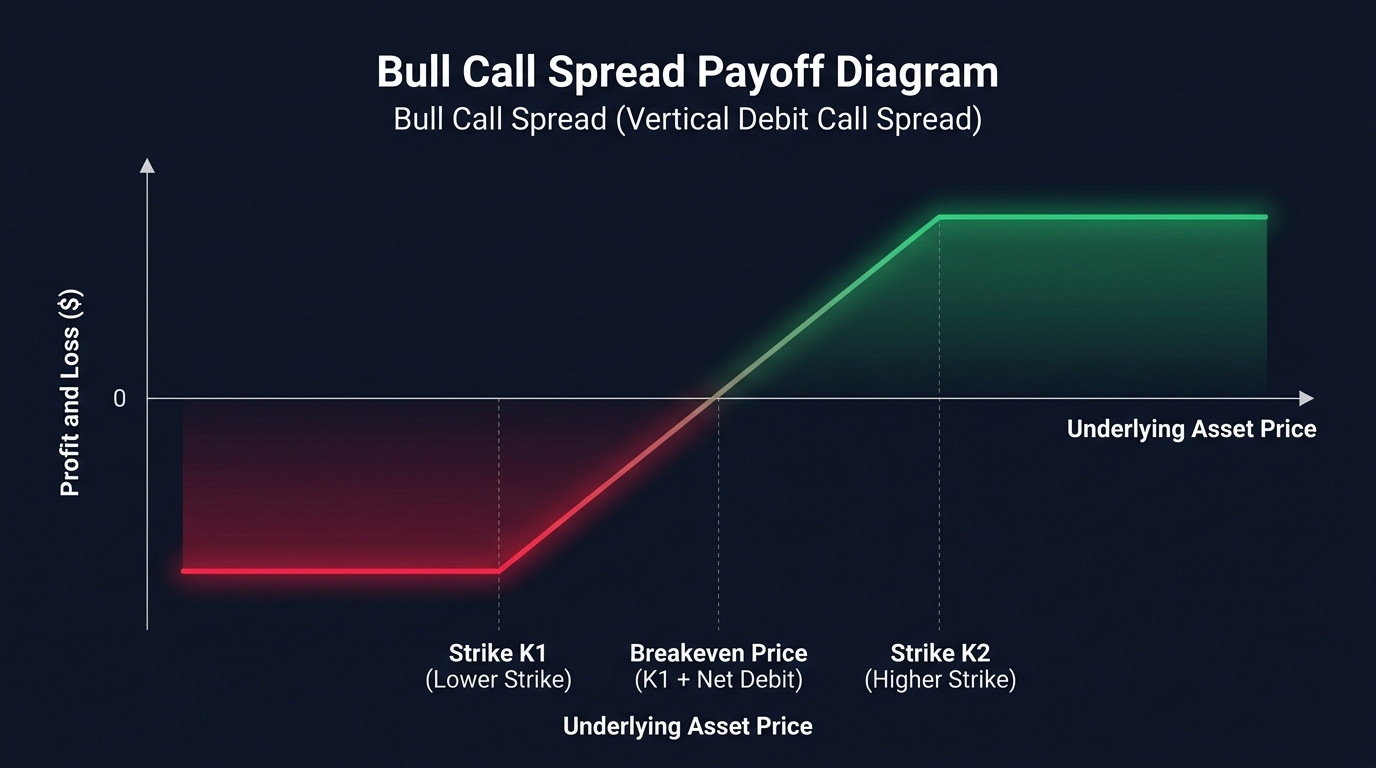
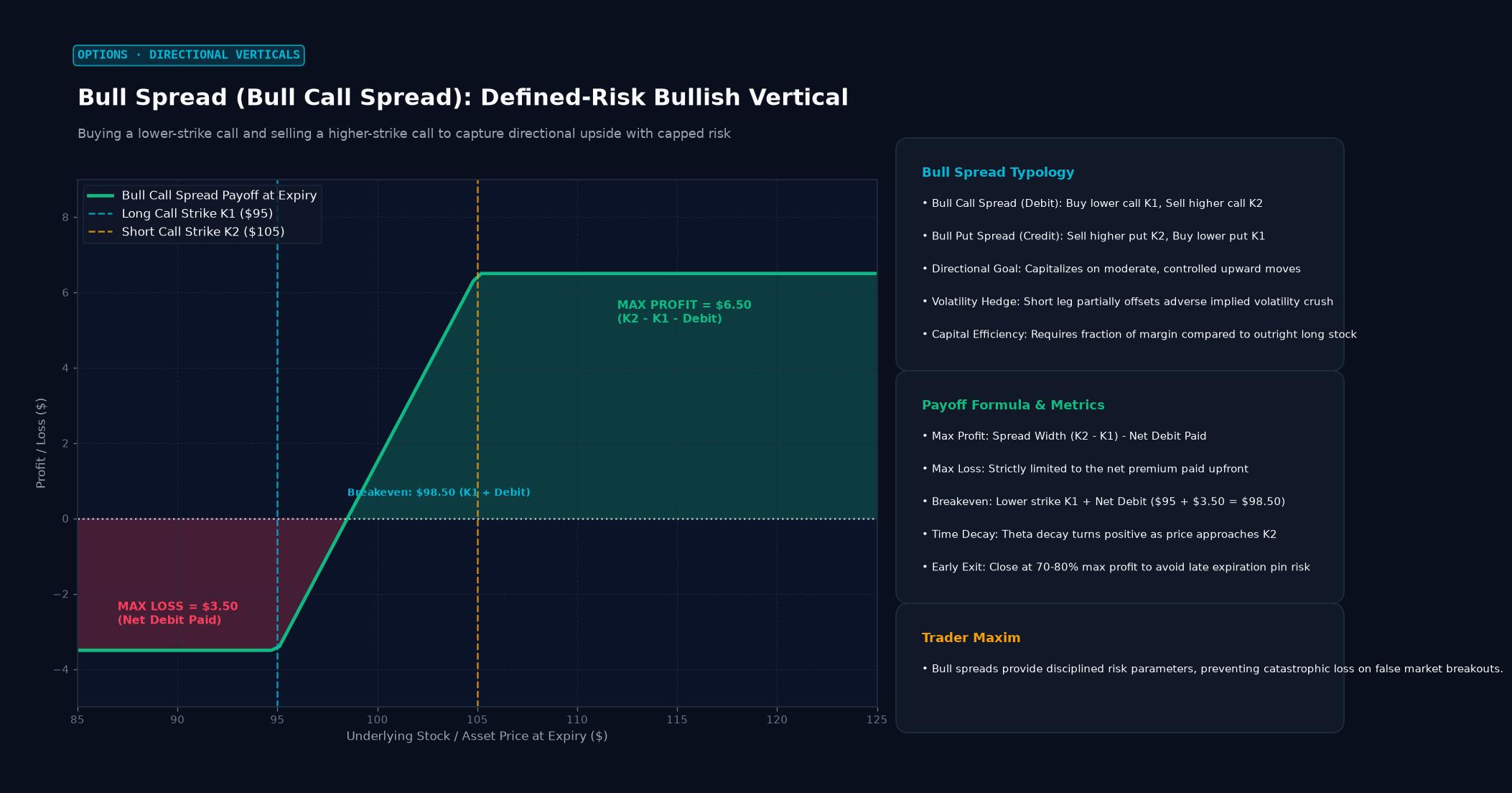 Figure: Buying a lower-strike call and selling a higher-strike call to capture directional upside with capped risk
Bull Call Spread vs. Bull Put Spread
Traders select between calls and puts depending on whether they prefer paying an initial debit or collecting an upfront credit.
1. Bull Call Spread (Debit Spread)
A bull call spread involves:
- Buying an In-the-Money (ITM) or At-the-Money (ATM) call with a lower strike price ($K_1$).
- Selling an Out-of-the-Money (OTM) call with a higher strike price ($K_2$).
Because lower-strike calls carry higher intrinsic and extrinsic value than higher-strike calls, this transaction results in a net debit to the trader’s account.
- Maximum Loss: Equal to the net premium paid upfront.
- Maximum Gain: $(\text{Strike } K_2 - \text{Strike } K_1) - \text{Net Debit Paid}$.
- Breakeven Point: $\text{Strike } K_1 + \text{Net Debit Paid}$.
2. Bull Put Spread (Credit Spread)
A bull put spread achieves a similar directional exposure using put contracts:
- Selling an Out-of-the-Money or At-the-Money put option at a higher strike ($K_2$).
- Buying a further Out-of-the-Money put option at a lower strike ($K_1$) for disaster insurance.
Because the sold put has a higher strike than the purchased put, the position generates an immediate net credit.
- Maximum Gain: Limited strictly to the net credit collected upon entry.
- Maximum Loss: $(\text{Strike } K_2 - \text{Strike } K_1) - \text{Net Credit Received}$.
- Breakeven Point: $\text{Strike } K_2 - \text{Net Credit Received}$.
Step-by-Step Currency Example: Bull Call Spread on EUR/USD
Consider a foreign exchange options trader analyzing EUR/USD ahead of an upcoming European Central Bank meeting. The spot rate is currently trading at 1.0800, and the trader expects the euro to appreciate moderately toward 1.0950 over the next 30 days.
Instead of buying a naked 1.0800 call for a steep premium of 140 pips ($1,400 per 100,000 standard contract), the trader initiates a 30-day vertical bull call spread:
- Buy 1 contract of EUR/USD 1.0800 Call (lower strike $K_1$) for 140 pips.
- Sell 1 contract of EUR/USD 1.0950 Call (higher strike $K_2$) for 50 pips.
Trade Financials
- Net Debit Paid: $140 - 50 = 90 \text{ pips}$ ($900 per contract).
- Strike Width: $1.0950 - 1.0800 = 150 \text{ pips}$ ($1,500 gross value).
- Maximum Potential Profit: $150 - 90 = 60 \text{ pips}$ ($600 per contract).
- Maximum Potential Loss: $90 \text{ pips}$ ($900 per contract).
- Breakeven Price at Expiry: $1.0800 + 0.0090 = 1.0890$.
Outcome Scenarios at Expiry
| Scenario | EUR/USD Spot at Expiry | 1.0800 Call Value | 1.0950 Call Value | Net Payoff (Pips) | P&L ($ per Lot) |
|---|---|---|---|---|---|
| Bearish Breakdown | 1.0720 | 0 pips | 0 pips | -90 pips | -$900 (Capped Loss) |
| Below Breakeven | 1.0850 | 50 pips | 0 pips | 50 - 90 = -40 pips | -$400 |
| Exact Breakeven | 1.0890 | 90 pips | 0 pips | 90 - 90 = 0 pips | $0 |
| Target Achieved | 1.0950 | 150 pips | 0 pips | 150 - 90 = +60 pips | +$600 (Max Profit) |
| Parabolic Surge | 1.1100 | 300 pips | 150 pips (short) | (300 - 150) - 90 = +60 pips | +$600 (Capped Profit) |
Notice that even if EUR/USD surges to 1.1100, the profit remains capped at +$600 because the short 1.0950 call requires delivering the currency at that price. However, the trader saved 50 pips upfront, dramatically lowering the breakeven threshold from 1.0940 (on a naked call) down to 1.0890.
Strategy Comparison: Bull Spread vs. Alternative Approaches
| Feature | Naked Long Call | Bull Call Spread (Debit) | Bull Put Spread (Credit) | Covered Call |
|---|---|---|---|---|
| Directional Bias | Aggressively Bullish | Moderately Bullish | Neutral to Moderately Bullish | Neutral to Mildly Bullish |
| Initial Cash Flow | Debit (Full premium) | Reduced Debit | Net Credit (Cash received) | Outlay for spot asset |
| Maximum Loss | 100% of premium paid | Capped at net debit | Capped at strike width minus credit | Downside price drop minus premium |
| Maximum Profit | Theoretically unlimited | Capped at spread width minus debit | Capped at initial credit | Capped at short strike plus premium |
| Time Decay (Theta) | Negative (hurts position) | Partially hedged / neutral | Positive (works in trader’s favor) | Positive |
| Implied Volatility (Vega) | Long Vega (benefits from volatility spikes) | Mixed / low net sensitivity | Short Vega (benefits from volatility drops) | Short Vega |
Impact of the Greeks on a Bull Spread
- Delta (Directional Sensitivity): A bull spread has a net positive delta. However, because the short call has negative delta, the net delta of the spread is lower than a single naked call, producing smoother equity swings.
- Theta (Time Decay): In a bull call spread, time decay works against the long call but favors the short call. When the underlying asset trades between the two strikes, time decay often stabilizes or even turns positive as the short leg loses value faster. In a bull put spread, theta is consistently positive.
- Vega (Volatility Sensitivity): Net vega exposure is substantially lower than single-leg options. An abrupt collapse in implied volatility will not ruin a bull call spread as long as spot price advances toward the higher strike.
Strategic Advantages and Critical Risks
Advantages
- Lower Capital Requirement: Selling the second leg reduces entry cost by 30% to 60% compared to outright options.
- Lower Breakeven Bar: The market needs to move significantly less to achieve profitability.
- Reduced Volatility Risk: Sudden shifts in implied volatility affect both legs simultaneously, muting portfolio volatility.
Risks and Pitfalls
- Capped Upside: If the currency experiences an explosive breakout, the short strike prevents participation in any gains above that level.
- Early Assignment Risk: On American-style options contracts, if the short call moves deep into the money, the counterparty may exercise early, forcing an unexpected cash or underlying delivery obligation.
- Bid-Ask Slippage: Executing two legs concurrently doubles transaction friction and bid-ask spread costs.
Key Takeaways
- A bull spread is an options strategy that utilizes two contracts with different strikes to capture moderate price appreciation with capped risk.
- A bull call spread is entered for a net debit, while a bull put spread generates an immediate net credit.
- Maximum profit is achieved when the underlying asset closes at or above the higher strike price at expiration.
- Maximum loss is strictly bounded, protecting traders against flash crashes or black swan market drops.
- The primary trade-off is sacrificing unlimited upside in exchange for cheaper trade entry and a higher probability of profit.
Frequently Asked Questions
When should I choose a bull call spread over a naked call option?
Choose a bull call spread when you anticipate a moderate, measured price rise rather than an explosive rally, or when option implied volatility is high. Selling the higher strike call offsets expensive option premiums and substantially lowers your breakeven level.
What happens if the price falls below the lower strike price at expiration?
In a bull call spread, both call options expire worthless. Your loss is strictly limited to the net debit paid when opening the position, regardless of how far the underlying price collapses.
Can a bull spread be closed before expiration?
Yes. Traders frequently exit bull spreads prior to expiration to lock in partial profits or limit losses. You close the spread by selling the long option and buying back the short option in a single multileg order.
How does early assignment affect a bull spread?
If you trade American-style options and the market rallies strongly, the holder of your short call may exercise before expiration. While your long call provides coverage, managing the resulting exercise requires capital adjustments or exercising your own long leg through your broker.
Ready to trade forex?
Open a free demo account with a regulated broker. Practice with virtual funds before risking real money.