CUP
The ISO 4217 currency code for the Cuban Peso, the official legal tender of the Republic of Cuba, administered by the Banco Central de Cuba.
What is the CUP (Cuban Peso)?
CUP is the three-letter international currency code assigned under ISO 4217 to the Cuban Peso (locally designated as peso cubano or moneda nacional), the official legal tender and national monetary unit of the Republic of Cuba. Denominated by the dollar sign ($) or ₱ and divided into 100 centavos, the currency is issued, circulated, and regulated by the Banco Central de Cuba (BCC), headquartered in Havana.
In international macroeconomics, foreign exchange trading, and emerging markets, the Cuban Peso represents one of the world’s most administratively controlled, non-convertible currencies. Shaped by decades of socialist central planning, the comprehensive United States economic embargo, and the legacy of complex multi-tiered exchange rate regimes, the valuation of the CUP is characterized by severe distortions between official government-administered conversion rates and the reality of the domestic informal street currency market.
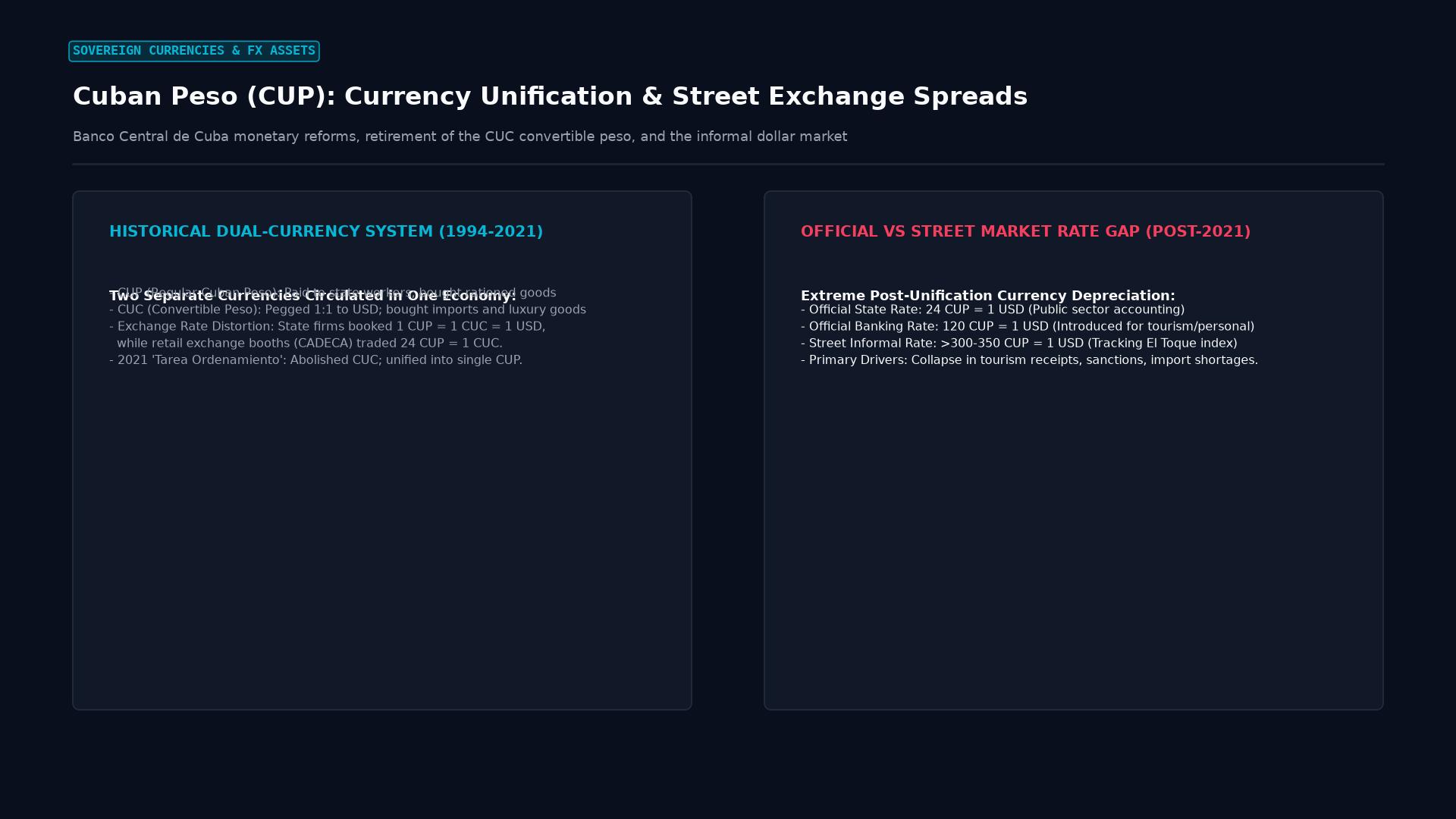 Figure: Post-unification currency distortions: retirement of the convertible peso (CUC), official banking rates, and extreme parallel street market dollar premiums.
Historical Context: The Dual-Currency Era (1994–2021)
To understand the modern Cuban Peso, examine the monetary system that governed the island for over a quarter of a century: the dual-currency regime.
Following the collapse of the Soviet Union in 1991, Cuba entered an economic depression known as the Special Period (Período Especial). Deprived of Soviet oil subsidies and guaranteed sugar export contracts, the national economy contracted by over 35%.
To stabilize state finances, the government legalized the US Dollar in 1993, and in 1994 introduced the Cuban Convertible Peso (CUC):
+------------------------------------+------------------------------------+
| 1. Cuban Peso (CUP - Regular Peso) | 2. Convertible Peso (CUC)          |
+------------------------------------+------------------------------------+
| Used by ordinary citizens to       | Initially pegged strictly at 1:1   |
| receive state salaries, pay basic  | with the US Dollar.                |
| utilities, and purchase subsidized |                                    |
| goods via the food ration book.    | Used in the international tourism  |
|                                    | sector, foreign joint ventures, and|
| Traded at a low purchasing power   | specialized state retail stores    |
| of 24 to 25 CUP per 1 CUC.         | stocking imported consumer items.  |
+------------------------------------+------------------------------------+
This dual-currency system created structural socioeconomic inequality. Citizens with access to foreign remittances or tips from tourists in CUC lived with substantial purchasing power, while medical doctors, teachers, and state employees earning solely in CUP experienced severe declines in real living standards.
Within state-owned industrial enterprises, the government enforced a fictitious accounting parity of 1 CUP = 1 CUC = 1 USD. This artificial valuation hid massive enterprise operating losses, distorted production metrics, and made objective cost-benefit analysis impossible.
The 2021 Monetary Unification: “Tarea Ordenamiento”
On January 1, 2021, the Cuban government implemented an ambitious economic shock program known as the Tarea Ordenamiento (Day of the Ordering), designed to unify the monetary and exchange rate system:
- Abolition of the CUC: The Convertible Peso was officially retired, leaving the CUP as the sole legal tender of the nation.
- Unified Exchange Rate Peg: The government established a unified official exchange rate of 24.00 CUP per 1.00 USD across the entire economy, ending the 1:1 enterprise accounting fiction.
- Wage and Price Decontrol: State salaries and pensions were increased up to fivefold to compensate for the elimination of sweeping state subsidies on basic food items, electricity, and transport.
The Inflationary Spiral and Market Breakdown
Rather than stabilizing the economy, the Tarea Ordenamiento triggered extreme domestic inflation:
- State enterprises, now facing real import costs at 24 CUP per dollar rather than 1:1, passed astronomical price increases onto consumers.
- The supply of physical goods collapsed due to ongoing domestic shortages and reduced imports, while the money supply expanded rapidly to fund higher nominal public wages.
- The official exchange rate of 24 CUP per USD became completely unviable, as state banks had zero liquid dollars to sell to citizens at that price.
The Moneda Libremente Convertible (MLC) and De Facto Dollarization
Facing acute shortages of foreign exchange reserves, the government opened state-run retail stores operating exclusively via Moneda Libremente Convertible (MLC):
- The MLC Mechanism: An MLC is a virtual, digital dollar-denominated unit credited to domestic bank debit cards.
- Funding Channels: MLC accounts can be funded only through incoming foreign currency bank remittances from abroad or by depositing physical foreign cash (Euros, Canadian Dollars, Mexican Pesos, and US Dollars).
- The Supply Distortion: Because basic groceries, hygiene products, electronics, and vehicle parts were moved exclusively to MLC stores, ordinary citizens were forced to acquire foreign currency on the black market to load their MLC cards, creating persistent downward pressure on the cash CUP.
The Three-Tiered Exchange Rate Disconnect
By 2022, the divergence between official government exchange rates and the economic reality of the street forced the central bank to introduce a multi-tiered exchange framework:
  Tier Level              Exchange Rate in Practice            Permitted Operational Scope
  ──────────────────────────────────────────────────────────────────────────
  Tier 1: Official State  Fixed at 24.00 CUP per 1.00 USD     Restricted strictly to essential
  Enterprise Rate                                             state imports (crude oil, wheat)

  Tier 2: Retail State    Fixed at 120.00 CUP per 1.00 USD    Operated by state exchange bureaus
  CADECA Exchange Rate                                        (CADECA); tight purchase quotas

  Tier 3: Informal Street Fluctuation: 300.00 to 360.00+      The true market-clearing rate
  Parallel Market Rate    CUP per 1.00 USD (elToque index)    reflecting actual supply & demand
Because state exchange bureaus (CADECA) rarely have foreign cash available to sell to the public at the 120 CUP rate, the informal parallel rate tracked daily by independent media aggregators (such as the elToque reference index) functions as the de facto pricing metric for the entire private merchant economy.
International Trade Restrictions and Embargo Constraints
The Cuban Peso is an inconvertible closed currency that does not trade on global electronic foreign exchange communication networks (such as EBS or Refinitiv Dealing).
Cross-border trade involving the CUP is bound by severe legal constraints:
- The United States Embargo: Under the Trading with the Enemy Act, the Helms-Burton Act of 1996, and related US Treasury Office of Foreign Assets Control (OFAC) regulations, Cuba is blocked from using the US financial system or clearing international transactions in US Dollars.
- Exclusion from Financial Infrastructure: Cuban state banks have limited access to international correspondent banking networks. Global financial institutions routinely block or refuse payments involving Cuban counterparties to avoid massive secondary sanctions and fines from US regulators.
- Barter and Bilateral Clearing: To finance petroleum and food imports, Cuba relies heavily on bilateral government accords with political allies (such as Venezuela, Russia, and China), settling trade through oil-for-medical-services barters, specialized lines of credit, or alternative currency clearing accounts denominated in Chinese Yuan (CNY) or Euros (EUR).
Frequently Asked Questions
Can an international tourist use credit cards issued by US banks in Cuba?
No. Due to the United States financial embargo, credit cards, debit cards, and travelers checks issued by United States financial institutions (such as Visa, Mastercard, or American Express issued by US banks) do not function in Cuba. Visitors must bring physical cash (such as Euros, Canadian Dollars, or British Pounds) or utilize non-US credit cards cleared through third-country banks.
Where can a traveler exchange foreign currency in Cuba?
Travelers can exchange foreign currency legally at official state-run currency exchange bureaus known as CADECA (Casas de Cambio) located at international airports, major tourist hotels, and commercial banking centers, where transactions execute at the official retail rate (typically around 120 CUP per USD, minus administrative service commissions).
What happens if an individual is caught trading currency on the informal street market?
Informal street currency exchange is officially illegal under Cuban penal law. Individuals caught conducting unauthorized currency trades on the black market face criminal sanctions, including substantial fines, the total confiscation of all foreign and domestic cash found on their person, and potential prison sentences for unauthorized currency trafficking.
Ready to trade forex?
Open a free demo account with a regulated broker. Practice with virtual funds before risking real money.