Customers Advance
A balance sheet liability representing prepayments or cash deposits received from customers prior to the delivery of contracted goods or performance of services, accounted for as deferred revenue under ASC 606 and IFRS 15.
What is a Customers Advance?
A customers advance (also termed a customer deposit, unearned revenue, or contract liability) is a monetary prepayment received by an enterprise from a customer before the delivery of contracted goods, the execution of manufacturing specifications, or the completion of agreed commercial services. Under standard accrual accounting principles, receiving cash does not constitute immediate revenue. Because the business has not yet fulfilled its contractual duties, the cash inflow creates an unperformed legal obligation, requiring the company to record a current liability on its balance sheet.
In corporate financial analysis, working capital management, and statutory reporting under US GAAP (ASC 606) and IFRS (IFRS 15), customer advances represent a critical operational indicator. They provide interest-free working capital that funds raw material procurement, specialized engineering, and manufacturing tooling without forcing the company to borrow bank credit lines. Once the performance obligations are completed and goods are delivered, the liability is derecognized from the balance sheet and recognized as earned revenue on the income statement.
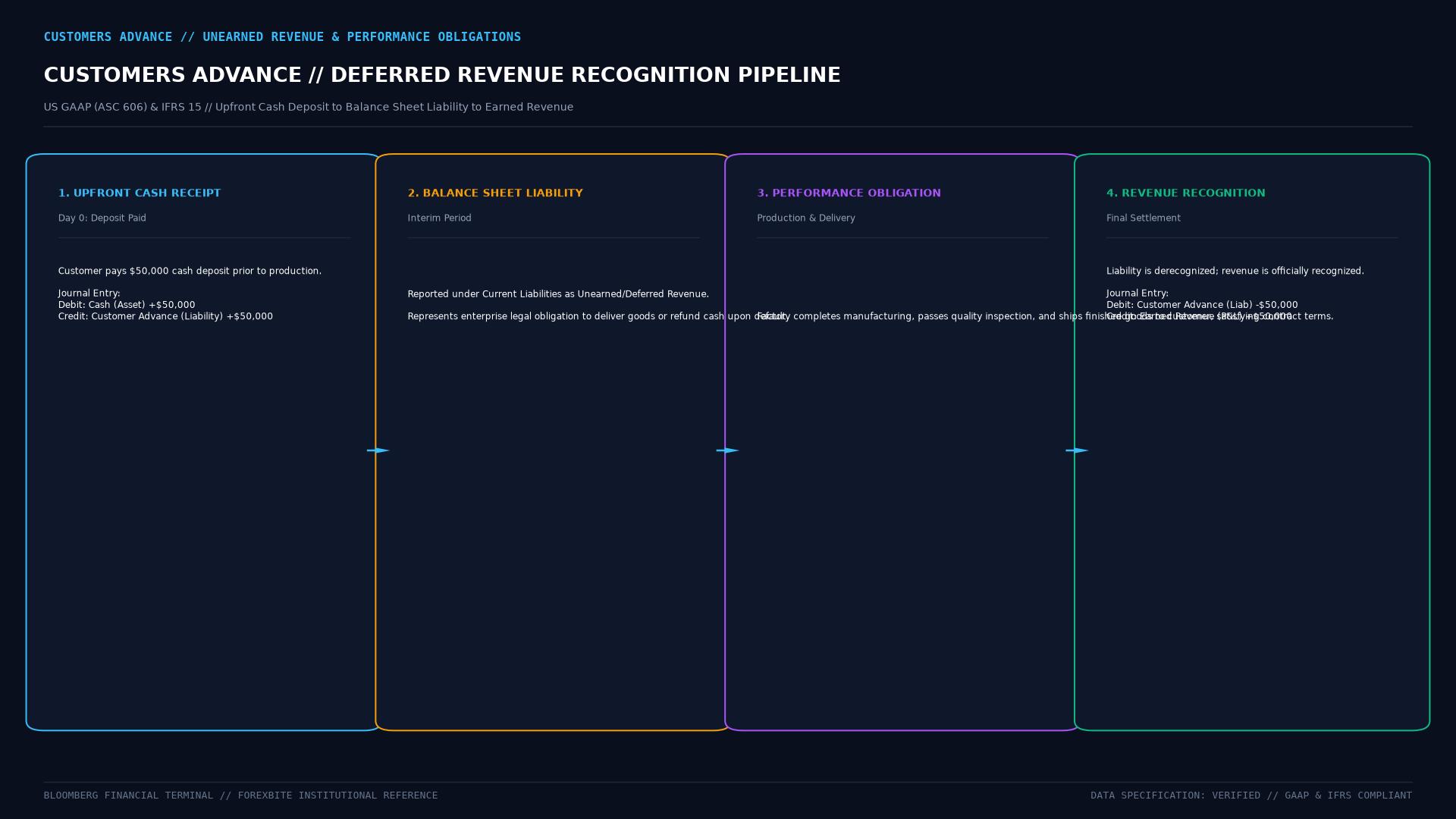 Figure: Accounting treatment of Customer Advances (Unearned Revenue) under ASC 606 / IFRS 15, showing initial cash debit and liability credit, performance obligation fulfillment, and revenue recognition.
Regulatory Framework: ASC 606 and IFRS 15
Modern revenue accounting across both US GAAP (codified in ASC 606) and International Financial Reporting Standards (IFRS 15) establishes a five-step framework for revenue recognition:
- Identify the contract with a customer.
- Identify the performance obligations in the contract.
- Determine the transaction price.
- Allocate the transaction price to the performance obligations.
- Recognize revenue when (or as) the entity satisfies a performance obligation.
+------------------------------------+------------------------------------+
| Balance Sheet Reporting Line       | Commercial Context & Industry      |
+------------------------------------+------------------------------------+
| Contract Liability (Current):      | Standard commercial advances to be |
| Performance obligations expected to| fulfilled within 12 months (e.g.,  |
| be satisfied within standard cycle.| annual software SaaS subscriptions,|
|                                    | airline tickets, custom tooling).  |
|                                    |                                    |
| Contract Liability (Non-Current):  | Long-term milestone prepayments on |
| Multi-year construction, defense,  | infrastructure projects, aerospace |
| or industrial delivery horizons.   | manufacturing, or commercial ships.|
+------------------------------------+------------------------------------+
The Significant Financing Component
If the timing of payments provides the customer or the enterprise with a significant financing benefit (for example, a buyer paying cash three years in advance of delivery on a commercial real estate tower), ASC 606 and IFRS 15 require the enterprise to adjust the promised transaction price for the time value of money. The company must record interest expense over the multi-year holding period, expanding the carrying value of the contract liability until delivery occurs.
Working Capital Advantages: The “Negative Working Capital” Float
From a corporate treasury perspective, customer advances provide exceptional financial leverage. In traditional manufacturing, a company must fund accounts receivable, extending 30-day or 60-day credit terms to buyers, which consumes working capital:
$$\text{Working Capital} = \text{Current Assets} - \text{Current Liabilities}$$
When an enterprise possesses strong pricing power or operates in specific business models, it can demand customer advances, achieving negative working capital:
  Business Model          Customer Advance Mechanism          Working Capital Effect
  ──────────────────────────────────────────────────────────────────────────
  Enterprise Software     Annual upfront software license     Generates immediate cash float
  (SaaS Subscriptions)    billing (12 months paid upfront)    funding R&D and cloud servers

  Commercial Airlines     Tickets purchased 2 to 6 months     Massive cash float used to pay
                          prior to flight departure date      jet fuel and aircraft leases

  Aerospace & Defense     Progress milestone payments on      Eliminates bank borrowing for
  (Boeing, Lockheed)      military and commercial jets        expensive alloy inventory

  Luxury Goods / Auto     Substantial customer deposits to    Guarantees order completion
  (Ferrari, Tesla)        secure limited allocation slots     and eliminates unsold stock risk
This customer-funded cash float allows fast-growing corporations to scale operations rapidly without selling equity or issuing expensive corporate bonds.
Bankruptcy Priority and Consumer Protection: 11 U.S.C. § 507(a)(7)
When a commercial business enters Chapter 11 reorganization or Chapter 7 liquidation, customer advances face specific legal hierarchies under the United States Bankruptcy Code:
+------------------------------------+------------------------------------+
| Commercial Corporate Prepayments   | Consumer Retail Deposits           |
+------------------------------------+------------------------------------+
| General Unsecured Claims:          | Statutory Priority under           |
| B2B buyers who paid cash advances  | 11 U.S.C. § 507(a)(7):             |
| to an insolvent vendor are grouped | Individual retail consumers who    |
| with trade creditors.              | paid deposits for family or        |
|                                    | household goods receive statutory  |
| Severe Risk of Total Loss:         | priority up to statutory caps      |
| Typically recover pennies on the   | (periodically adjusted for CPI).   |
| dollar after secured bank loans    |                                    |
| and bondholders are settled.       | Uncapped Excess: Any excess deposit|
|                                    | balance above statutory caps drops |
| Risk Mitigation: B2B buyers demand | to general unsecured status.       |
| Advance Payment Surety Bonds.      |                                    |
+------------------------------------+------------------------------------+
To shield themselves against vendor insolvency, sophisticated corporate procurement departments require suppliers to provide an Advance Payment Guarantee (APG) or surety bond issued by an investment-grade bank. If the supplier enters bankruptcy before shipping the machinery, the bank reimburses the customer advance in full.
Forensic Analysis and Equity Valuation Signals
Equity analysts, short-sellers, and credit rating agencies monitor the trajectory of customer advances on corporate balance sheets to assess operational health and detect financial manipulation:
- Advance Growth Outpacing Revenue: When customer advances expand by 30% while reported revenue grows by only 5%, it demonstrates strong forward customer demand and an expanding order book, serving as a reliable leading indicator of upcoming quarterly revenue acceleration.
- Delivery Bottleneck Warning: If contract liabilities accumulate for years without converting into revenue, it reveals that the company is suffering severe engineering roadblocks, supply chain breakdowns, or manufacturing defects that prevent customer acceptance.
- The Abrupt Contraction Red Flag: A sharp, unexpected drop in customer advances is one of the most alarming signals in corporate forensic analysis. It indicates that customers are canceling forward orders, demanding deposit refunds, or switching to competitors, foreshadowing a collapse in future cash flows.
Frequently Asked Questions
Is a customer advance considered taxable income when received?
For federal income tax purposes in the United States, tax accounting rules under Internal Revenue Code (IRC) Section 451 differ from GAAP accounting. Under Treasury Regulation § 1.451-8, accrual-method taxpayers can defer the recognition of advance payments for goods and services for one taxable year, but must recognize any remaining unperformed advance payment in gross income in the taxable year immediately following the year of receipt.
What happens if a customer cancels an order on which they paid an advance?
If the contractual terms specify that the advance is non-refundable, and the customer cancels the order, the enterprise relieves the contract liability from the balance sheet and recognizes the forfeited deposit directly as miscellaneous income on the income statement. If the contract stipulates that deposits are refundable, the company must issue a cash refund, clearing the liability with a credit to cash.
How does a customer advance differ from a security deposit?
A customer advance is a prepayment intended to be applied directly against the purchase price of goods or services delivered in the future. A security deposit (such as a commercial lease deposit or equipment rental deposit) is held in escrow by the company as collateral against property damage or lease default, with the mutual expectation that the funds will be returned to the customer at the conclusion of the contract.
Ready to trade forex?
Open a free demo account with a regulated broker. Practice with virtual funds before risking real money.