Accrual Basis Accounting
Accrual Basis Accounting is a financial reporting methodology mandated by GAAP and IFRS that recognizes revenues when earned and expenses when incurred, matching economic activity rather than physical cash movements.
What Is Accrual Basis Accounting?
Accrual Basis Accounting (or the accrual method) is the standard financial accounting system mandated by Generally Accepted Accounting Principles (US GAAP) and International Financial Reporting Standards (IFRS) for public corporations, financial institutions, and large enterprises.
Under the accrual framework, economic transactions are recognized on financial statements in the accounting period in which they occur, rather than when cash changes hands. Revenues are reported on the income statement when earned (goods delivered or contractual performance obligations satisfied), and expenses are recorded when incurred (resources consumed or services utilized).
This methodology stands in direct contrast to Cash Basis Accounting, where income is recorded only when cash deposits clear the corporate bank account, and expenses are registered only when cash checks or electronic disbursements are released. While cash accounting is straightforward for micro-businesses, it produces volatile, distorted financial statements that fail to reflect the true operational performance of commercial enterprises.
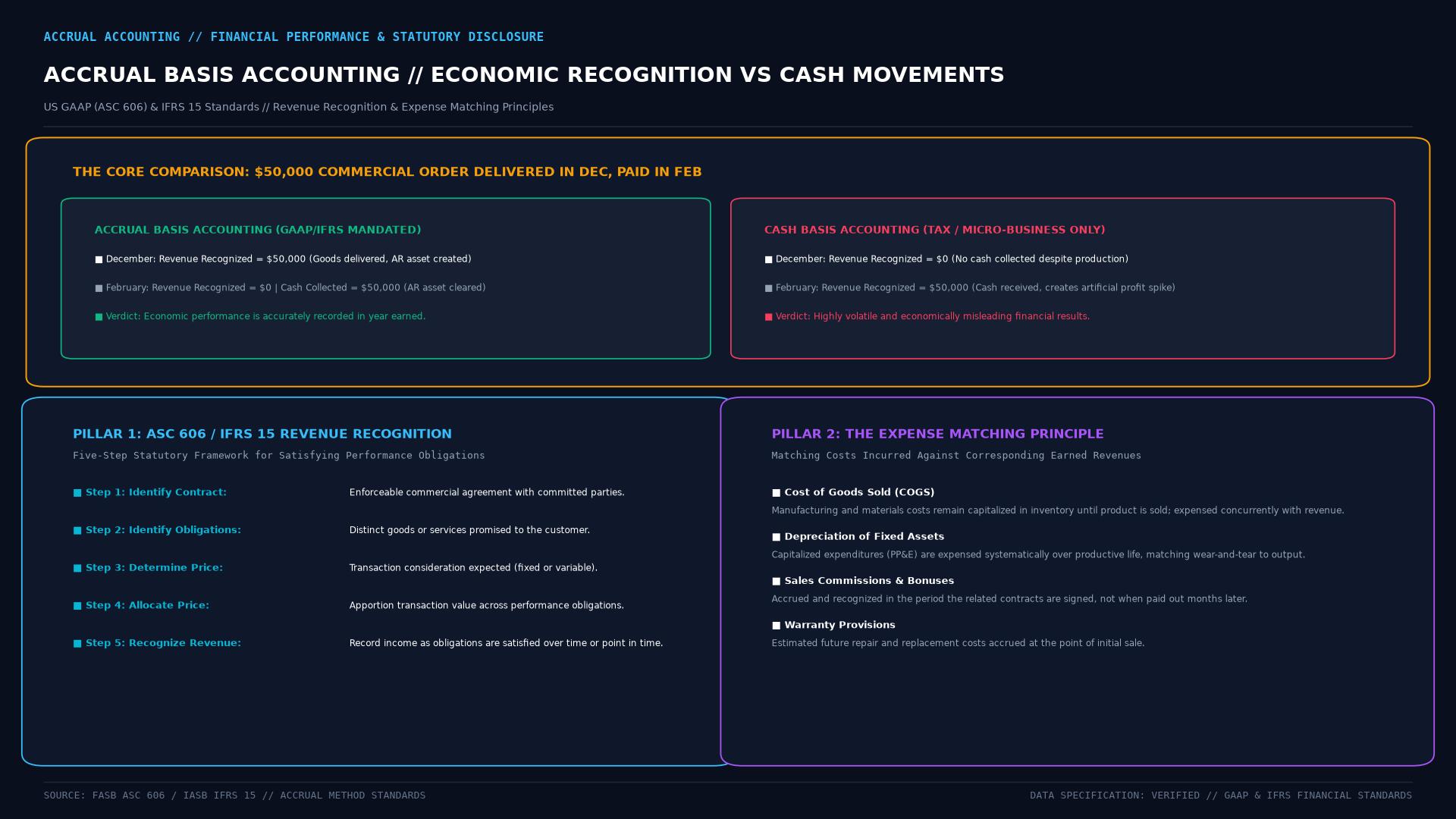 Figure: Comparative analysis of Accrual Basis versus Cash Basis Accounting, highlighting the ASC 606 / IFRS 15 5-step revenue recognition standard, the matching principle for capitalized expenses, and a practical timeline scenario.
Technical Mechanics & Core Principles
Accrual accounting is built upon two foundational accounting doctrines:
1. The Revenue Recognition Principle (ASC 606 / IFRS 15)
Revenue is recognized upon the transfer of promised goods or services to customers in an amount that reflects the consideration expected in exchange. Under the five-step framework:
- Identify the contract with a customer.
- Identify the discrete performance obligations in the contract.
- Determine the transaction price.
- Allocate the transaction price to the performance obligations.
- Recognize revenue as each performance obligation is satisfied over time or at a point in time.
2. The Matching Principle (Expense Recognition)
Expenses must be matched to and recognized in the identical accounting period as the revenues they helped generate:
- Cost of Goods Sold (COGS): Inventory costs remain capitalized on the balance sheet as an asset until the finished product is sold. Only then are inventory costs expensed against recognized sales.
- Depreciation & Amortization: Fixed asset purchases (such as machinery or patents) are capitalized and systematically expensed over their useful productive life, matching annual wear-and-tear against annual operational output.
- Accrued Liabilities: Employee wages earned during the final week of December are recorded as an accrued payroll expense in December, even if payroll checks are disbursed in January.
The Four Pillars of Accrual Adjusting Entries
At the conclusion of each accounting period, accountants post adjusting entries across four specific categories to ensure balance sheet fidelity:
- Accrued Revenues: Revenues earned for goods or services already delivered but not yet billed or collected (Debit: Accrued Accounts Receivable, Credit: Service Revenue).
- Accrued Expenses: Expenses already incurred by the company that have not yet been billed or paid (Debit: Expense, Credit: Accrued Liability Payable).
- Deferred (Unearned) Revenues: Cash received from customers in advance of product delivery or service execution, recorded as a liability until earned (Debit: Cash, Credit: Unearned Revenue Liability).
- Prepaid Expenses: Cash paid in advance for future economic benefits, such as commercial property insurance or software licenses, capitalized as current assets and expensed incrementally (Debit: Prepaid Asset, Credit: Cash).
Comparative Matrix: Accrual vs. Cash Accounting
| Operational Dimension | Accrual Basis Accounting | Cash Basis Accounting |
|---|---|---|
| Revenue Timing | When earned (performance obligation satisfied) | When cash is received and cleared |
| Expense Timing | When incurred (matching principle) | When cash is disbursed |
| Regulatory Compliance | Mandatory under US GAAP, IFRS, and SEC filings | Permitted only for small private businesses, sole props |
| Balance Sheet Fidelity | Reflects complete assets, payables, receivables | Excludes unpaid invoices and outstanding liabilities |
| Profit Measurement | True economic profitability across periods | Distorted by timing of vendor payments and collections |
| Complexity & Audit | High; requires double-entry bookkeeping, accruals | Low; simple single-entry ledger or checkbook register |
Real-World Case Study: Construction Contractor Revenue Restructuring
In 2023, a regional commercial infrastructure contractor operating on cash-basis accounting appeared highly profitable on paper, showing $4.2 million in pre-tax profit after receiving large upfront client mobilization advances for three major municipal projects.
However, when preparing for an institutional syndicated credit line, the underwriting bank required audited financial statements prepared under GAAP accrual basis accounting.
The audit team discovered that while the firm held $6.8 million in cash deposits, $5.1 million represented unearned contract liabilities for work not yet performed. At the same time, the contractor held $2.4 million in unpaid subcontractor invoices and accrued raw material liabilities incurred during project excavation. Under accrual accounting:
Accrual Net Income = Recognized Earned Revenue ($2.1M) - Actual Incurred Project Expenses ($2.8M) = -$700,000 Net LossThe accrual audit revealed that the contractor was actually operating at a structural operational deficit on its active jobs, masking cash burn through customer advance deposits. Transitioning to accrual accounting allowed management to identify unprofitable bidding formulas, reprice subsequent bids, and avoid corporate insolvency.
Frequently Asked Questions (FAQ)
Why is the Statement of Cash Flows essential under accrual accounting?
Because accrual net income includes non-cash items (depreciation, stock compensation) and timing differences (unpaid receivables, accrued bills), net income does not represent cash generated. The Statement of Cash Flows reconciles accrual net income to actual operating cash flow, showing investors whether earnings are supported by liquid cash.
How does accrual accounting prevent corporate earnings manipulation?
By requiring strict adherence to the matching principle and standardized revenue milestones under ASC 606, accrual accounting prevents managers from artificially inflating quarterly profits simply by postponing vendor payments or accelerating cash billing.
Can a company use cash accounting for taxes and accrual accounting for financial reporting?
Yes. Under US tax code regulations, qualified businesses with average annual gross receipts below statutory thresholds (adjusted periodically for inflation under the Tax Cuts and Jobs Act) may elect to file taxes on a cash basis to manage immediate tax liability, while preparing internal management and GAAP reports on an accrual basis.
Ready to trade forex?
Open a free demo account with a regulated broker. Practice with virtual funds before risking real money.