CZK
The ISO 4217 currency code for the Czech Koruna, the official national currency of the Czech Republic, governed by the Czech National Bank.
What is the CZK (Czech Koruna)?
CZK is the three-letter international currency code assigned under ISO 4217 to the Czech Koruna (koruna česká), the official legal tender and national monetary unit of the Czech Republic. Represented domestically by the currency symbol Kč and nominally divided into 100 haléřů (although all haléř coins have been withdrawn from active circulation), the Koruna is issued, regulated, and managed by the Czech National Bank (ČNB / Česká národní banka), headquartered in Prague.
Established on February 8, 1993, following the peaceful dissolution of Czechoslovakia (known as the Velvet Divorce), the Czech Koruna has emerged as one of Central and Eastern Europe’s most resilient and liquid free-floating currencies. Driven by a advanced manufacturing base deeply integrated into German and European supply chains (particularly in automotive engineering, electronics, and industrial machinery), the CZK is actively traded against the Euro (EUR/CZK) and US Dollar (USD/CZK) across global institutional interbank platforms.
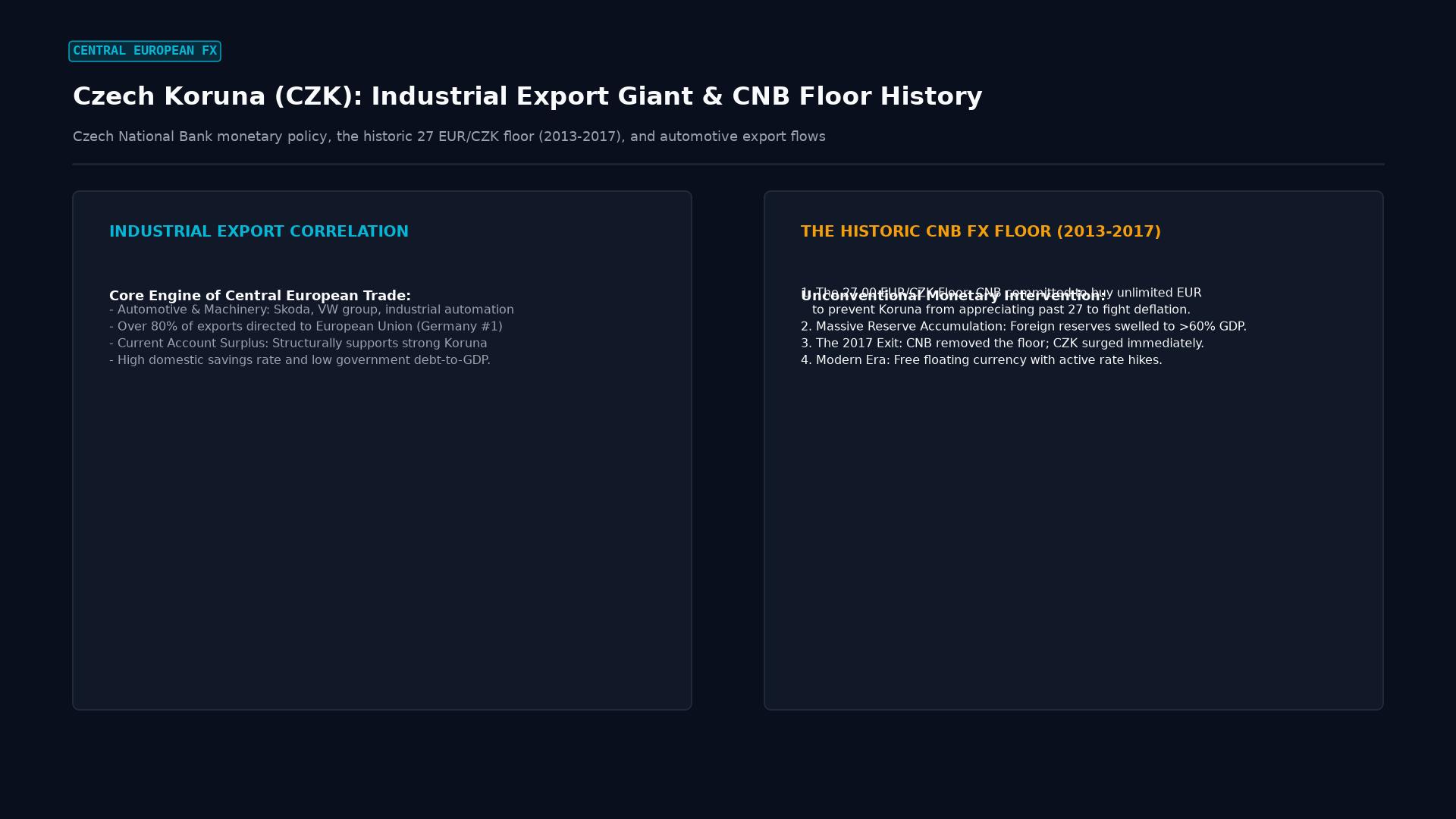 Figure: Central European industrial powerhouse: Czech National Bank monetary policy, automotive export flows, and the historical 2013-2017 27 EUR/CZK floor.
The Industrial Export Engine and German Economic Co-Integration
The fundamental strength of the Czech Koruna is rooted in the Czech Republic status as the industrial heartland of Central Europe:
+------------------------------------+------------------------------------+
| Economic Characteristic            | Practical Macroeconomic Impact     |
+------------------------------------+------------------------------------+
| Industrial Share of GDP:           | The highest industrial employment  |
| Nearly 30% of gross domestic value | share in the European Union,       |
| added is generated by industry.    | insulating the nation from debt.   |
|                                    |                                    |
| Automotive Ecosystem:              | Massive automotive production      |
| Škoda Auto (Volkswagen Group),     | hub, generating billions of Euros  |
| Hyundai, and Toyota assembly lines.| in net foreign trade surpluses.    |
|                                    |                                    |
| German Supply Chain Integration:   | High economic synchronization with |
| Over 30% of all Czech merchandise  | the German business cycle; German  |
| exports flow to German buyers.     | factory orders drive the Koruna.   |
+------------------------------------+------------------------------------+
Because Czech manufacturers invoice international corporate customers in Euros while paying domestic workers, taxes, and local supply chains in Korunas, large exporters routinely sell billions of Euros on the interbank market, generating persistent organic upward pressure on the CZK.
The Historic ČNB Exchange Rate Floor (2013–2017)
The most famous monetary intervention in modern Central European financial history was the ČNB Exchange Rate Commitment.
Between 2012 and 2013, the Czech economy suffered protracted economic stagnation. Inflation plummeted toward zero, threatening a deflationary debt spiral. Because the ČNB had already cut its key two-week repo interest rate to the “technical zero” lower bound of 0.05%, the central bank had exhausted conventional monetary policy tools.
  Chronology of the 2013–2017 Exchange Rate Commitment
  ──────────────────────────────────────────────────────────────────────────
  November 7, 2013: ČNB initiates an unconventional monetary intervention,
                    announcing an artificial floor: It will not permit the
                    Koruna to appreciate past 27.00 CZK per 1.00 EUR.

  The Intervention: To defend the 27.00 floor, the ČNB stood as an unlimited
                    buyer of Euros on the open interbank market, printing
                    hundreds of billions of new Korunas.

  Reserve Accumulation:ČNB foreign exchange reserves exploded from approximately
                    $45 billion to over $145 billion, reaching an extraordinary
                    70% of Czech national GDP.

  April 6, 2017:    Having successfully reflated the domestic economy and
  (The "Czech Exit")brought CPI inflation back to its 2.0% target, the ČNB
                    terminated the floor, returning the Koruna to a free float.
Unlike the Swiss National Bank turbulent 2015 exit from its EUR/CHF floor (which caused catastrophic intraday market crashes), the ČNB orchestrated a smooth, well-communicated exit. The central bank pre-warned global financial markets, allowing speculative positions to unwind without destroying brokerage liquidity.
Monetary Policy Framework: Independent Inflation Targeting
The Czech National Bank operates with a high degree of constitutional independence, insulated from parliamentary political interference:
- Price Stability Mandate: The primary objective of the ČNB is price stability, formally quantified as an annual Consumer Price Index (CPI) target of 2.0% with a tolerance band of $\pm 1.0%$ (1.0% to 3.0%).
- Policy Levers: The Bank Board adjusts three key interest rates: the Two-Week Repo Rate, the Discount Rate, and the Lombard Rate.
- Floating Exchange Rate: Outside of extraordinary emergency interventions, the ČNB allows the Koruna to float freely, utilizing currency appreciation or depreciation as an organic monetary transmission channel to tighten or loosen financial conditions.
The Euro Adoption Debate in Czech Politics
Under the terms of the 2004 Treaty of Accession to the European Union, the Czech Republic agreed to adopt the Euro once it satisfies the Maastricht convergence criteria:
  Maastricht Convergence Criterion    Czech Economic Status
  ──────────────────────────────────────────────────────────────────────────
  Price Stability (Inflation Rate)    Cyclical compliance; proactive ČNB rate policy
  Fiscal Budget Deficit (< 3.0% GDP)  Consistent compliance over economic cycles
  Public Debt-to-GDP Ratio (< 60.0%)  Strong compliance (consistently under 45% of GDP)
  Long-Term Interest Rate Convergence Compliant; Czech sovereign yields track Bunds
  ERM II Participation (2 Years)      NON-COMPLIANT: Czechia refuses to enter ERM II
Despite satisfying nearly all fiscal criteria, the Czech Republic has deliberately avoided joining the Exchange Rate Mechanism II (ERM II).
A broad political consensus and overwhelming public skepticism (with polls consistently revealing 70% to 80% public opposition to abandoning the Koruna) have kept the country outside the Eurozone:
- Monetary Independence: Retaining the Koruna allows the ČNB to set customized interest rates tailored strictly to domestic Czech macroeconomic conditions rather than accepting a single policy set by the European Central Bank in Frankfurt.
- Sovereign Buffer: An independent Koruna functions as a shock absorber during global economic crises, depreciating during downturns to protect domestic exporters without forcing painful internal wage deflation.
Trading Conventions in Global FX Markets
In international foreign exchange markets, trading the CZK follows standard liquid institutional conventions:
- Continuous Quotation: The CZK is traded on major electronic communication networks (EBS, Refinitiv Dealing, Bloomberg FXGO) with tight bid-ask spreads, making it the most liquid currency in Central Europe alongside the Polish Zloty (PLN) and Hungarian Forint (HUF).
- Three-Decimal Pricing: Standard quotes for EUR/CZK and USD/CZK are expressed to three decimal places (e.g., 25.125 CZK per EUR).
- Cross-Border Corporate Hedging: Multinational corporations hedging cross-border production contracts utilize over-the-counter EUR/CZK forward contracts, cross-currency swaps, and vanilla currency options traded through major European investment banking desks.
Frequently Asked Questions
Can an international tourist use Euros in Prague and the Czech Republic?
While some major international retail chains, hotels, and tourist restaurants in central Prague accept Euro cash, paying in Euros is generally disadvantageous for travelers. Merchants typically apply unfavorable internal conversion rates and return change in Czech Korunas. For all everyday expenses, dining, and transit, paying directly in Korunas or using contactless credit cards yields the best exchange rates.
What are Haléře, and why are they no longer in circulation?
The haléř (plural: haléře or haléřů) was the subdivision of the Koruna, with 100 haléřů equaling 1 Koruna. Due to post-communist economic inflation in the 1990s, the physical purchasing power of small copper coins dropped below their physical metal minting costs. The ČNB withdrew 10-haléř and 20-haléř coins in 2003, and phased out the final 50-haléř coin in 2008. Haléře exist today purely as electronic accounting units on bank statements and retail grocery receipts.
How does the Czech Koruna behave during global risk-off market shocks?
In global financial markets, the CZK is categorized as an emerging market / European satellite currency. When geopolitical crises, market crashes, or European energy shocks trigger a “risk-off” flight to quality, international investors dump liquid CEE currencies, causing the Koruna to weaken temporarily against the US Dollar and Swiss Franc. However, because the Czech Republic maintains low public debt and substantial foreign exchange reserves, the CZK recovers significantly faster than other regional peers.
Ready to trade forex?
Open a free demo account with a regulated broker. Practice with virtual funds before risking real money.