DOP
DOP is the ISO 4217 currency code for the Dominican Peso, the official currency of the Dominican Republic, managed under a floating exchange rate regime by Banco Central de la República Dominicana.
The Dominican Peso (ISO code: DOP, symbol: RD$) is the official legal tender of the Dominican Republic, the largest and fastest-growing economy in the Caribbean. Managed by the Banco Central de la República Dominicana (BCRD), the peso operates under a managed floating exchange rate regime anchored by an inflation-targeting framework. The value of the peso reflects a dynamic interplay between robust structural foreign exchange inflows (tourism revenues, family remittances, free-trade zone manufacturing, and gold mining) and persistent import demands for refined petroleum and intermediate capital goods.
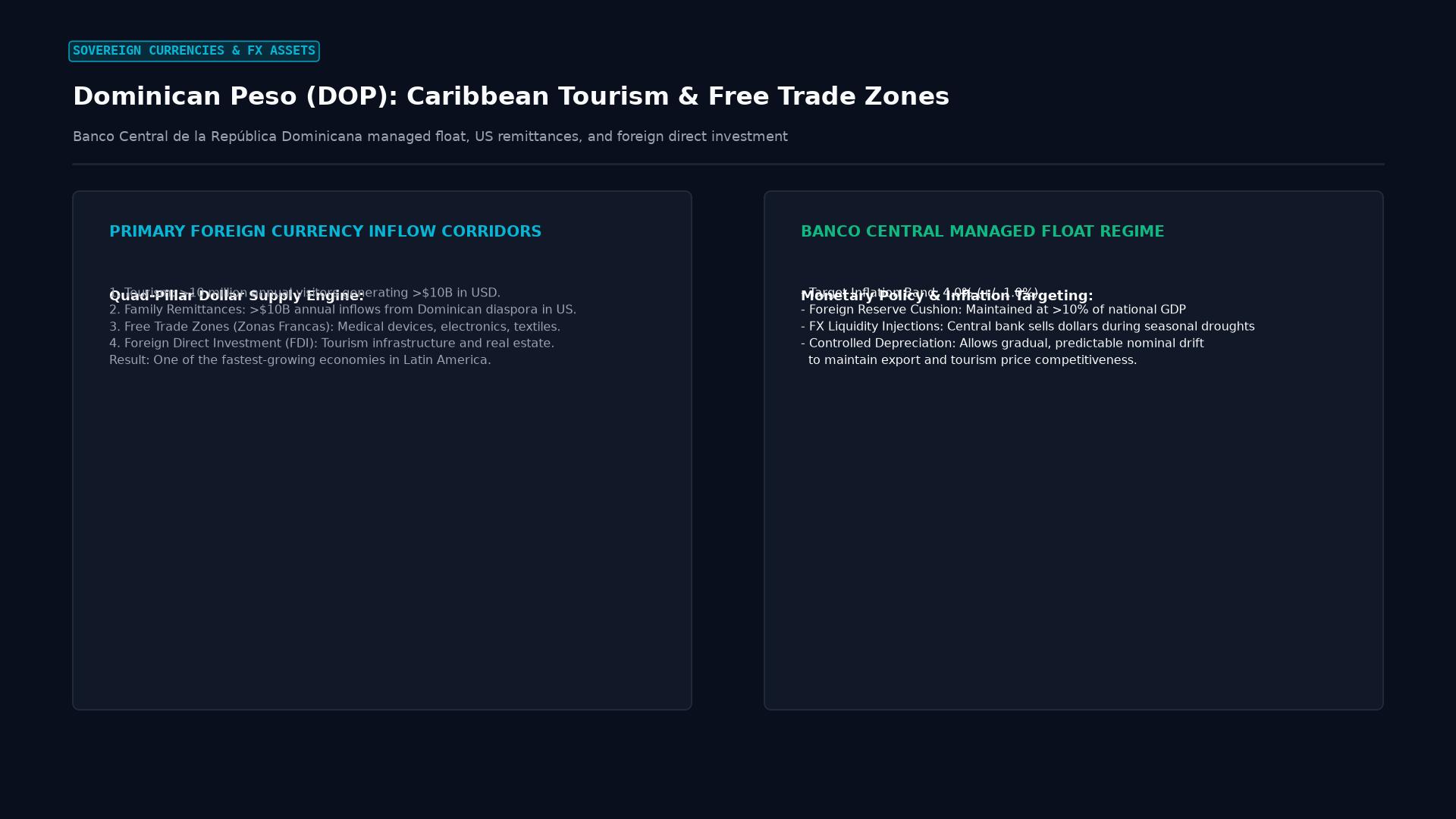 Figure: Quad-pillar foreign currency supply: tourism, US remittances, free trade manufacturing, and foreign direct investment supporting Banco Central managed float.
Historical Trajectory and Monetary Reforms
The Dominican Peso traces its lineage to 1844, when the Dominican Republic declared independence from Haiti and introduced its first national coinage to replace the Haitian gourde. Between 1905 and 1947, following severe sovereign debt crises and customs administration agreements with the United States, the US dollar circulated alongside local fractional currency as de facto legal tender.
In 1947, under the regime of Rafael Trujillo, the government founded the Banco Central de la República Dominicana and established the modern Dominican Peso (initially denominated as the peso oro), pegged at exact 1:1 parity with the US dollar. This artificial 1:1 parity endured until the mid-1980s, when fiscal expansion, falling world sugar prices, and mounting external debt forced authorities to recognize the parallel black market and abandon the fixed parity.
The most severe monetary crisis in modern Dominican history erupted in 2003 with the collapse of Banco Intercontinental (Baninter), the country’s second-largest private commercial bank, due to massive accounting fraud. The central bank intervened to guarantee depositor balances, expanding the monetary base by over 100 percent in a matter of months. This monetary explosion triggered hyper-depreciation:
- The exchange rate plummeted from approximately 18 DOP per USD in 2002 to over 50 DOP per USD by mid-2004.
- Annual inflation exceeded 50 percent, destroying real wages and wiping out domestic savings.
Following this crisis, the Dominican Republic passed the landmark Monetary and Financial Law (Law No. 183-02), modernizing banking supervision, establishing strict capital adequacy ratios, and granting constitutional autonomy to the Banco Central de la República Dominicana.
Institutional Framework: BCRD and Inflation Targeting
In 2012, the BCRD formally adopted an explicit inflation-targeting regime, setting an annual consumer price inflation target range of $4.0% \pm 1.0%$.
The central bank conducts monetary policy primarily through its benchmark policy rate, the Tasa de Política Monetaria (TPM). The TPM operates within an asymmetric interest rate corridor formed by two standing liquidity facilities:
- Overnight Deposit Facility (Tasa de Depósito Remunerado): Serves as the lower floor of the corridor, providing commercial banks with interest on excess reserves.
- Standing Liquidity Facility (Tasa de Facilidad Permanente de Expansión): Serves as the upper ceiling of the corridor, granting short-term liquidity loans to commercial banks against eligible sovereign collateral.
$$\text{Interest Rate Corridor} = [\text{Deposit Rate}, ; \text{TPM}, ; \text{Liquidity Loan Rate}]$$
The BCRD actively manages systemic liquidity through open market operations, issuing short-term central bank paper (Certificados del Banco Central) to absorb surplus liquidity and maintain commercial interbank lending rates in alignment with the target TPM.
Macroeconomic Inflow Drivers
The Dominican Republic boasts one of the most diversified foreign exchange generation models in the developing world. The health of the DOP rests on four distinct foreign currency pillars:
1. Diaspora Family Remittances
Remittance flows represent a cornerstone of external liquidity, generating over 10 billion US dollars annually (approximately 8 to 10 percent of national GDP). The Dominican diaspora, concentrated in the New York metropolitan area, Florida, Massachusetts, and Spain, transmits monthly funds to families across the island. These dollar inflows enter domestic commercial banks and specialized money transfer operators, providing constant, non-debt foreign exchange liquidity.
2. Tourism Receipts
The Dominican Republic is the premier tourist destination in the Caribbean basin, welcoming over 10 million air and cruise visitors annually to destinations such as Punta Cana, La Romana, and Puerto Plata. Foreign hotel chains and airlines invoice and collect payments in US dollars and euros, exchanging foreign currency into DOP to pay local wages, taxes, and service contractors.
3. Free Trade Zone (Zonas Francas) Exports
Unlike traditional commodity-dependent Caribbean economies, the Dominican Republic developed extensive industrial free trade zones. These manufacturing clusters produce medical devices, electronic components, surgical instruments, pharmaceuticals, and premium handmade cigars for export to the United States and Europe.
4. Gold and Mineral Mining
The Pueblo Viejo open-pit gold mine in Sánchez Ramírez province, operated by Barrick Gold, ranks among the largest gold reserves in the Western Hemisphere. Mineral exports generate vital fiscal royalties and corporate tax revenues denominated in US dollars.
| Inflow Engine | Annual Value (USD) | Primary Mechanism for DOP Support |
|---|---|---|
| Family Remittances | $10B+ | Smooths household consumption; steady retail dollar supply |
| Tourism Receipts | $9B - $11B | Offsets trade deficits; seasonal peak inflows in Q1 and Q4 |
| Free Trade Zones | $8B+ | Diversified manufactured exports; insulates against agricultural shocks |
| Gold & Ferronickel | $1.5B - $2B | Natural hedge; rising gold prices strengthen central bank reserve buffers |
Foreign Exchange Market Structure and Interbank Trading
The domestic foreign exchange market operates through the Sistema de Negociación de Divisas, an electronic platform administered by the BCRD where commercial banks, authorized financial intermediaries, and registered exchange brokers (casas de cambio) execute spot transactions.
Trading in USD/DOP occurs primarily over the counter between local authorized institutions. International institutional investors access the Dominican market primarily through:
- Local-Currency Sovereign Bonds: Ministry of Finance treasury bonds (Bonos de Hacienda) denominated in DOP, cleared through local custodians and accessible via international clearinghouses (Euroclear).
- Non-Deliverable Forwards (NDFs): Global investment banks price offshore NDF contracts on USD/DOP to allow international bondholders to hedge currency exposure without executing onshore physical currency deliveries.
The central bank intervenes in the spot market through discretionary dollar sales or foreign exchange auctions whenever external shocks, such as spikes in international crude oil prices, create temporary supply-demand imbalances that threaten disorderly peso depreciation.
Key Risks and Volatility Drivers
Despite decades of macroeconomic stability, the Dominican Peso faces structural vulnerabilities:
- Oil Import Dependence: Because the Dominican Republic produces no commercial crude oil or natural gas, sharp rises in global Brent or WTI crude oil prices inflate the national import bill, expanding the current account deficit and driving dollar demand.
- US Monetary Policy Sensitivity: When the US Federal Reserve maintains elevated interest rates, the spread between Dominican and US yields narrows, incentivizing institutional capital to flow back into dollar assets and requiring the BCRD to maintain higher domestic interest rates.
- External Shocks to Tourism: Pandemics, global aviation disruptions, or deep economic downturns in the United States directly compress tourism receipts, weakening the primary commercial buffer of the foreign exchange market.
Frequently Asked Questions
Can foreign tourists use US Dollars inside the Dominican Republic?
Yes. Major tourist resorts, international hotels, and tour operators in Punta Cana and Santo Domingo widely accept US dollars. However, local restaurants, supermarkets, toll booths, and public transport require payment in Dominican Pesos (DOP). Converting small amounts of dollars into pesos through commercial banks or official exchange kiosks ensures fair exchange rates.
How does the Banco Central de la República Dominicana prevent sharp devaluations?
The central bank maintains a substantial buffer of gross international reserves, typically exceeding four to five months of imports. When private demand for dollars surges, the BCRD conducts foreign exchange interventions, selling dollars directly to commercial banks or offering dollar repo facilities to smooth exchange rate volatility and anchor inflation expectations.
Why is the Dominican Republic considered an economic outperformer in Latin America?
The Dominican Republic has achieved average real annual GDP growth exceeding 5 percent over the past three decades. This performance stems from political stability, a diversified export base combining high-tech free trade zones with services and mining, strong foreign direct investment protection, and prudent macroeconomic management by the central bank.
Ready to trade forex?
Open a free demo account with a regulated broker. Practice with virtual funds before risking real money.